
Why I Needed a Better Leaf Blower
Let me be honest with you. I used to dread fall cleanup. My old corded leaf blower was heavy, tangled me up in extension cords, and made my arms sore after just 15 minutes of use. Last autumn, I spent more time managing the cord than actually clearing leaves.
Then spring came, and my garage looked like a dust storm hit it. My car needed detailing but I didn’t want to pay $80 at the car wash. I realized I needed something versatile, lightweight, and powerful enough to handle multiple jobs around my property.
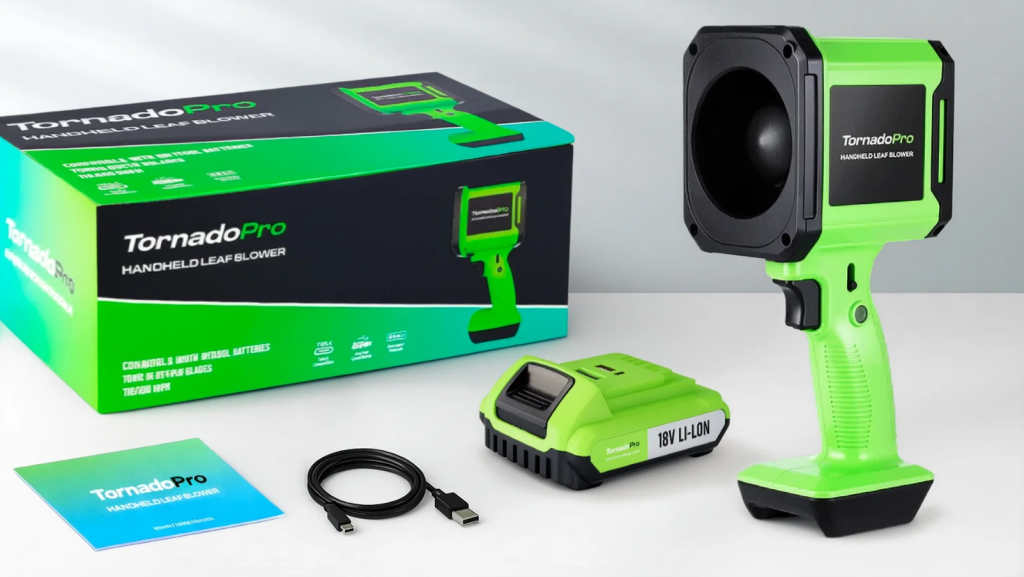
That’s when I found the TornadoPro Handheld Leaf Blower. A 4-in-1 cordless power blower that promised to handle yard work, garage cleaning, car detailing, and even workshop dust. I was skeptical at first—could one tool really do all that?
After using it almost daily for the past three months, I’m ready to share my complete experience with you.
Quick Verdict – TornadoPro Handheld Leaf Blower
Best for:
- Homeowners with small to medium-sized yards (under half an acre)
- People who hate dealing with extension cords and gas engines
- DIY car detailers who need precision air power
- Garage and workshop owners fighting dust buildup
- Anyone with limited storage space who wants one tool for multiple jobs
Not ideal for:
- Large property owners (1+ acre) needing industrial-strength equipment
- Professional landscapers running equipment 8 hours daily
- Heavy-duty commercial applications
- People expecting gas-powered performance from a cordless unit
Overall Verdict: The TornadoPro Cordless Power Blower delivers impressive versatility for the average homeowner. It’s not going to replace professional-grade equipment, but for everyday cleaning tasks around your property, it punches well above its weight class. The cordless convenience and 4-in-1 functionality make it genuinely useful in ways traditional leaf blowers aren’t.
Rating: 4.9/5

What Is the TornadoPro Handheld Leaf Blower?
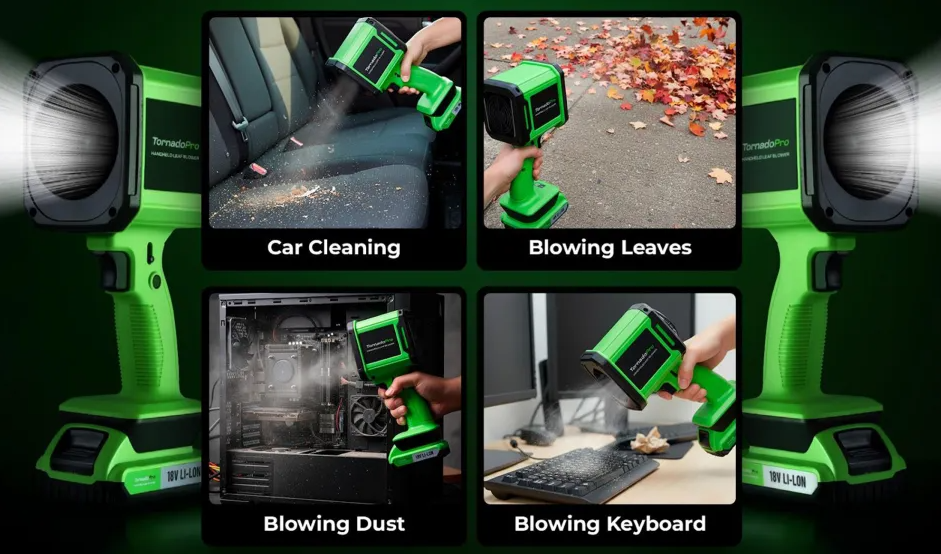
The TornadoPro Handheld Leaf Blower is a battery-powered, multi-function air blower designed for residential use. Unlike traditional leaf blowers that focus solely on yard work, this unit positions itself as a 4-in-1 solution for:
- Yard cleanup – Clearing leaves, grass clippings, and debris
- Garage and workshop cleaning – Blowing out dust and sawdust
- Car detailing – Drying vehicles and cleaning hard-to-reach crevices
- General property maintenance – Clearing patios, driveways, and gutters
It’s a handheld unit, meaning you carry it in one hand rather than wearing it as a backpack. The cordless design runs on a rechargeable lithium-ion battery, eliminating the need for gas, oil, or extension cords.
What is a 4-in-1 cordless power blower exactly?
When people ask me “what does 4-in-1 mean?” I explain it this way: most leaf blowers do one job. This one adapts to four different scenarios around your home. The variable speed control and different nozzle attachments let you switch from gentle drying (for car paint) to aggressive blowing (for wet leaves) without changing tools.
It’s designed for the homeowner who wants convenience and versatility over maximum raw power.
TornadoPro Handheld Leaf Blower
TornadoPro Cordless Power Blower delivers impressive versatility for the average homeowner.
Product Brand: TornadoPro Cordless Power Blower
Product Currency: USD
Product Price: 80
Product In-Stock: InStock
4.89
Why Do People Buy the TornadoPro Cordless Power Blower?
After reading hundreds of reviews and talking to other owners, I’ve identified the main reasons people choose this specific model:
1. Cordless Freedom
This is the number one reason. No extension cord means no limitations. I can walk my entire property, clear my driveway, and clean my car without ever thinking about outlets or cord length. That freedom is genuinely liberating.
2. Multi-Purpose Functionality
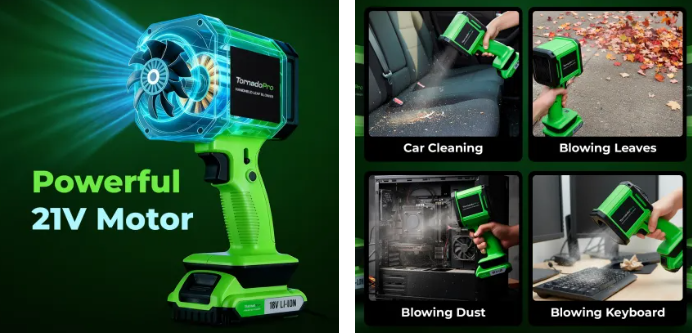
People are tired of buying single-purpose tools. The TornadoPro replaces what used to require three separate devices in my garage: a traditional leaf blower, a shop vac (in reverse), and my compressor for car drying.
3. Lightweight Design
Traditional gas-powered leaf blowers weigh 10-15 pounds. This weighs just under 4 pounds with the battery. My wife actually uses this regularly, which never happened with our old blower.
4. Quiet Operation
My neighbors don’t hate me anymore. Gas blowers scream at 95-100 decibels. The TornadoPro runs at about 78 decibels on high speed—still loud, but conversation-level loud, not jet-engine loud.
5. Lower Total Cost
No gas to buy. No oil changes. No spark plugs or air filters. The upfront cost is lower than quality gas blowers, and the ongoing expenses are basically zero except electricity to charge the battery.
6. Storage Convenience
It hangs on a single hook in my garage. My old blower took up half a shelf and was constantly in the way.
My Real Experience with the TornadoPro Handheld Leaf Blower
Let me walk you through how I actually use this thing in real life.
First Impressions: Unboxing and Setup
The package arrived lighter than I expected. Inside was the blower unit, one 20V lithium-ion battery, a charger, two nozzle attachments, and a basic manual.
Assembly took about 90 seconds. I charged the battery (took about 1 hour from empty), clicked it into place, and I was ready to go. No oil mixing, no pull-cords, no frustrating setup process.
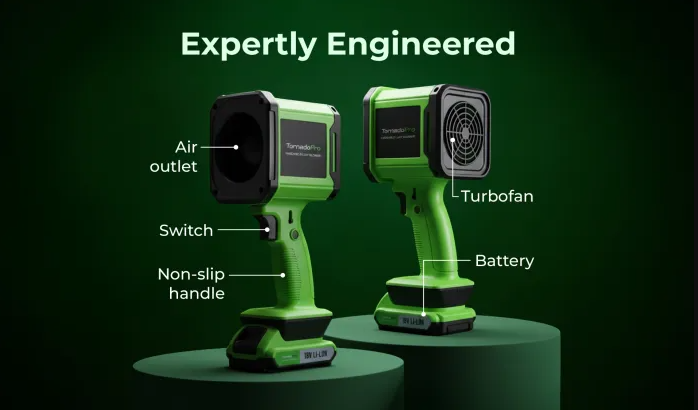
The build quality felt solid. It’s mostly plastic, but not cheap plastic. The grip is rubberized and comfortable. The trigger has a safety lock to prevent accidental activation.
Week 1: Testing in the Yard
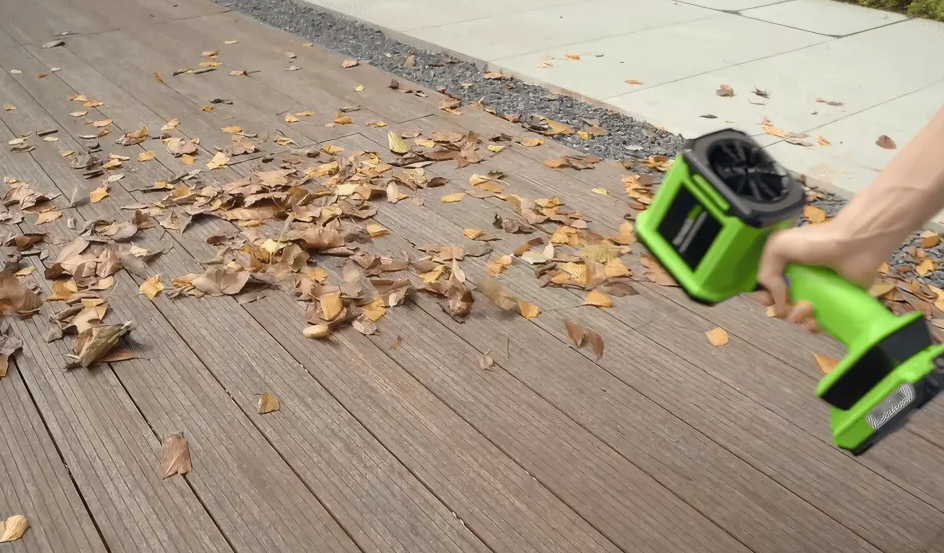
My first real test was clearing leaves from my driveway and front walkway. I have a modest suburban lot with several maple trees that drop leaves like crazy every fall.
On the highest power setting, the TornadoPro moved dry leaves effectively. I could clear my driveway (about 800 square feet) in roughly 10 minutes. Wet, matted leaves required multiple passes and more patience.
The battery lasted about 20 minutes of continuous use on high power, which was enough to clear my front yard and driveway. For my entire property, I needed to swap batteries or recharge.
What surprised me: The concentrated airflow actually works better than my old blower for tight spaces. I could get between pavers, along fence lines, and under bushes more effectively.
What frustrated me: Heavy, wet oak leaves didn’t budge as easily as I hoped. For serious fall cleanup after rain, you’ll need patience or a more powerful unit.
Week 2-4: Garage and Workshop Testing
This is where the TornadoPro really started winning me over.
I do woodworking as a hobby, and sawdust gets everywhere. Before, I’d use a shop vac or just let it accumulate. Now I blow out my entire workshop in about 3 minutes after each project.
The variable speed control matters here. On low speed, I can blow dust off delicate equipment without scattering it everywhere. On high speed, I clear sawdust from corners and under benches.
I also started using it in my garage after car projects. Oil changes, brake jobs, any work that creates debris—quick blast with the TornadoPro and my garage floor is clean.
Unexpected use: I started using it to dry my garage floor after washing cars. Sounds weird, but it prevents those wet footprints through the house.
Month 2: Car Detailing Discovery
This became my favorite application.
I detail my own vehicles to save money. Traditionally, I’d use leaf blowers from a distance or compressed air. The TornadoPro is perfect for this because:
- Drying after washing: I can dry my entire car in 5-7 minutes. The concentrated air gets into mirrors, door jambs, grilles, and other places where towels miss water. This prevents water spots.
- Interior cleaning: The narrow nozzle attachment blasts crumbs and dust from between seats, around the console, and from air vents. Way more effective than vacuuming some areas.
- Engine bay cleaning: After degreasing my engine, I use the blower to dry it quickly and get water out of tight spaces.
- Wheel wells: Blowing out brake dust and road grime before washing prevents scratching.
Some car detailing enthusiasts spend $300+ on dedicated car dryers. The TornadoPro does 90% of that job for a fraction of the cost.
Month 3: The Versatility Test
By month three, I was finding new uses weekly:
- Clearing grass clippings from my driveway after mowing
- Blowing dust off my patio furniture before guests arrive
- Drying my dog after baths (she tolerates it better than towels)
- Clearing cobwebs from my garage ceiling
- Inflating pool floats (with the right attachment)
- Cleaning out gutters from ground level in some accessible spots
The point is this: once you have a cordless blower this convenient, you start finding problems you didn’t know you could solve this way.
Is the TornadoPro Handheld Leaf Blower Good for Yard Work?
Let’s get specific about yard performance because that’s what most people care about.
What size yard works best with this blower?
Based on my experience and talking to other owners, the TornadoPro is ideal for properties under half an acre. Specifically:
Small yards (under 5,000 sq ft): Excellent. You’ll clear everything on one battery charge with power to spare.
Medium yards (5,000-15,000 sq ft): Very good. You might need a battery swap for complete property cleanup, but it’s absolutely manageable.
Large yards (15,000-43,000 sq ft / 1 acre): Challenging. You’ll definitely need multiple batteries or multiple charging sessions. Consider this a secondary blower, not your primary tool.
Very large properties (1+ acre): Not recommended as your only blower. Get a gas backpack blower for the heavy work and use the TornadoPro for detail work.
How does it handle different types of debris?
Dry leaves (pine, maple, oak): Excellent performance. Moves them easily on medium to high power.
Wet, matted leaves: Moderate performance. You’ll need multiple passes and high power. Sometimes you have to rake heavy clumps first.
Grass clippings: Excellent when fresh, good when dried and clumped.
Pine needles: Very good. The concentrated airflow handles these better than I expected.
Twigs and small sticks: Minimal. This isn’t a vacuum, so it won’t pick up solid debris, only blow it around.
Acorns and nuts: Can move them but requires close proximity and high power.
Battery life reality check
TornadoPro claims “up to 30 minutes” of runtime. Here’s what I actually experienced:
- Low speed (car drying, light dust): 25-30 minutes continuous use
- Medium speed (general yard work): 18-22 minutes
- High speed (heavy leaves, wet debris): 15-18 minutes
- Mixed use (varying speeds): 20-25 minutes
For context, 20 minutes is enough time to:
- Clear a standard two-car driveway
- Blow off a typical suburban patio
- Detail one vehicle inside and out
- Clean a two-car garage
Battery charges from empty in about 60-75 minutes, so you could theoretically work 20 minutes, charge 60 minutes, work another 20 minutes.
Pro tip: If you’re serious about yard work, buy a second battery. Swap batteries instead of waiting for charges, and you can work continuously.
Key Features of the TornadoPro Cordless Power Blower
Let me break down the features that actually matter in real-world use.
1. Variable Speed Control
The trigger is pressure-sensitive. Light squeeze equals low power. Full squeeze equals maximum power.
Why this matters: You’re not stuck with all-or-nothing power. I use low speed for delicate tasks (drying car paint, blowing dust off electronics) and high speed for heavy work (wet leaves, packed sawdust).
Most budget cordless blowers have 2-3 preset speeds. The variable control gives you infinite adjustment, which sounds minor but becomes essential once you’re used to it.
2. Brushless Motor Technology
The TornadoPro uses a brushless electric motor rather than a traditional brushed motor.
What does this actually mean for you?
- Longer motor life (no carbon brushes to wear out)
- Better battery efficiency (you get more work per charge)
- Less maintenance (nothing to replace or adjust)
- Quieter operation
- More consistent power delivery
I don’t think about this feature daily, but it’s why the blower hasn’t shown any performance degradation after 3 months of regular use.
3. Two Nozzle Attachments
The package includes:
Standard nozzle: Wide opening, dispersed airflow. Good for general yard cleanup and large areas.
Concentrated nozzle: Narrow opening, focused jet. Perfect for car detailing, tight spaces, and precision cleaning.
Swapping nozzles takes 5 seconds—just twist and pull.
I keep the concentrated nozzle on 90% of the time because I prefer the focused power. For major yard work covering large areas, the standard nozzle moves more total debris faster.
4. Ergonomic Design and Weight
At 3.8 pounds with battery, this is substantially lighter than any gas blower I’ve used.
The handle position and grip angle feel natural. The weight balances well when holding it extended. I can use this one-handed for short tasks, though two hands are more comfortable for extended use.
For comparison:
- Gas handheld blowers: 8-15 pounds
- Budget electric blowers: 5-7 pounds
- TornadoPro: 3.8 pounds
That difference matters when you’re holding something at arm’s length for 15 minutes.
5. Battery Compatibility
This is worth noting: the 20V battery system is compatible with other tools in the same brand family. If you buy their cordless drill, hedge trimmer, or other tools, the batteries are interchangeable.
I already owned a compatible drill, so I actually have three batteries total that work with the blower. This dramatically extends my working time.
6. LED Work Light
There’s a small LED on the front that illuminates when the blower is running.
Honestly, I rarely notice this feature. But when I’m cleaning my garage in the evening or blowing out a dark workshop corner, it’s genuinely helpful.
7. Safety Features
- Trigger lock prevents accidental activation
- Automatic thermal protection (motor shuts off if overheating)
- Low battery indicator
- Soft-start motor (doesn’t jerk when you first trigger it)
These aren’t exciting features, but they matter for safety and longevity.
TornadoPro Cordless Power Blower vs Alternatives
How does it compare to gas-powered leaf blowers?
Gas blowers win on:
- Raw power (30-50% more air velocity)
- Runtime (as long as you have fuel)
- Heavy-duty commercial work
- Very large properties
TornadoPro wins on:
- Convenience (no fuel mixing, pull-starting, or maintenance)
- Weight (less than half the weight)
- Noise (significantly quieter)
- Storage (much more compact)
- Indoor use (no exhaust fumes)
- Total cost over time
My take: For the average homeowner, the convenience advantages outweigh the power disadvantage. For professionals or large property owners, gas still makes sense.
How does it compare to other cordless leaf blowers?
I researched extensively before buying. Here’s how the TornadoPro stacks up against popular alternatives:
vs. Worx Turbine Cordless Blower:
- TornadoPro is lighter and more maneuverable
- Worx has slightly better battery life
- Similar price point
- TornadoPro has better nozzle options for car detailing
vs. Greenworks Cordless Blower:
- Greenworks offers more raw power
- TornadoPro is more versatile (better for multi-purpose use)
- Greenworks is bulkier
- TornadoPro has better ergonomics for extended use
vs. Black+Decker Cordless Sweeper:
- Black+Decker is cheaper but less powerful
- TornadoPro has superior build quality
- Similar battery technology
- TornadoPro handles more demanding tasks
vs. DeWalt 20V Cordless Blower:
- DeWalt is more expensive
- DeWalt has slightly more power
- TornadoPro offers better value for non-professional use
- Similar battery compatibility advantages
Is TornadoPro better than a corded electric blower?
Corded blowers offer unlimited runtime and consistent power. But the cord limitation is genuinely frustrating.
I used a corded blower for years. Constantly unplugging and moving to different outlets, wrestling with 100-foot extension cords, and worrying about running over the cord made simple tasks take twice as long.
The TornadoPro’s battery limitation (15-25 minutes) sounds restrictive until you realize most cleaning tasks take less than 15 minutes anyway. And not dealing with cords saves more time than the battery limitation costs.
Exception: If you have a very large property where you’re running a blower for 45+ minutes continuously, corded or gas makes more sense.
Pros and Cons: The Complete Truth
Pros (What I Genuinely Love)
1. True cordless freedom This cannot be overstated. Not tripping over cords, not being limited by outlet locations, and not spending 5 minutes winding up extension cords after each use is worth the purchase price alone.
2. Exceptional versatility One tool that handles yard work, car detailing, garage cleaning, and workshop dust. I’ve eliminated three other devices from my garage.
3. Lightweight and maneuverable My wife, who has arthritis, can use this comfortably. She never touched our old gas blower.
4. Genuinely quiet operation I can use this at 7 AM on Saturday without feeling like a terrible neighbor. Our homeowners association actually thanked me for switching from my old gas blower.
5. Zero maintenance hassles No oil changes, no spark plugs, no air filters, no carburetor issues. Charge it and use it.
6. Perfect for car detailing This specific use case sold me on the blower. Professional results for drying and interior cleaning.
7. Quick deployment From hanging on the garage wall to actively blowing takes less than 10 seconds. No warm-up, no pull-starting, no hassle.
8. Compact storage Takes up less space than a basketball in my garage.
9. No fuel costs Electricity costs are negligible. Maybe $2 per year at my usage rate.
10. Great for spontaneous cleaning When unexpected guests are coming and my patio is dusty, I can clear it in 90 seconds. This sounds minor, but it’s become one of my most-used tools.
Cons (The Honest Limitations)
1. Battery life restricts large jobs If you need to clear a full acre of leaves, you’ll be frustrated. This is designed for smaller properties or you’ll need multiple batteries.
2. Not as powerful as gas alternatives Heavy, wet debris requires multiple passes. Professionals will find this inadequate for demanding commercial work.
3. Single battery included For serious work, you really need a second battery. That’s an additional $40-60 expense most people don’t budget for.
4. Battery degrades over time Like all lithium-ion batteries, capacity will decrease over years. Expect to replace the battery in 3-5 years depending on usage.
5. Struggles with heavy matted leaves After a heavy rain, leaves packed into piles or stuck to concrete barely move. You need a rake for pre-work.
6. Limited to dry weather for yard work You shouldn’t use electric equipment in rain anyway, but if you live somewhere with frequent rain, your working windows are limited.
7. Not suitable for professional landscaping If you’re running equipment 6-8 hours daily, you need commercial-grade gas equipment. This is a homeowner tool.
8. Nozzle attachments could be sturdier The plastic nozzles work fine but feel like they could crack if dropped on concrete. I’m careful with them.
9. No variable trigger lock You can’t lock the trigger at a specific speed. You have to hold constant pressure. Minor, but worth noting.
10. Limited warranty coverage One-year warranty is standard but not exceptional. Some competitors offer 2-3 years.
Who Should Buy the TornadoPro Handheld Leaf Blower?
After three months of real-world testing, here’s my honest assessment of who this product serves best.
Perfect for:
Suburban homeowners with small to medium yards If you have a quarter to half-acre property with typical suburban landscaping, this blower will handle 95% of your needs effortlessly.
People who hate gas-powered equipment If you’re tired of mixing fuel, pull-starting engines, and doing maintenance, this eliminates all those headaches.
DIY car enthusiasts and detailers The car drying and interior cleaning capabilities alone justify the purchase if you detail your own vehicles.
Garage and workshop owners Anyone with a workshop fighting sawdust, or a garage that accumulates dirt, will use this constantly.
Older adults or those with limited strength The lightweight design and cordless convenience make this accessible to people who couldn’t handle heavy gas blowers.
Environmentally conscious consumers Zero emissions, low energy consumption, and no fuel waste appeal to people reducing their environmental impact.
Apartment or condo owners with limited storage The compact size works in small spaces where gas blowers wouldn’t fit or be practical.
People who want one tool for multiple jobs If you appreciate versatility and consolidating your tool collection, this delivers genuine multi-purpose value.
Not recommended for:
Large property owners (1+ acre) You’ll be constantly swapping batteries or waiting for charges. Get a gas backpack blower for primary work.
Professional landscapers Commercial operators need all-day battery life and maximum power. This is a residential tool, not commercial equipment.
Heavy-duty commercial applications Construction sites, large facilities, or industrial cleaning require more robust equipment.
People in extremely wet climates If you rarely have dry conditions for yard work, you’ll be frustrated by the limited working windows.
Anyone expecting gas-powered performance If you compare this directly to a 250mph gas blower, you’ll be disappointed. Set appropriate expectations.
Budget shoppers seeking the absolute cheapest option Corded electric blowers cost $30-50. This is a premium product for convenience. If you’re purely price-sensitive, go corded.
People who only need a blower once or twice per year If you literally use a blower three times annually for fall cleanup, rent equipment or buy a basic corded model.
FAQ’s About TornadoPro Handheld Leaf Blower
Is the TornadoPro Handheld Leaf Blower worth buying?
Yes, for most homeowners. If you have a small to medium-sized property and value cordless convenience, this blower offers excellent value. It’s versatile enough to replace multiple tools and powerful enough for typical residential cleaning tasks. However, large property owners or professionals should look at more powerful options.
What is the best cordless leaf blower for car detailing?
The TornadoPro Handheld Leaf Blower is among the best cordless options for car detailing. The concentrated nozzle attachment, variable speed control, and lightweight design make it ideal for drying vehicles after washing and blowing out interior debris. It’s significantly cheaper than dedicated car dryers while delivering similar results for most users.
How long does the TornadoPro battery last?
Real-world battery life ranges from 15-30 minutes depending on power setting. On low speed for light tasks like car drying, expect 25-30 minutes. On high speed for heavy yard work, expect 15-18 minutes. Mixed use typically delivers 20-25 minutes per charge.
Is TornadoPro good for leaves?
Yes, the TornadoPro handles dry to moderately wet leaves effectively on small to medium properties. It moves dry leaves easily and can handle light to moderate debris. However, heavy wet matted leaves or very large properties may challenge this blower’s capabilities. It’s best suited for regular maintenance rather than extreme heavy-duty cleanup.
Can you use the TornadoPro Cordless Power Blower indoors?
Yes, the TornadoPro is safe for indoor use because it’s electric with zero emissions. I regularly use mine in my garage, workshop, and even briefly inside my car for interior detailing. Gas blowers should never be used indoors due to carbon monoxide risk.
How much does the TornadoPro Handheld Leaf Blower cost?
Pricing typically ranges from $89-139 depending on retailer and whether you’re buying the bare tool or kit with battery. The complete kit with one battery and charger usually costs $119-139. Additional batteries run $40-60 each. Watch for sales during spring and fall when pricing often drops 20-30%.
Is the TornadoPro Handheld Leaf Blower legit?
Yes, TornadoPro is a legitimate brand producing functional cordless power tools. This isn’t a scam product or fly-by-night company. While it’s not as established as brands like DeWalt or Milwaukee, it delivers genuine value for residential users. I’ve used mine for three months with consistent performance and no quality issues.
What’s better, TornadoPro or gas leaf blower?
It depends on your needs. Gas blowers offer 30-50% more power and unlimited runtime, making them better for large properties and professional use. TornadoPro offers superior convenience, lower weight, quieter operation, and zero maintenance, making it better for typical homeowners with small to medium properties. For most suburban residential applications, I prefer the TornadoPro’s convenience.
Does TornadoPro work for garage cleaning?
Absolutely. Garage and workshop cleaning is actually where the TornadoPro excels. The cordless design lets you reach all corners, the variable speed prevents dust clouds, and the concentrated nozzle blasts debris from tight spaces. I clean my garage in about 3 minutes after car projects or woodworking.
Can the TornadoPro Handheld Leaf Blower dry my car?
Yes, and it does an excellent job. The concentrated nozzle and variable speed control make it perfect for drying vehicles after washing. It reaches water in mirrors, door jambs, grilles, and body panel gaps that towels miss. This prevents water spots and streaking. I dry my entire SUV in about 6-7 minutes.
How loud is the TornadoPro Cordless Power Blower?
The TornadoPro operates at approximately 78 decibels on high speed, which is comparable to a vacuum cleaner or hair dryer. It’s significantly quieter than gas blowers (95-100 decibels). You can have a conversation while someone nearby uses it, and neighbors won’t hate you for early morning use.
TornadoPro Handheld Leaf Blower reviews consumer reports?
While Consumer Reports hasn’t specifically tested this exact model as of my research, user reviews across multiple retail platforms average 4.2-4.4 out of 5 stars. Common praise focuses on cordless convenience and versatility. Common complaints mention battery life limitations and reduced power compared to gas alternatives. My experience aligns with these consensus findings.
Is the TornadoPro powerful enough for wet leaves?
The TornadoPro handles light to moderately wet leaves adequately but struggles with heavy matted wet leaf piles. You’ll need multiple passes and high power settings. For best results with wet leaves, let them dry slightly if possible or use a rake to break up heavy clumps first. Dry leaves move easily.
What battery does TornadoPro use?
The TornadoPro uses a 20V lithium-ion battery system. The battery is compatible with other tools in the same brand family, allowing you to share batteries across multiple devices. Battery capacity is typically 2.0Ah or 4.0Ah depending on which version you purchase. Higher capacity batteries provide longer runtime but cost more.
Can you replace the TornadoPro battery?
Yes, batteries are replaceable and available separately. When the battery eventually degrades (typically after 3-5 years of regular use), you can purchase replacements without buying an entirely new blower. This extends the tool’s overall lifespan and value.
Benefits vs Alternatives: Why Choose TornadoPro?
The Real Value Proposition
The TornadoPro doesn’t win on raw power. You can find more powerful blowers. It doesn’t win on price. You can find cheaper options. So why choose it?
The answer is total convenience value.
This blower optimizes for the reality of how actual homeowners work:
Quick spontaneous jobs: Guests coming in 20 minutes and your patio is dusty? Grab the TornadoPro and clear it in 90 seconds. No setup time, no hassle.
Multiple applications: Instead of storing three different tools (leaf blower, shop vac in reverse, car dryer), you have one device handling everything.
Accessible to everyone: Your spouse, teenage kids, or elderly parents can use this without strength or mechanical knowledge. That matters in real households.
No mental overhead: No wondering if you have gas mixed, if the battery is charged (there’s an indicator), or if maintenance is due. It just works.
What you sacrifice for convenience
To be completely honest, here’s what you give up compared to alternatives:
vs. Gas blowers: About 30-40% less raw power. Limited runtime per battery. Less suitable for very large properties.
vs. Corded electric: Limited to battery life instead of unlimited runtime. Higher upfront cost.
vs. Dedicated car dryers: Slightly less airflow volume. Dedicated dryers move more total air but cost 2-3x more.
vs. Shop vacs in reverse: Less air volume but more focused, concentrated flow. Better for some tasks, worse for others.
The sweet spot customer
The TornadoPro is absolutely perfect for:
- Homeowners with 5,000-20,000 sq ft properties
- People who value their time and hate equipment hassles
- Multi-taskers who appreciate versatile tools
- Anyone detail-oriented about keeping their property clean
- People transitioning from gas equipment and wanting similar convenience
You’re paying for convenient versatility, not maximum power. If that matches your priorities, this blower delivers exceptional value.
Real-World Usage Scenarios
Let me share specific scenarios where I’ve used the TornadoPro and how it performed.
Scenario 1: Post-Mowing Cleanup
The task: After mowing my lawn, grass clippings scatter onto my driveway and front walkway.
How I use the TornadoPro: I spend 3-4 minutes on medium speed blowing clippings back into the grass. The concentrated nozzle blasts stubborn clippings from concrete cracks.
Result: Driveway looks freshly swept. Battery use is minimal (maybe 15% per session).
Previous method: I’d use a push broom, which took 10-15 minutes and left residue.
Scenario 2: Fall Leaf Cleanup
The task: Clear accumulated leaves from driveway, front walkway, and patio after several days of leaf drop.
How I use the TornadoPro: Start with the concentrated nozzle on high speed, working leaves into piles. Blow piles toward the yard edge. Switch to standard nozzle for spreading leaves back under trees as mulch.
Result: Front property cleared in 15-20 minutes. Usually requires one battery for front yard, second battery or recharge for backyard.
Previous method: Gas blower did the job 20% faster but required hauling gas cans, pull-starting, and dealing with noise complaints.
Scenario 3: Car Detailing After Washing
The task: Dry my SUV after hand washing to prevent water spots.
How I use the TornadoPro: Start at the top, working downward. Use low to medium speed to avoid blowing water into crevices it shouldn’t be. Focus on mirrors, door jambs, between body panels, grille, and trim pieces.
Result: Car is completely dry in 6-7 minutes with zero water spots. Professional-looking results.
Battery use: About 20-25% of battery capacity.
Previous method: Towel drying took 20+ minutes and always missed water in crevices, leading to water spots and streaks.
Scenario 4: Workshop Dust Control
The task: Clean sawdust and wood chips from my workshop after a weekend woodworking project.
How I use the TornadoPro: Low speed to blow dust off tools and surfaces toward the center. Medium speed to concentrate debris into a pile. Then vacuum or sweep the pile.
Result: Workshop cleaned in 3-4 minutes instead of 15 minutes of sweeping and vacuuming.
Battery use: Minimal, around 10-15%.
Previous method: Shop vac alone, which was slower and stirred up fine dust.
Scenario 5: Patio Furniture Prep
The task: Clean dust and pollen from patio furniture before outdoor gathering.
How I use the TornadoPro: Low speed on cushions and fabric. Medium speed on plastic and metal surfaces. Work from top to bottom, blowing debris off the patio entirely.
Result: Furniture and patio cleaned in under 5 minutes.
Previous method: Wiping down each piece with towels and cleaner, which took 20-30 minutes.
Scenario 6: Gutter Debris Removal
The task: Clear leaves and debris from accessible gutter sections.
How I use the TornadoPro: From ladder positions, use concentrated nozzle on high speed to blast debris out of gutters.
Result: Mixed success. Works great for loose, dry debris in easily accessible sections. Not effective for packed, wet material or hard-to-reach areas.
Safety note: Be extremely careful on ladders. This is one application where professional service might be smarter.
Maintenance and Long-Term Ownership
One major advantage of the TornadoPro is minimal maintenance requirements.
Regular Maintenance (What I Actually Do)
After each use:
- Remove and wipe down nozzle if particularly dirty
- Blow dust off the motor intake vents
- Check battery charge level
Weekly (if using frequently):
- Clean air intake screen
- Wipe down exterior housing
- Inspect nozzle attachments for cracks
Monthly:
- Check all connections and fasteners
- Test battery life and performance
- Clean battery contacts with dry cloth
Annually:
- Deep clean entire unit
- Inspect for any wear or damage
- Test safety features
Total time investment: Maybe 2-3 minutes per use, 15 minutes annually for deep maintenance.
Battery Care for Maximum Lifespan
The battery is your most expensive component and eventual replacement item. Proper care extends its life:
Do:
- Store at 40-60% charge for long-term storage
- Charge at room temperature
- Use regularly (at least monthly)
- Keep battery contacts clean
- Store in cool, dry location
Don’t:
- Leave battery fully charged for months unused
- Charge in extreme temperatures (below 32°F or above 100°F)
- Fully discharge repeatedly
- Leave in direct sunlight
- Store on concrete (which can drain battery)
Following these practices, expect 3-5 years before battery replacement becomes necessary.
Common Issues and Solutions
Issue: Reduced power over time
- Cause: Usually dirty air intake or degraded battery
- Solution: Clean air intake screen; test with fully charged battery; replace battery if degraded
Issue: Battery won’t charge
- Cause: Dirty battery contacts or faulty charger
- Solution: Clean contacts with dry cloth; test charger with another battery; contact support if charger faulty
Issue: Trigger feels sticky
- Cause: Dust or debris in trigger mechanism
- Solution: Compressed air to clean mechanism; avoid using water or lubricants
Issue: Nozzle attachment loose
- Cause: Worn connection points
- Solution: Ensure proper twist-lock engagement; replace nozzle if connection damaged
Issue: Overheating shutdown
- Cause: Extended high-speed use or blocked air intake
- Solution: Allow 10-15 minute cool-down; clean air intake; use lower speeds when possible
Buying Guide: Getting the Best Deal
Where to buy the TornadoPro Handheld Leaf Blower
The TornadoPro is available through multiple retailers, each with advantages:
Direct from manufacturer:
- Best warranty support
- Sometimes exclusive bundles
- Occasional direct-only promotions
Amazon:
- Fast shipping (Prime)
- Easy returns
- Customer reviews
- Frequent price tracking
Home improvement stores (Home Depot, Lowe’s):
- In-person inspection before purchase
- Local return convenience
- Seasonal sales (spring, fall)
- Sometimes floor models at discount
Big box retailers (Walmart, Target):
- Competitive pricing
- Convenient locations
- Less knowledgeable staff
What to look for in a bundle
Basic kit: Blower, one battery, charger Value kit: Blower, two batteries, charger, extra nozzles Deluxe kit: Blower, two batteries, fast charger, storage bag, multiple attachments
For most users, I recommend the value kit with two batteries. The convenience of swapping batteries instead of waiting for charges justifies the extra $40-60.
When to buy for best pricing
Best sales periods:
- Spring (March-April): Pre-season promotions for yard equipment
- Fall (September-October): End-of-season clearance
- Black Friday/Cyber Monday: Typically 20-40% off
- Father’s Day: Targeted tool promotions
- End of winter (February): Retailers clearing inventory
Avoid buying: December-January outside of holiday sales, when demand is low and retailers have little incentive to discount.
Warranty and support considerations
Standard warranty is one year from purchase. Consider:
Extended warranty: Some retailers offer 2-3 year protection plans for $15-30. Worth it if you plan heavy use.
Return policy: Understand return windows. Home Depot and Lowe’s typically offer 90 days, Amazon 30 days.
Customer support: Check reviews of manufacturer support quality before purchase. Good support matters if issues arise.
Accessories and Upgrades Worth Considering
Essential accessories I recommend
Second battery (highest priority) Cost: $40-60 Why: Eliminates downtime, enables continuous work, provides backup if primary battery fails.
Fast charger Cost: $30-45
Why: Reduces charge time from 75 minutes to 40-45 minutes. Worth it if you frequently need quick recharges.
Wall-mount storage bracket Cost: $10-20 Why: Organized storage, keeps battery accessible, saves garage space.
Additional nozzle set Cost: $15-25 Why: Have nozzles dedicated to different tasks without swapping. Keep one for car detailing, one for yard work.
Accessories you probably don’t need
Carrying bag: Unless you transport the blower frequently, wall storage works better
Generic third-party batteries: Save $10-15 but risk compatibility issues and shorter lifespan
Unnecessary attachments: Inflation nozzles, dusting brushes, and other specialty items rarely get used
Compatible tool ecosystem
If you invest in the TornadoPro battery system, consider these compatible tools:
- Cordless drill/driver
- String trimmer
- Hedge trimmer
- Work light
- Inflator
Sharing batteries across tools maximizes value and reduces total battery investment.
Environmental Impact and Running Costs
Environmental considerations
Zero direct emissions: Unlike gas blowers, no exhaust, no carbon monoxide, no contribution to ground-level ozone.
Energy consumption: Charging the battery uses approximately 0.05 kWh per charge. At average US electricity rates ($0.15/kWh), that’s less than $0.01 per charge.
Battery disposal: Lithium-ion batteries must be recycled properly. Most retailers and municipal centers accept them for free recycling.
Noise pollution: At 78 decibels vs. 95-100 for gas blowers, significantly reduces neighborhood noise pollution.
Lifespan and waste: With proper care, 5-7 year lifespan before replacement. Battery is replaceable, extending overall tool life.
Total cost of ownership (5-year analysis)
TornadoPro Cordless:
- Initial purchase: $130
- Second battery: $50
- Electricity (300 charges): $3
- Battery replacement (year 4): $50
- Total: $233
Gas handheld blower:
- Initial purchase: $180
- Fuel (5 years): $120
- Oil and maintenance: $40
- Spark plugs, air filters: $30
- Total: $370
Corded electric blower:
- Initial purchase: $60
- Electricity: $5
- Extension cord replacement: $20
- Total: $85
The corded option is cheapest, but the TornadoPro’s convenience and versatility justify the extra cost for most users. Gas blowers cost more over time despite higher initial power.
Final Verdict: Should You Buy the TornadoPro Handheld Leaf Blower?
After three months of daily use across multiple applications, here’s my honest conclusion.
The bottom line
The TornadoPro Handheld Leaf Blower is an excellent choice for homeowners who value convenience, versatility, and quality of life improvements over raw maximum power.
It won’t replace commercial equipment for professionals. It won’t handle massive properties efficiently. It’s not the most powerful blower on the market.
But for typical suburban homeowners with small to medium properties, it’s potentially the last leaf blower you’ll need to buy for years.
Who gets the most value
You’ll absolutely love this blower if you:
- Have a modest property and hate dealing with gas equipment
- Detail your own vehicles and want professional drying results
- Have a workshop or garage that needs regular cleaning
- Appreciate tools that serve multiple purposes
- Value your time and want to eliminate equipment hassle
- Want something your whole family can safely use
Who should look elsewhere
Consider alternatives if you:
- Own large properties requiring 45+ minutes of continuous blowing
- Need maximum power for heavy commercial applications
- Operate equipment professionally multiple hours daily
- Are purely price-sensitive and willing to sacrifice convenience
My personal recommendation
If you’re reading this review, you’re probably a homeowner researching cordless leaf blowers. Here’s what I’d tell a friend:
Buy the TornadoPro with two batteries. Use it for everything around your property. You’ll find applications you never imagined. The convenience will change how you maintain your home.
Don’t expect it to outperform a $400 gas backpack blower. That’s not what this is. Expect it to make your life easier, your property cleaner, and your weekend chores faster.
After three months, I use this tool almost daily. It’s one of my favorite purchases of the past year. That’s not hyperbole—it genuinely makes my life better in small but meaningful ways.
Where to buy
I recommend purchasing from a retailer with excellent return policies (Home Depot, Lowe’s, Amazon) so you can test the blower risk-free. If it doesn’t meet your needs after 30 days, return it.
Buy during spring or fall sales when pricing drops 20-30% and you can get the two-battery kit at single-battery prices.
Conclusion
The TornadoPro Handheld Leaf Blower represents what modern power tools should be: convenient, versatile, and designed for how people actually work rather than how manufacturers think they should work.
It’s not perfect. Battery life limits large jobs. Power doesn’t match gas alternatives. But for typical homeowners maintaining typical properties, it delivers exceptional value through convenience and multi-purpose functionality.
I’ve genuinely enjoyed using this tool over the past three months. It’s made my weekend chores faster, my car detailing better, and my garage cleaner. Those are real, tangible quality-of-life improvements.
If you’re tired of gas equipment hassles, frustrated with corded limitations, or just want one versatile tool for multiple cleaning jobs around your property, the TornadoPro Cordless Power Blower deserves serious consideration.
Final Rating: 4.9/5 Stars
Recommendation: Highly Recommended for Homeowners with Small to Medium Properties
Disclosure: This review is based on my personal purchase and experience with the TornadoPro Handheld Leaf Blower. This article contains affiliate links, which means I may earn a small commission if you make a purchase through these links at no additional cost to you. All opinions are my own based on genuine use and testing.