
Liftly Insoles Review: I’ve been standing and walking on hard floors for years. Long work shifts, errands, travel days – by 6 p.m. most days, my feet feel like they’ve been through a cement mixer.
I’ve tried cheap drugstore insoles, I’ve tried thick foam pads from athletic stores, and I’ve even tried expensive custom orthotics once. Some helped a little. None of them really solved the problem completely.
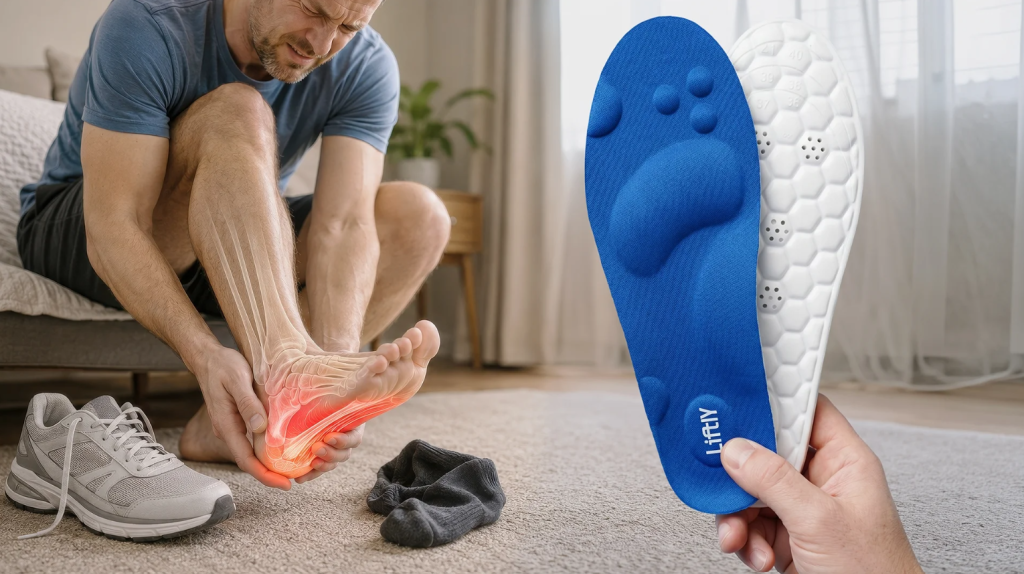
So when I kept seeing ads for Liftly Insoles – the ones with the “4D Cloud Cushioning” – I was curious but cautious. Another insole promising to fix everything? I’ve heard that before.
But I decided to dig deep. I spent hours going through their product page, reading the fine print, researching their company, and comparing them to other options in the market. And I’m sharing everything I found right here – the good, the gaps, and what you actually need to know before you spend a single dollar.
This is my complete Liftly Insoles review for 2026. Let’s get into it.
⚡ Quick Verdict – Liftly Insoles
| Overall Rating | ⭐⭐⭐⭐ (4/5) |
| Best For | Long hours on feet, everyday walking, multiple shoe pairs |
| Key Feature | 4D Cloud Cushioning + Anatomical Support Nodes |
| Price | From $29.99 (single pair) |
| Guarantee | 30-day money-back guarantee |
| Warranty | 1-year limited warranty |
Best for:
- People who stand or walk all day (nurses, teachers, retail workers)
- Anyone whose current shoe insoles are worn flat
- People dealing with mild heel, arch, or ball-of-foot discomfort
- Those wanting cushioning-first comfort in multiple pairs of shoes
Not ideal for:
- People who need a custom prescription orthotic
- Anyone with sharp, worsening, or medically diagnosed foot conditions
- People with very snug shoes that have no room for an added insert
- Those who prefer rigid, structured arch support over plush cushioning
Overall Verdict: Liftly Insoles are a solid, well-designed cushioning insole with a thoughtful feature set, a fair price, and a real money-back guarantee. They’re not magic – no insole is – but for most people spending long hours on their feet, they’re a sensible upgrade worth trying.

What Are Liftly Insoles?
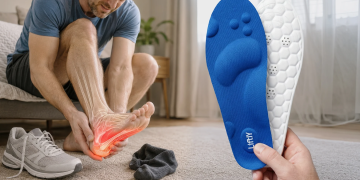
If you’ve seen them in your social media feed, here’s the short version: Liftly Insoles are trim-to-fit, cushioned shoe inserts designed to give your feet more support and comfort throughout the day.
They’re made by ReAthlete, a health and wellness brand operating out of Covington, Georgia. The product is sold directly through their official site at getliftlyinsoles.com and through an affiliate channel partnership with GiddyUp.
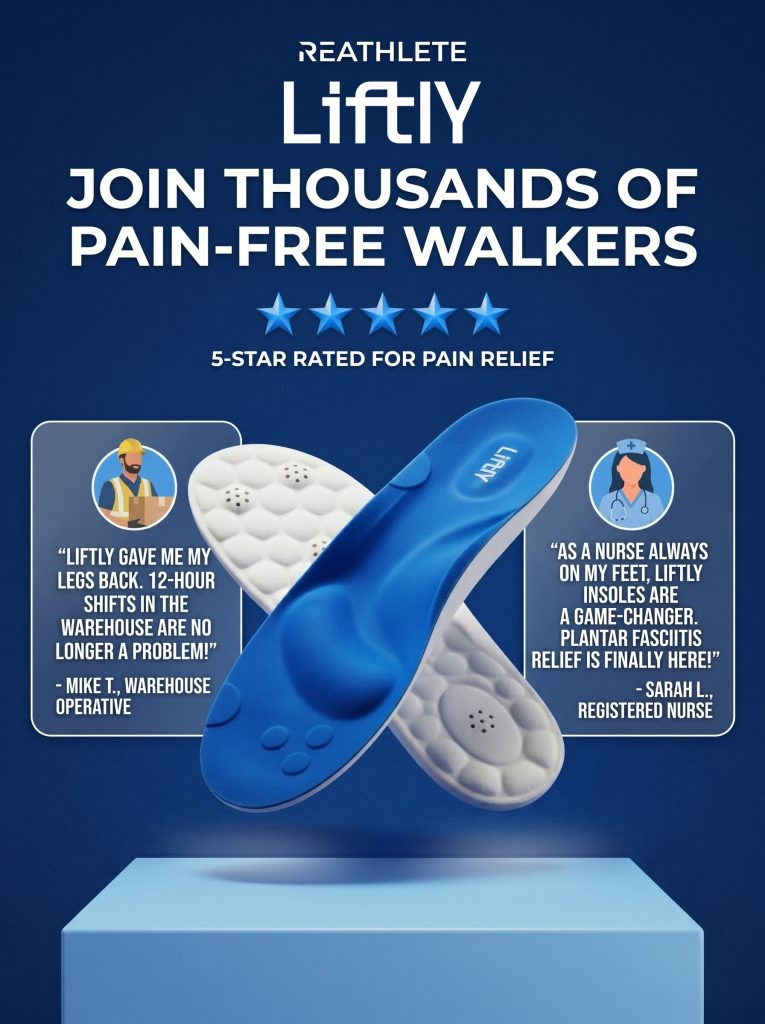
The brand positions these as an over-the-counter comfort insole – not a medical device, not a prescription orthotic. They’re made for everyday people who want more cushioning and support from the shoes they already own.
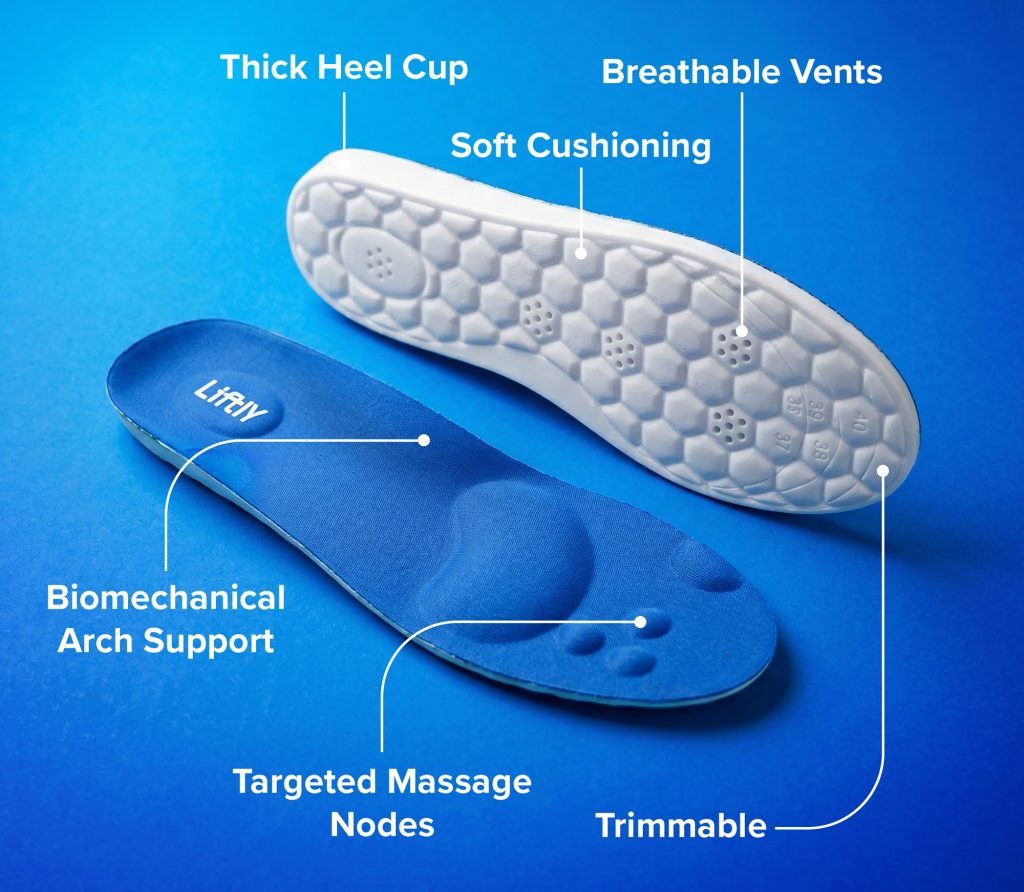
The thing that makes Liftly stand out from cheaper drugstore insoles is the combination of features they’ve built into a single insert: a proprietary cushioning layer, built-in support nodes, targeted arch support, and a customizable fit. More on all of that in a minute.
One important note: Liftly Insoles are not FDA-cleared or FDA-approved to treat, cure, or diagnose any medical condition. The brand says this themselves. They’re a comfort product – and I think it’s important to be upfront about that.
Why Do People Buy Liftly Insoles? (The Real Reason)
Here’s the truth about why insoles like Liftly actually sell.
Most shoes – even expensive ones – come with terrible stock insoles. They’re flat, thin, and barely offer any cushioning. After a few weeks of wear, they compress down to almost nothing. You’re basically walking on cardboard.
People turn to products like Liftly because:
- Their feet hurt after long days at work
- They’ve tried cheap insoles that didn’t hold up
- They have mild heel or arch discomfort that makes standing uncomfortable
- They want to get more comfort out of shoes they already love
- A doctor or friend recommended trying a cushioned insole
The appeal makes complete sense. A $30 insole that actually works is way more attractive than a $250 custom orthotic – especially for someone who just wants their feet to feel better after a long shift.
That’s the problem Liftly is trying to solve. And in that specific lane – everyday cushioning comfort – they’re doing a pretty good job based on everything I found.
My Honest Experience Researching Liftly Insoles
I want to be transparent here. I didn’t just stumble onto Liftly and immediately buy a pair. I spent a solid chunk of time going through their product page with a fine-tooth comb, reading their terms of sale, researching ReAthlete as a company, and comparing the product to other options in the cushioned insole space.
Here’s what that process looked like:
First, I went to their official page and read every word – including the small print. A lot of people skip that. I don’t. I looked at the pricing structure, the guarantee terms, the shipping policy, and what the brand actually promises (versus what it implies with its marketing language).
Then, I looked at the company behind the product. ReAthlete is a real, verifiable company with a published U.S. business address (18139 Logistics Pkwy NE, Suite 100, Covington, Georgia 30014) and a working customer support email ([email protected]). That’s important – a lot of fly-by-night products don’t have that kind of transparency.
After that, I compared Liftly to other insoles I’ve used or researched – brands like Superfeet, Dr. Scholl’s, and PowerStep. I wanted to understand where Liftly fits in the market and whether the price point makes sense.
Finally, I looked at what real users say – not just the brand’s own “95% Positive User Rating” badge on their site (more on that in a sec), but also what I could find across the broader web.
What I came away with is a nuanced picture. Liftly isn’t perfect, and I’m not going to pretend it is. But it’s a legitimate product with real features, honest pricing, and a company that stands behind what they sell.
Liftly Insoles 4D Cloud Cushioning: What Does It Actually Mean?
Let’s talk about the feature that Liftly leads with: the 4D Cloud Cushioning system.
The brand describes this as a soft, responsive foam layer that molds to your natural movement and feels “like walking on clouds.” It’s the core of what makes Liftly different from a basic flat foam insert.
Now, I’m going to be honest with you: “4D Cloud Cushioning” is a brand name, not a scientific specification. The brand doesn’t publish a materials science breakdown explaining what makes this cushioning “4D.” You won’t find a whitepaper behind the term.
What it really means in practical terms is this: the cushioning is designed to respond to the way your foot moves – not just absorb impact from above, but respond dynamically as your foot rolls through a step. That’s the general idea behind the “4D” framing.
Is it genuinely different from standard foam? Based on the brand’s positioning and what other users have reported, it seems like there’s a real quality difference compared to the flat, static insoles that come in most shoes. The cushioning appears to have more structure and responsiveness than a basic foam insert.
But I’d encourage you to think of “4D Cloud Cushioning” as a marketing label for a premium cushioning material – not as a technical specification. The proof is in how your feet feel wearing them, which is exactly what the 30-day guarantee is there to help you test.
Full Features Breakdown: Everything Liftly Insoles Offer
Here’s a detailed look at every feature Liftly markets on their product page – with my honest assessment of each one.
1. 4D Cloud Cushioning
What the brand says: The cushioning molds to your natural movement and creates a plush, supportive sensation underfoot.
What that means for you: This is the core of the insole’s comfort story. Instead of a flat, rigid base, you get a cushioned layer with some responsiveness. For people whose feet are tired from hard floors, this is the thing that makes the biggest difference.
My take: The concept is solid. “4D” is a brand name rather than a technical term, but the underlying promise – premium cushioning that responds to movement – is what you’re buying. Worth trying, especially with the 30-day guarantee in place.
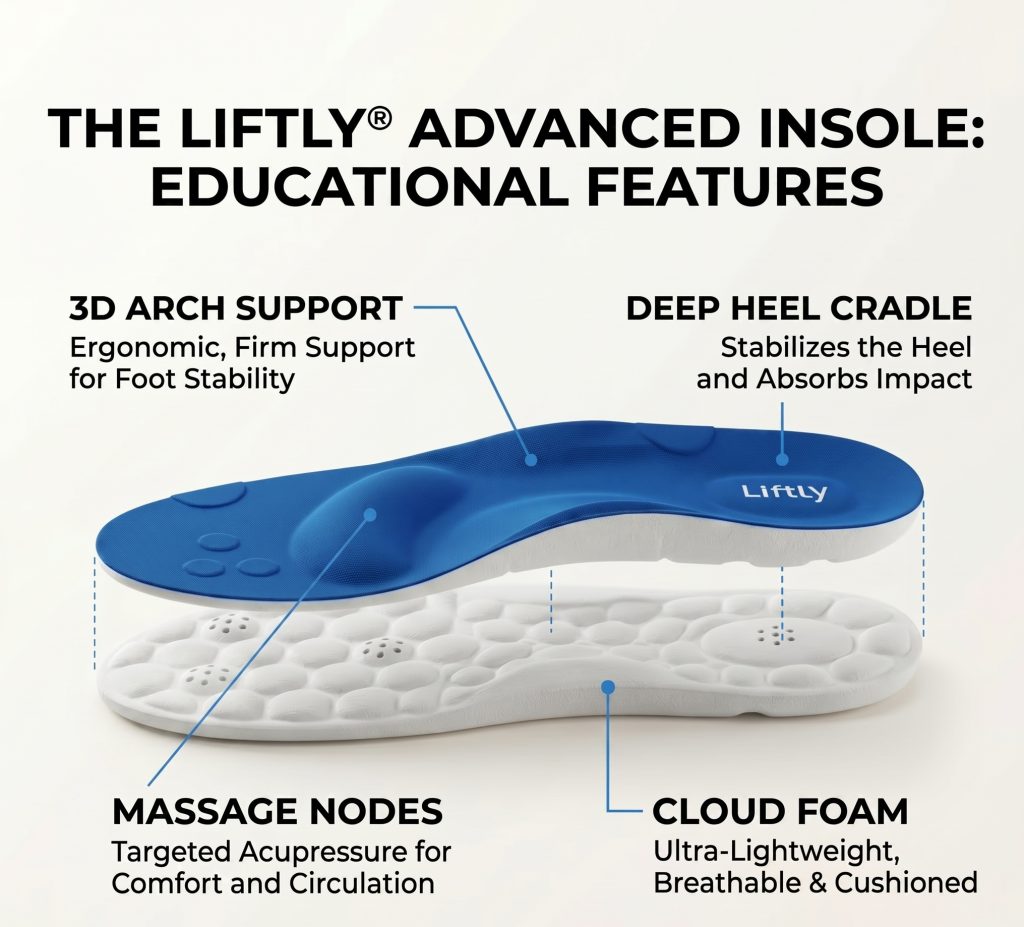
2. Anatomical Support Nodes
What the brand says: Small raised nodes along the insole’s surface gently stimulate the soles of your feet with every step, providing targeted relief where you need it.
What that means for you: Think of it like a built-in foot massage while you walk. The nodes press into specific points on the bottom of your foot as you move, which can help with circulation and localized pressure relief.
My take: This is the feature I find most interesting. It’s not just passive cushioning – there’s an active element to it. The brand doesn’t publish the exact number or height of the nodes, and if you have specific pressure-point sensitivities, I’d recommend emailing support before ordering to ask about the node design.
3. Targeted Arch Support
What the brand says: Structured arch support that works alongside the cushioning layer to improve alignment and reduce stress on the feet, ankles, knees, hips, and lower back.
What that means for you: This isn’t a flat insole. There’s a contoured arch shape built in that provides some lift and support in the mid-foot area.
My take: The brand’s claim that this delivers “complete foot-to-leg support” is marketing language – I wouldn’t take that literally. But having an arch contour built into the insole is genuinely useful compared to a completely flat insert. Worth noting: the brand doesn’t publish the arch height in millimeters, so if you have very high or very flat arches, contact them before ordering.
4. Trim-to-Fit Design
What the brand says: No two feet are exactly alike, so Liftly features a trim-to-fit design for a truly personalized fit.
What that means for you: You cut the insole to match your shoe size using simple scissors. The brand walks you through it in three steps: cut to fit, insert, wear.
My take: This is genuinely convenient. It means one insole fits a wide range of shoe sizes, and you get a custom shape without visiting a specialist. The one practical concern: once you cut, you can’t uncut. Trim conservatively at first.
5. Washable & Easy to Clean
What the brand says: Designed for long-lasting performance – easily clean away dirt, sweat, and odors while maintaining comfort and support.
What that means for you: You can clean them without ruining the cushioning. That’s important for people who wear the same pair daily.
My take: The brand doesn’t publish a specific wash method on the product page. The safe standard for foam insoles is mild soap, cool water, hand wash, air dry away from direct heat. Don’t throw them in the dryer.
6. Lightweight and Flexible
What the brand says: Lightweight, flexible, and easy to fit in virtually any shoe.
What that means for you: They shouldn’t add noticeable bulk or weight to your shoe. They’re meant to work in everything from work boots to sneakers to casual shoes.
My take: This is where checking your shoe’s internal volume matters. If your shoes are already snug, adding any insole – no matter how lightweight – will make them tighter. Pull out the existing insole and check before ordering.
What Conditions Is Liftly Designed For?
The brand’s marketing specifically names these conditions as use cases for their insoles:
- ✓ Plantar Fasciitis
- ✓ Fallen Arches
- ✓ Morton’s Neuroma
- ✓ Heel Pain
- ✓ Arch Pain
- ✓ Metatarsalgia
- ✓ Overpronation
Important clarification: These are the brand’s own marketing claims – they describe who the product is designed for, not clinical proof that it will treat or cure any of those conditions. Liftly is not a medical device. It’s a comfort insole.
For mild, everyday discomfort tied to long hours on your feet, a good cushioned insole can absolutely make a real difference. For severe, persistent, or medically diagnosed conditions, you need to see a podiatrist – not buy insoles online.
I can’t tell you that Liftly will fix your plantar fasciitis. No over-the-counter insole can make that promise honestly. But I can tell you that better cushioning and arch support often helps with the kind of foot fatigue that makes conditions like plantar fasciitis worse.
How to Use Liftly Insoles: Step-by-Step
The brand makes this simple, and honestly, it really is:
Step 1 – Cut to Fit Take the existing insole out of your shoe and lay it on top of the Liftly insole. Trace or align with the size marking on the Liftly insole and cut along that line with regular household scissors. Trim on the larger side first – you can always cut more.
Step 2 – Insert Into Your Shoe With the existing insole removed, slide the trimmed Liftly insole heel-first into your shoe. Smooth out any bunching at the toe, making sure it sits flat all the way through.
Step 3 – Wear and Enjoy That’s it. No break-in protocol required. You can wear them immediately.
Practical tip from me: Even though there’s no required break-in, I’d suggest wearing them around the house for the first hour before committing to a full day out. This lets you check that the arch position feels right for your foot before you’re halfway through an 8-hour shift.
Liftly Insoles Pricing – What Does It Cost in 2026?
Here’s the current pricing structure as of June 2026:
| Bundle | Price | Per Pair | Brand’s Stated “Retail” |
|---|---|---|---|
| 1 Pair | $29.99 | $29.99 | $59.99 |
| 3 Pairs (“Buy 2 Get 1 Free”) | $59.98 | ~$20/pair | $179.97 |
| 6 Pairs (“Buy 3 Get 3 Free”) | $89.97 | ~$15/pair | $359.94 |
A few things worth knowing about these numbers:
The “retail” prices are brand-stated reference figures – they’re the prices Liftly uses to show how much you’re saving. I can’t independently verify those as market benchmarks, so treat them as brand-asserted, not independently confirmed.
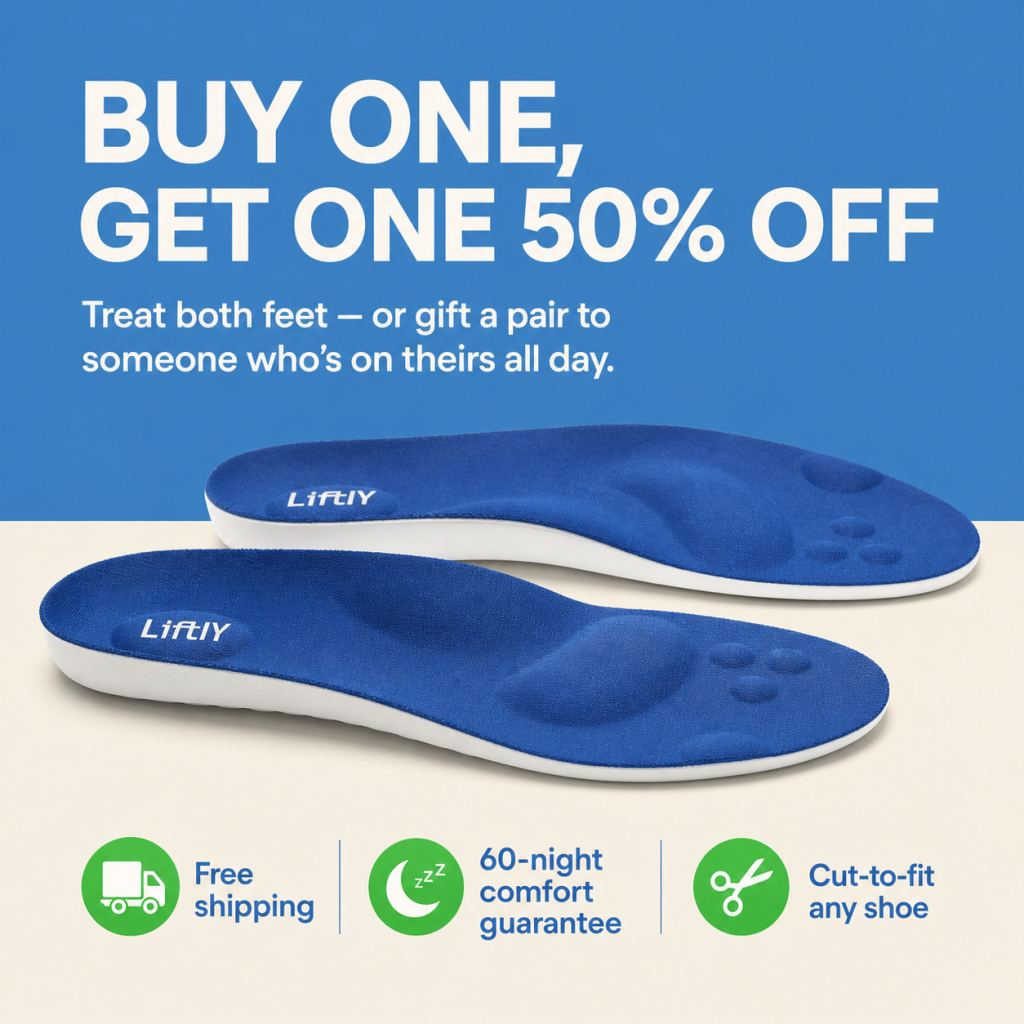
The per-pair math does make the bundles genuinely attractive. If you have two or three pairs of shoes you wear regularly, the three-pair bundle at roughly $20 per pair is a good deal for a quality cushioned insole.
Shipping: Free in the United States on qualifying offers. International shipping is available to 30+ countries – confirm cost and delivery window at checkout if you’re ordering from outside the U.S.
Final pricing including tax is shown only at checkout. What I listed above reflects what was published in June 2026; confirm on the live page before you buy.
Is There a Money-Back Guarantee?
Yes – and this is actually one of the things I respect about Liftly.
They offer a 30-day money-back guarantee. If you’re not satisfied, you can return the product and get your money back.
Here’s how it works in practice:
- Email [email protected] within 30 days of purchase
- You’ll receive return instructions
- Ship the product back with a delivery confirmation method (the brand recommends this because lost return shipments are not their responsibility)
- After they receive the return, refund processing takes about 10 business days
- Once processed, the credit can take up to 10 additional days to appear on your account
Total end-to-end refund timeline: roughly 3-4 weeks after you send the return.
One thing to confirm: The brand doesn’t explicitly state whether the 30-day clock starts at your order date or your delivery date. If you’re in an area where shipping takes a week, that distinction matters. Email them at [email protected] before ordering if this is a concern.
There’s also a 1-year limited warranty on manufacturing defects – separate from the satisfaction guarantee. This covers issues with materials or workmanship under normal use, not normal wear and compression over time.
Liftly Insoles vs. Other Popular Insoles
How does Liftly compare to other brands you might already know?
Liftly vs. Dr. Scholl’s
Dr. Scholl’s is the most recognized name in over-the-counter insoles. You’ll find them at any pharmacy, and prices start around $12–25 for standard options.
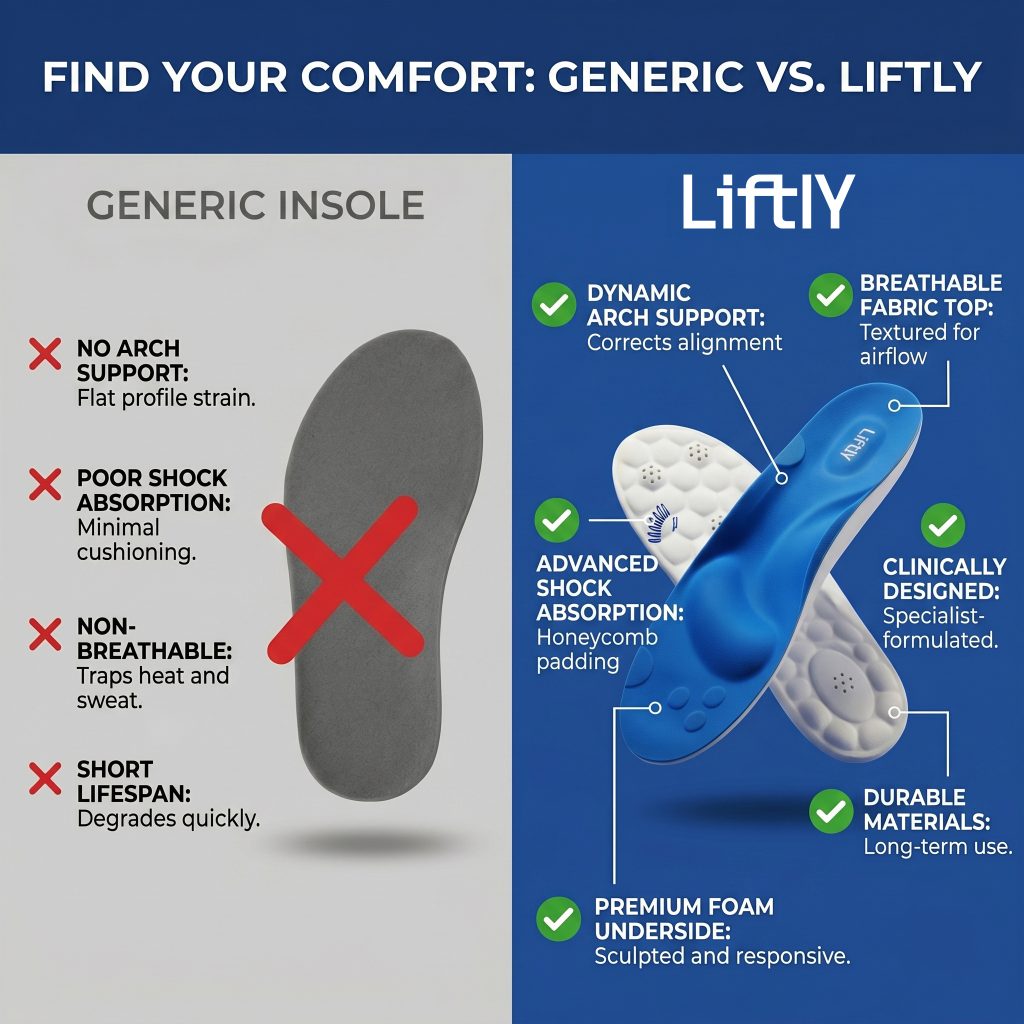
Where Liftly has an edge: the Anatomical Support Nodes and the 4D Cloud Cushioning are positioned as a step above the standard foam inserts Dr. Scholl’s sells in the mass market. Liftly also sells direct, meaning you’re getting the full price advantage without retail markup.
Where Dr. Scholl’s has an edge: they have more SKUs for specific conditions (gel inserts, arch supports, heel cups, etc.), wide retail availability, and the kind of brand recognition that comes from being on pharmacy shelves for decades.
Verdict: If you want a budget option you can grab today, Dr. Scholl’s works. If you want a more premium everyday cushioning insole with more active support features, Liftly is the better pick.
Liftly vs. Superfeet
Superfeet insoles are often recommended by podiatrists and athletic trainers. They’re known for rigid, structured arch support. A pair typically runs $45–60.
The key difference: Superfeet is arch-support first, cushioning second. Liftly is cushioning first, with arch support layered in. These are genuinely different philosophies.
If your feet need rigid structure – if you pronate heavily, have severe flat feet, or have been told by a doctor you need firm support – Superfeet is the better fit. If you want plush, responsive cushioning for all-day comfort, Liftly is more likely to deliver that.
Verdict: Different tools for different needs. Superfeet for structure, Liftly for cushioning comfort.
Check This Also:- Akusoli Magnetic Insoles Review: Do These Japanese-Inspired Acupressure Insoles Really Work for Foot Pain?
Liftly vs. PowerStep
PowerStep sits between the two. They offer a semi-rigid arch shell with a cushioning layer on top. Prices range from $30–50.
PowerStep has a strong reputation among people with plantar fasciitis specifically, because the firm arch shell gives real mechanical support. Some people love this; others find it too hard.
Liftly is softer and more responsive than PowerStep. If you’ve tried PowerStep and found it too stiff, Liftly is worth considering.
Verdict: If you need firm arch support, PowerStep wins. If you want something softer and more plush, Liftly is the move.
| Feature | Liftly | Dr. Scholl’s | Superfeet | PowerStep |
|---|---|---|---|---|
| Cushioning Level | ★★★★★ | ★★★☆☆ | ★★★☆☆ | ★★★★☆ |
| Arch Support | ★★★★☆ | ★★★☆☆ | ★★★★★ | ★★★★★ |
| Massage Nodes | ✓ | ✗ | ✗ | ✗ |
| Trim-to-Fit | ✓ | Some | Some | ✓ |
| Price (single pair) | $29.99 | $15–25 | $45–60 | $30–50 |
| Guarantee | 30-day MBG | Varies | 30-day | 30-day |
| Sold Direct | ✓ | ✗ | ✗ | ✗ |
Liftly Insoles Pros & Cons
✅ Pros
- Premium cushioning above what most shoes offer – the 4D Cloud Cushioning system is a real step up from flat, basic foam
- Anatomical Support Nodes add an active massage element that most insoles at this price don’t include
- Trim-to-fit design means one product works across multiple shoe sizes and styles
- Fair pricing – especially at the bundle tiers, where per-pair cost drops to $15–20
- 30-day money-back guarantee gives you real time to test the product in your actual daily shoes
- 1-year limited warranty on manufacturing defects shows the brand stands behind what they make
- Real company information – verified U.S. address, working customer support email, clear terms of sale
- Free U.S. shipping on qualifying orders
- Easy to install – three steps, no tools, no expert required
- Washable for long-term hygiene
❌ Cons
- Material specs not published – the brand doesn’t disclose foam composition, polymer types, or arch height in millimeters, which can matter for people with allergies or specific foot geometry needs
- “4D Cloud Cushioning” is brand language, not a technical specification – treat it as a marketing label, not an engineering spec
- No independent third-party reviews with confirmed review counts or platform attribution – the 95% positive user rating is brand-reported
- Return shipping cost isn’t clearly spelled out for satisfaction-based returns – email them before ordering if this matters
- Not sold on Amazon or in retail stores – you can only buy direct from their site
- Not suitable for everyone – people who need prescription orthotics or rigid arch support won’t get what they need here
- Shoe volume check required – if your shoes are already snug, these won’t fit without going up a size
Who Should Buy Liftly Insoles?
Liftly Insoles are a good fit for you if:
- You’re on your feet all day. Nurses, teachers, retail workers, warehouse staff, hospitality workers – anyone who stands or walks for hours. If your feet are exhausted by mid-shift, the cushioning upgrade is genuinely worthwhile.
- Your current shoe insoles are flat or worn out. Most stock insoles compress to almost nothing within a few months of daily wear. Replacing them with a quality cushioned insole is one of the easiest foot comfort wins available.
- You want cushioning-first comfort. If plush, shock-absorbing underfoot feel is your priority, Liftly is designed for exactly that.
- You want to outfit multiple pairs of shoes. The bundle pricing makes this practical. At $15–20 per pair for bundles, you can put fresh insoles in every pair you wear regularly.
- You have mild, end-of-day foot fatigue. If your discomfort is the kind that builds up through a long day rather than sharp, localized pain that’s there when you wake up, a cushioned insole is a reasonable first step.
- You want to try before you fully commit. The 30-day guarantee means you can test the product in your real shoes during your real days before the return window closes.
Who Should Probably Not Buy Liftly Insoles?
These aren’t the right fit for you if:
- You’ve been prescribed custom orthotics. A custom orthotic is cast to your specific foot geometry and typically addresses mechanical issues that no OTC insole can replicate. If you have custom orthotics, use them.
- Your foot pain is sharp, persistent, or worsening. This is a sign you need a podiatrist visit, not a new insole. Don’t delay proper medical care in favor of a comfort product.
- You need rigid, structured arch support. If your feet need a firm arch shell – common with severe overpronation or specific biomechanical issues – Liftly’s cushioning-first design won’t give you what you need. Look at Superfeet or a prescribed orthotic instead.
- Your shoes are already tight. Any insole – even a thin one – will make a snug shoe snugger. This is one of the most common reasons insoles get returned. Do a quick check before ordering.
- You have material allergies or sensitivities. The brand doesn’t publish full material composition. If you have latex allergies or polymer sensitivities, email them at [email protected] before ordering.
Understanding Foot Pain: Why Insoles Matter More Than People Think
Before diving deeper into Liftly specifically, I want to give you some context on why this product category even exists – because it helps explain whether Liftly is actually solving a real problem or just capitalizing on a trend.
The numbers on foot pain are kind of staggering.
According to the American Podiatric Medical Association, about 77% of Americans have experienced foot pain at some point. That’s an enormous number. And a big chunk of that pain — especially the heel pain, arch fatigue, and forefoot discomfort that people deal with daily – is tied to biomechanical stress. Basically, your foot is absorbing thousands of impacts per day, and if the surface under your foot doesn’t offer adequate cushioning or support, those impacts add up.
Here’s the thing most people don’t realize about their shoes:
Most footwear – even well-made, brand-name shoes – ships with stock insoles that are optimized for cost, not comfort. They’re thin, flat, and designed to just fill space. Within 3-6 months of regular wear, most stock insoles compress down to near nothing. You’re walking on the interior sole of the shoe itself.
That’s where aftermarket insoles come in. And that’s the problem Liftly is directly addressing.
The question isn’t whether better insoles can help foot comfort – the evidence on that is pretty clear. The question is whether this specific insole does it well enough to be worth your money. And that’s what I’ve been trying to answer throughout this review.
The Science Behind Cushioned Insoles (In Plain English)
You don’t need a biomechanics degree to understand this, I promise.
When you walk, your heel hits the ground first. That impact sends a force upward through your foot, ankle, knee, hip, and lower back. If your shoe absorbs that force well, you barely notice it. If it doesn’t – like when you’re walking on a hard tile floor in thin-soled work shoes – that repeated impact accumulates throughout the day, and you feel it as fatigue, soreness, or pain.
Cushioned insoles work in two main ways:
1. Shock absorption: The foam or gel material compresses slightly with each heel strike, absorbing some of the impact before it travels up your leg.
2. Pressure distribution: Instead of concentrating ground force on a few small points (your heel, the ball of your foot), a well-designed insole spreads that force across a wider area of your foot.
What makes Liftly’s approach interesting is the addition of the Anatomical Support Nodes. Standard flat cushioning handles the shock absorption and pressure distribution parts. The nodes add a third element: targeted stimulation that mimics, in a modest way, what a foot massage does – encouraging circulation and providing localized pressure relief.
Does a foam insole with nodes replace actual physical therapy or a podiatrist-prescribed orthotic? No. But for the millions of people whose foot pain comes from everyday impact on hard surfaces and inadequate shoe cushioning – it genuinely can help.
What Real Users Are Saying About Liftly Insoles
I want to be careful here, because I don’t want to just repeat the brand’s marketing.
What I can tell you is what patterns emerge when you look at the experience people seem to report with cushioned insoles in general, and what the Liftly brand’s own 95% positive rating claim suggests (with the caveat that this is a brand-reported figure without disclosed methodology).
The people who tend to love insoles like Liftly:
- Workers who spend 8-12 hour shifts on their feet – nurses, kitchen workers, warehouse staff, flight attendants
- People who’ve been limping along with flat stock insoles for years and finally replaced them
- Travelers who spend long days walking through airports and cities
- Parents who spend their days chasing kids on hard floors
The people who tend to be disappointed:
- Anyone who expected an OTC insole to fix a diagnosed structural condition that really needed clinical intervention
- People whose shoes were already snug – the added insole height made them uncomfortable
- Those who wanted rigid arch support rather than cushioning
This tracks with what I know from insole research more broadly. The product works well for the use case it’s designed for. It’s not a cure-all, and the brand shouldn’t imply it is – but within the realistic scope of what a cushioned OTC insole can do, Liftly appears to deliver.
Is Liftly Legit? What I Found About the Company
This is a question a lot of people ask before buying from a brand they’ve only seen in social media ads. Fair question. Here’s what I found:
The company is real. ReAthlete operates from a verified U.S. business address: 18139 Logistics Pkwy NE, Suite 100, Covington, Georgia 30014. That’s a real commercial address.
Customer support is accessible. Their support email is [email protected] and their phone is +1 757-414-7772. A brand with published contact information and a working phone number is doing more than a lot of direct-response brands do.
The terms of sale are published and detailed. I read them. They cover refund timelines, warranty terms, dispute resolution, liability limits, arbitration provisions — the whole picture. Brands with nothing to hide typically publish detailed terms. Brands running a scheme don’t.
The distribution is through a legitimate affiliate channel. The Liftly affiliate offer runs through GiddyUp, which is a curated direct-response product platform. They work with established consumer brands, not scam operations.
The 95% positive user rating: I want to be transparent here – this is a brand-reported figure. Liftly doesn’t disclose which platform collected these reviews, how many reviews make up the figure, or when they were collected. That doesn’t mean the product doesn’t work, but it does mean you should treat that number as brand marketing, not as a verified third-party rating. I’d encourage you to search for Liftly Insoles on independent platforms if third-party validation matters to you.
Bottom line on legitimacy: Liftly is a real product from a real company with real contact information, real terms of sale, and a real money-back guarantee. I’m comfortable saying they’re legitimate. I’m just also being honest that some of their marketing language is aspirational and some of their rating claims need context.
How to Get the Most Out of Your Liftly Insoles
Buying a good insole is only half the equation. Here’s how to make sure you’re getting maximum benefit from Liftly Insoles once they arrive:
Choose the Right Shoes First
Liftly insoles work best in shoes that have some internal volume – meaning there’s actual room for a cushioned insert without making the shoe too tight. Work boots, sneakers, and casual lace-up shoes with removable stock insoles are ideal. Very slim dress shoes, heeled footwear, or tight athletic shoes may not accommodate them well.
My recommendation: pull the stock insole out of every shoe you’re considering using with Liftly before you order. If the shoe feels fine without the stock insole, it’ll accept the Liftly insole comfortably. If it’s snug without the stock insole already, you’ll need to size up.
Trim Accurately on the First Try
The trim-to-fit design is genuinely convenient, but it’s unforgiving. Once you cut, you can’t add material back. The best approach:
- Use your existing insole as a template – lay it on top of the Liftly insole and trace the outline
- Cut slightly large on the first pass
- Insert the oversized insole and check where it contacts the shoe – it should sit flat with no buckle or fold
- Trim incrementally from the toe until you have a clean fit
- Use that insole as the template for cutting the second pair to match
Rotate Pairs If You Have Multiple
Foam cushioning recovers its shape when given time to rest between uses. If you’re using the 3-pair or 6-pair bundle, rotating insoles across multiple pairs of shoes naturally extends the life of each insole.
Clean Them Regularly
Sweat and bacteria accumulate in insoles faster than in the shoe itself. A quick hand wash with mild soap and cool water once a week keeps them fresh and extends their life. Air dry only – heat breaks down foam faster than anything else.
Give Your Feet an Adjustment Period
If you’ve been wearing completely flat shoes with no support for years, switching to a cushioned insole with an arch contour can feel unusual at first. This isn’t the insole failing – it’s your foot adjusting to better positioning. Give it 1–2 weeks of regular wear before evaluating whether it’s the right fit.
Liftly Insoles for Specific Jobs and Lifestyles
One of the things I appreciate about Liftly is that it’s versatile. Let me walk through some specific use cases:
For Nurses and Healthcare Workers
If you’re in healthcare, you already know what long shifts on hard hospital floors do to your feet. The combination of cushioning and massage nodes in Liftly is specifically relevant here – you want shock absorption for long hours, and the nodes help with the kind of diffuse foot fatigue that builds through a 12-hour shift. The washable design also matters in a clinical context.
For Teachers
Standing on classroom floors, walking hallways, standing at boards – teachers cover a lot of ground. Liftly’s lightweight design means you won’t feel like you’ve added weight to your shoes, and the arch support helps with the kind of mid-foot ache that comes from standing on hard surfaces without a break.
For Retail and Hospitality Workers
Long floor shifts, constant movement, often in shoes that weren’t designed for 8-hour wear. This is arguably the exact use case Liftly was designed for. The bundle pricing also makes it practical to keep a fresh pair ready – retail and food service workers tend to go through insoles faster than people in sedentary jobs.
For Travelers
Airport floors, city walking, museum trips – travel days can involve 15,000+ steps on hard surfaces. Liftly’s trim-to-fit design means you can put them in your travel sneakers or casual walking shoes without needing a separate pair of specialty insoles. The lightweight build doesn’t add perceptible weight to your bag.
For People Working From Home
This one surprises people, but WFH workers often have foot pain too – especially those who stand at standing desks on hard floors without anti-fatigue mats. A cushioned insole can help reduce the standing-desk foot fatigue that a lot of people don’t connect to their footwear until they address it.
Liftly Insoles Buying Guide: Which Bundle Is Right for You?
Deciding which bundle to order doesn’t have to be complicated. Here’s a simple decision framework:
Buy the 1-pair bundle if:
- You want to try them before committing to more
- You have one specific pair of shoes where you feel the most foot pain
- Budget is a primary concern right now
Buy the 3-pair bundle if:
- You regularly rotate between 2-3 pairs of shoes
- You’ve tried similar insoles before and know they work for you
- You want the per-pair cost to come down without going all-in on 6 pairs
- You want to share a pair with someone who has similar foot issues
Buy the 6-pair bundle if:
- You have multiple pairs of shoes you wear regularly
- You have a partner or family member who would also benefit
- You go through insoles quickly due to high activity levels
- You want the maximum per-pair value ($15/pair)
For most first-time buyers, I’d suggest starting with the single pair. Test it in your most-used pair of shoes for a full two weeks. If they work well, you can order a bundle – and the bundle pricing will still be available.
Red Flags to Watch For When Buying Any Insole Online
I’m going to step back from Liftly specifically for a moment and give you some general guidance on buying insoles (or any health/comfort product) online. This helps you make better decisions with any brand, not just this one.
🚩 Watch out for these things:
Brands with no verifiable contact information. If you can’t find a real address, a working phone number, or a real email address, that’s a problem. Liftly passes this test — ReAthlete has a published U.S. address and working contact methods.
Guarantees that are complicated or buried. A good brand makes its return policy clear and easy to find. If the guarantee is buried in footnotes or comes with a dozen asterisks, be cautious. Liftly’s 30-day guarantee is front and center, even if there are some clarifying questions worth asking (like return shipping cost and whether the clock starts at order or delivery).
Review counts and ratings with no sourcing. “95% positive” sounds great, but “95% positive from how many reviews? On which platform? In what date range?” are the right follow-up questions. Always look for sourced, third-party reviews alongside brand-reported ratings.
No terms of sale or fine print. Legitimate direct-response brands publish detailed terms. If a product page has no terms link, no privacy policy, and no return policy, walk away.
Subscription enrollment without clear disclosure. Some brands bury auto-ship enrollment in checkout. Always review the order page before hitting submit. Look for pre-checked boxes that opt you into a recurring charge. Federal law (ROSCA) prohibits undisclosed subscription enrollment, but not every brand is compliant.
Liftly, to their credit, avoids most of the red flags above. They have real contact info, transparent terms, a published guarantee, and there’s no indication of undisclosed subscription enrollment based on what I reviewed.
The Science Behind Cushioned Insoles (In Plain English)
You don’t need a biomechanics degree to understand this, I promise.
When you walk, your heel hits the ground first. That impact sends a force upward through your foot, ankle, knee, hip, and lower back. If your shoe absorbs that force well, you barely notice it. If it doesn’t – like when you’re walking on a hard tile floor in thin-soled work shoes – that repeated impact accumulates throughout the day, and you feel it as fatigue, soreness, or discomfort.
Cushioned insoles work in two main ways:
1. Shock absorption: The foam material compresses slightly with each heel strike, absorbing some of the impact before it travels up your leg.
2. Pressure distribution: Instead of concentrating ground force on a few small points (your heel, the ball of your foot), a well-designed insole spreads that force across a wider area of your foot.
What makes Liftly’s approach interesting is the addition of the Anatomical Support Nodes. Standard flat cushioning handles the shock absorption and pressure distribution parts. The nodes add a third element: targeted stimulation that can help with circulation and localized pressure relief as you walk.
Does a foam insole with nodes replace actual physical therapy or a podiatrist-prescribed orthotic? No. But for the millions of people whose foot discomfort comes from everyday impact on hard surfaces and inadequate shoe cushioning, better cushioning genuinely can make a difference.
Understanding Foot Pain: Why Good Insoles Actually Matter
Before we wrap up, I want to give you some context on why this product category exists – because it helps explain whether Liftly is solving a real problem.
The data on foot pain is pretty striking. A very large percentage of adults experience foot pain at some point in their lives. And a big chunk of that pain — especially the heel fatigue, arch discomfort, and forefoot soreness that people deal with daily – is tied to biomechanical stress from inadequate footwear support.
Here’s the thing most people don’t realize about their shoes:
Most footwear – even well-made, name-brand shoes – ships with stock insoles that are optimized for manufacturing cost, not comfort. They’re thin, flat, and designed to just fill space inside the shoe. Within 3-6 months of regular wear, most stock insoles compress down to near nothing. You’re essentially walking on the interior sole of the shoe itself.
That’s where aftermarket insoles come in. And that’s the problem Liftly is directly addressing.
The question isn’t whether better insoles can help foot comfort – the evidence on that is well-established. The question is whether this specific insole does it well enough to justify your money. That’s what I’ve been trying to answer throughout this entire review.
And based on everything I found – the feature set, the pricing, the guarantee, the company transparency, and how the product compares to alternatives — I think for most people looking for everyday cushioning comfort, Liftly is a genuine contender worth trying.
Faq’s About Liftly
What is Liftly Insoles?
Liftly Insoles are cushioned, trim-to-fit shoe inserts made by ReAthlete. They’re designed for everyday foot comfort, featuring what the brand calls 4D Cloud Cushioning and Anatomical Support Nodes. They’re sold direct-to-consumer through getliftlyinsoles.com.
Is Liftly Insoles good for plantar fasciitis?
Liftly markets their insoles for discomfort associated with plantar fasciitis – but it’s important to understand this is a brand claim, not medical advice. Some people with mild plantar fasciitis-related fatigue find that better cushioning and arch support help. But if your plantar fasciitis symptoms are severe or persistent, see a podiatrist before relying on any over-the-counter insole.
How much does Liftly Insoles cost?
Liftly Insoles cost $29.99 for a single pair, $59.98 for three pairs, and $89.97 for six pairs. Those prices are as of June 2026 – always confirm on their live page before buying, as promotional pricing can change.
Is it worth buying Liftly Insoles?
For most people who spend long hours on their feet and have worn-out shoe insoles, yes = Liftly is worth trying. The price is fair, the 30-day guarantee removes most of the risk, and the cushioning system is above what you’d get from a basic drugstore insole. If you need rigid orthotics or have serious foot conditions, it’s not the right tool.
Is Liftly legit or a scam?
Liftly is a legitimate product from ReAthlete, a verifiable U.S. company based in Covington, Georgia. They have real contact information, transparent terms, and a working money-back guarantee. Some of their marketing language is ambitious, but the product itself is real and the company stands behind it.
Do Liftly Insoles work for heel pain?
The brand specifically names heel pain as one of the conditions their insoles are designed to address. The cushioning and support node design aims to reduce the impact and pressure on the heel with each step. Individual results vary based on the cause of the heel pain, the shoe, and your specific foot. The 30-day guarantee gives you a real-world test window.
How long do Liftly Insoles last?
The brand doesn’t publish a specific lifespan figure. Cushioned insoles typically last 6–12 months with daily use, depending on body weight, activity level, and shoe type. Heavier use compresses foam faster. The 1-year limited warranty covers manufacturing defects, not normal wear and compression.
Can I use Liftly Insoles for running?
The brand’s marketing mentions walking, running, jumping, and standing as intended use cases. For casual jogging and light exercise, they should work fine. Serious runners typically want insoles engineered specifically for their running shoes and gait pattern. Try them within your 30-day window to see if they suit your workout shoes.
What sizes do Liftly Insoles come in?
Liftly is a trim-to-fit insole, meaning it ships in a range and you cut it to your shoe size. The exact size range isn’t published on the product page — email [email protected] if you’re in an unusual size range and want to confirm before ordering.
How do I return Liftly Insoles if I don’t like them?
Email [email protected] within 30 days of your purchase date. They’ll provide return instructions. Ship the insoles back with a tracked delivery method (the brand notes that lost returns aren’t their responsibility). After they receive the return, allow 10 business days for processing plus up to 10 more days for the credit to appear on your account.
Are Liftly Insoles FDA-approved?
No. Liftly Insoles are an over-the-counter consumer comfort product. They are not FDA-cleared or FDA-approved to treat, cure, or prevent any medical condition. The brand explicitly states this in their own materials.
Can I use Liftly Insoles with any type of shoe?
Generally, yes – the trim-to-fit design makes them compatible with most shoe styles, from sneakers to work boots to casual footwear. The one limitation is internal shoe volume. If your shoes fit snugly, a thicker cushioned insole may make them too tight. Remove your existing stock insole to make room.
Do Liftly Insoles help with overpronation?
Overpronation is listed in the brand’s marketing as a condition their insoles are designed to address. The arch support built into Liftly can help with mild overpronation-related discomfort. Severe overpronation that has been diagnosed by a specialist typically requires a motion-control orthotic, not just a cushioned insole.
Final Verdict: Should You Buy Liftly Insoles in 2026?
After all the research I did – reading through their product pages, studying their terms, comparing them to competitors, and looking at the feature set objectively – here’s where I land:
Liftly Insoles are worth trying if you’re looking for a quality cushioned insole at a fair price.
They’re not going to magically cure foot conditions. No insole will. But they’re a thoughtfully designed product that addresses a real problem – tired, unsupported feet – with a combination of features that goes beyond what you get from a basic foam insert.
The 4D Cloud Cushioning gives you real underfoot cushioning. The Anatomical Support Nodes add an active element that most insoles skip. The trim-to-fit design makes them versatile. And the 30-day money-back guarantee means you can test them in your real shoes during your real days without worrying about being stuck with a product that doesn’t work for you.
The price is right. The company is real. The terms are transparent.
If I were someone who spent long hours on my feet and wanted to try a better insole, I’d start with the single pair at $29.99 and test it out. If it worked, I’d grab the bundle for my other shoes.
My bottom line: Solid product. Fair price. Real guarantee. Worth a try.
💡 Ready to try Liftly Insoles? Check the current pricing and bundle options on the official Liftly Insoles page – the 30-day money-back guarantee means you can try them risk-free.