

You’re standing in the grocery store aisle, holding two similar products, trying to figure out which one is actually healthier. The nutrition labels stare back at you with percentages, grams, and unfamiliar terms. Sound familiar?
You’re not alone. Studies show that while most consumers check nutrition labels, fewer than 10% fully understand what they’re reading. This confusion often leads to accidentally choosing products with hidden sugars, excessive sodium, or unhealthy fats—even when we’re genuinely trying to eat better.
Here’s the good news: reading nutrition labels doesn’t require a degree in nutritional science. Once you understand the basic framework and know what to look for, you can confidently evaluate any packaged food in seconds. This comprehensive guide will transform you from a confused label-gazer into a confident nutrition detective, empowering you to make choices that truly support your health goals.
Understanding the Nutrition Facts Label Layout
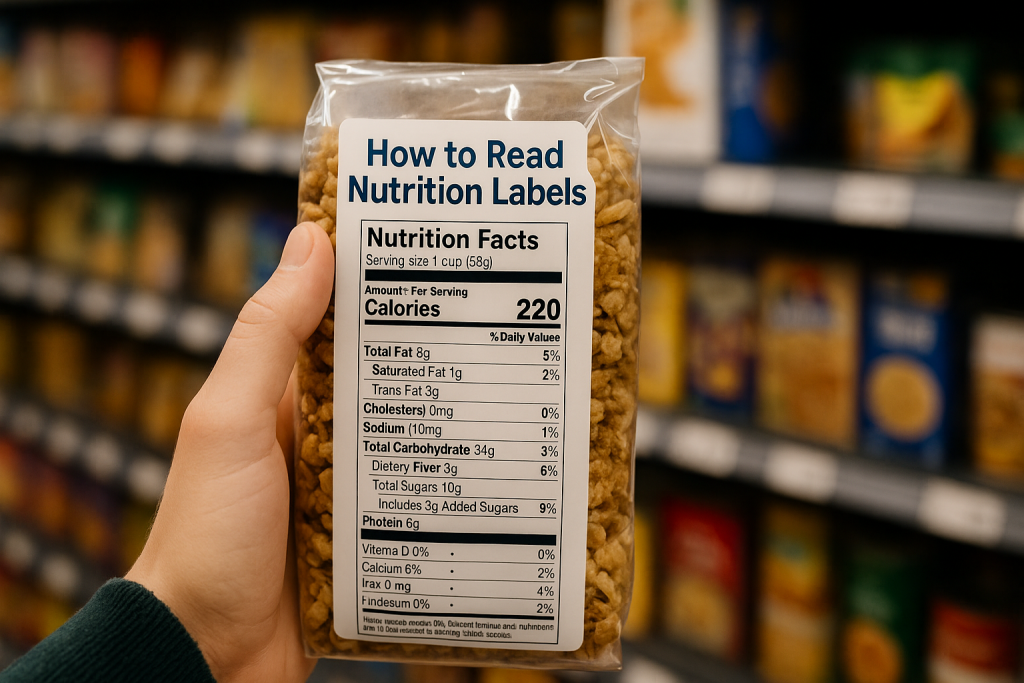
The standardized Nutrition Facts label follows a specific format designed by the FDA to help consumers make informed decisions. Let’s break down each section systematically.
The Serving Size: Your Starting Point
The serving size appears at the very top of the label and serves as the foundation for all other numbers listed. This is arguably the most critical piece of information, yet it’s frequently overlooked.
Why serving size matters: Every nutrient amount listed on the label corresponds to one serving, not the entire package. If you consume more or less than the stated serving size, you’ll need to adjust all the numbers accordingly.
Common serving size mistakes:
- Assuming one package equals one serving
- Not noticing when beverages contain multiple servings per bottle
- Forgetting to multiply nutrients when eating larger portions
- Comparing products without standardizing serving sizes first
Expert tip: Before comparing two products, always check if they use the same serving size. A cereal showing 110 calories might seem healthier than one with 150 calories, but if the first uses a 3/4 cup serving while the second uses 1 cup, the first one actually has more calories per volume.
Servings Per Container: The Multiplication Factor
Located directly below the serving size, this number tells you how many servings the entire package contains. This simple figure prevents one of the most common nutrition label mistakes.
Real-world example: That innocent-looking bottle of iced tea might list 90 calories per serving, but if the bottle contains 2.5 servings, you’re actually consuming 225 calories if you drink the whole thing.
Calories: Energy at a Glance
Calories measure the energy your body receives from food. While calorie counting isn’t necessary for everyone, understanding caloric content helps with portion control and energy balance.
Calorie guidelines per serving:
- 40 calories: Low
- 100 calories: Moderate
- 400 calories or more: High
What health experts consider: Rather than obsessing over calories alone, professionals look at calorie density relative to nutritional value. A 200-calorie serving of nuts provides protein, healthy fats, and fiber, while 200 calories of candy offers minimal nutrition.
Decoding the Nutrients Section: What Your Body Actually Needs
Total Fat: Beyond the Numbers
Fat often gets vilified, but your body needs it for hormone production, vitamin absorption, and brain health. The key is understanding which fats to embrace and which to limit.
The fat breakdown you’ll see:
| Fat Type | Daily Value | What to Know |
|---|---|---|
| Total Fat | Less than 78g (based on 2,000 calories) | Includes all fat types combined |
| Saturated Fat | Less than 20g | Limit intake; linked to heart health concerns when excessive |
| Trans Fat | 0g ideal | Avoid completely; often listed as “partially hydrogenated oils” in ingredients |
| Unsaturated Fats | Not required on label | The healthiest fats; found in nuts, avocados, olive oil, fish |
Expert strategy: Look for products where most fat comes from unsaturated sources. If a product has 10g total fat but only 2g saturated fat, the remaining 8g are likely healthier unsaturated fats.
Cholesterol and Sodium: The Cardiovascular Considerations
Cholesterol recommendations:
- Daily limit: Less than 300mg for most people
- Dietary cholesterol has less impact on blood cholesterol than once thought
- Focus more on saturated and trans fats, which affect cholesterol levels more significantly
Sodium guidelines:
- Recommended daily intake: Less than 2,300mg (about 1 teaspoon of salt)
- Many Americans consume 3,400mg daily on average
- Most dietary sodium comes from processed and restaurant foods, not the salt shaker
Hidden sodium sources to watch:
- Bread and rolls (often 100-200mg per slice)
- Deli meats (300-500mg per serving)
- Canned soups (600-1,000mg per cup)
- Frozen meals (700-1,800mg per meal)
- Condiments and sauces (150-400mg per tablespoon)
Quick sodium assessment: If the sodium percentage daily value (%DV) is 5% or less, it’s low. If it’s 20% or more, it’s high.
Total Carbohydrates: The Complete Picture
Carbohydrates include sugars, starches, and fiber. Understanding how to parse this section helps you choose carbs that provide sustained energy rather than blood sugar spikes.
The carbohydrate hierarchy:
- Total Carbohydrates: Everything combined
- Dietary Fiber: The amount your body can’t digest (this is good!)
- Total Sugars: All sugars, both natural and added
- Added Sugars: Sugars added during processing (watch this closely)
Dietary Fiber: Your Digestive System’s Best Friend
Fiber promotes digestive health, helps control blood sugar levels, supports heart health, and increases satiety. Most Americans consume only about half the recommended amount.
Fiber targets:
- Women: 25g daily
- Men: 38g daily
- Good source: 3-5g per serving
- Excellent source: 5g or more per serving
Expert trick: When evaluating bread, cereal, or grain products, look for at least 3g of fiber per serving. For every 10g of total carbohydrates, aim for at least 1g of fiber.
Sugar Decoding: Natural vs. Added
The 2020 FDA label update requires manufacturers to list added sugars separately—a game-changing feature for health-conscious consumers.
Natural sugars occur in whole foods like fruit (fructose) and milk (lactose). These come packaged with vitamins, minerals, and fiber.
Added sugars are introduced during processing or packaging. Common names include:
- Cane sugar, brown sugar, raw sugar
- High fructose corn syrup, corn syrup
- Agave nectar, honey, maple syrup
- Dextrose, fructose, glucose, sucrose
- Maltose, lactose (when added)
- Fruit juice concentrate
- Molasses, malt syrup
Daily added sugar limits:
- Maximum: 50g (12 teaspoons) for a 2,000-calorie diet
- American Heart Association recommends: 25g for women, 36g for men
- Children 2-18: Less than 25g
Red flag: If added sugars exceed 10g per serving for snacks or cereals, consider it a high-sugar product.
Protein: Building Blocks for Your Body
Protein supports muscle maintenance, immune function, hormone production, and satiety. Unlike other nutrients, the label doesn’t show a %DV because protein needs vary significantly based on activity level, age, and health goals.
General protein guidelines:
- Sedentary adults: 0.8g per kilogram of body weight
- Active individuals: 1.2-2.0g per kilogram
- Good protein source: 10g or more per serving
Complete vs. incomplete proteins: Animal products provide complete proteins (all nine essential amino acids), while most plant proteins are incomplete. Combine different plant proteins throughout the day to get all essential amino acids.
Understanding Percent Daily Value (%DV): Your Personal Nutrition Scorecard
The %DV column shows how much a nutrient in one serving contributes to your daily diet, based on a 2,000-calorie reference diet.
The 5/20 Rule: Simplifying Nutrition Decisions
This fundamental rule helps you quickly assess if a food is high or low in specific nutrients:
5% DV or less = Low: Use this for nutrients you want to limit (saturated fat, sodium, added sugars)
20% DV or more = High: Use this for nutrients you want to consume more of (fiber, vitamins, minerals)
The middle zone (6-19%): Moderate amounts that contribute meaningfully to your daily intake
Practical application: You’re comparing two granola bars. Bar A has 15% DV for fiber and 8% DV for added sugars. Bar B has 5% DV for fiber and 18% DV for added sugars. Bar A is the healthier choice.
Adjusting %DV for Your Caloric Needs
The 2,000-calorie reference doesn’t fit everyone. Here’s how to mentally adjust:
If you need 1,500 calories daily: %DV values will be slightly higher for you than listed
If you need 2,500 calories daily: %DV values will be somewhat lower for you than listed
Who needs more or fewer calories:
- Fewer: Smaller individuals, sedentary lifestyles, weight loss goals
- More: Larger individuals, highly active people, athletes, growing teenagers
Vitamins and Minerals: Essential Micronutrients
The bottom section lists vitamins and minerals. Current labels must include Vitamin D, calcium, iron, and potassium—nutrients many Americans don’t consume enough of.
Priority Micronutrients on Modern Labels
Vitamin D:
- Function: Bone health, immune support
- Target: 20 mcg (800 IU) daily
- Food sources: Fortified dairy, fatty fish, egg yolks
Calcium:
- Function: Bone and teeth health, muscle function
- Target: 1,300mg daily
- Food sources: Dairy products, fortified plant milks, leafy greens
Iron:
- Function: Oxygen transport, energy production
- Target: 18mg daily (women), 8mg daily (men)
- Food sources: Red meat, beans, fortified cereals, spinach
Potassium:
- Function: Blood pressure regulation, heart health
- Target: 4,700mg daily
- Food sources: Bananas, potatoes, beans, yogurt
Expert insight: Rather than expecting one food to provide 100% of these nutrients, aim for a variety of foods that collectively help you reach daily targets.
The Ingredient List: Where Truth Lives
While the Nutrition Facts panel shows the “what,” the ingredient list reveals the “how.” Ingredients appear in descending order by weight, making this list incredibly revealing.
Reading Ingredients Like a Professional
First three ingredients rule: These make up the majority of the product. If the first three include sugar, refined flour, or unhealthy oils, reconsider your choice.
Sugar’s many disguises: Manufacturers sometimes use multiple types of sweeteners to keep “sugar” from appearing first. Watch for several sweetener names throughout the list.
Whole food ingredients: The more recognizable whole foods you see (oats, almonds, tomatoes), generally the better.
Chemical additives to question:
- Artificial colors (Yellow 5, Red 40)
- Preservatives like BHA, BHT, TBHQ
- Artificial sweeteners (if avoiding)
- Partially hydrogenated oils (trans fats)
Length matters: While not absolute, shorter ingredient lists often indicate less processing. Compare different brands of the same product type.
Marketing Claims vs. Reality
Front-of-package marketing often misleads consumers. Here’s the truth behind common claims:
“Natural”: This unregulated term means almost nothing. Natural products can still be highly processed and unhealthy.
“Made with Whole Grains”: Might contain mostly refined flour with minimal whole grains. Check if whole grains are the first ingredient.
“No Added Sugar”: Can still contain natural sugars and may include artificial sweeteners or sugar alcohols.
“Low Fat”: Often compensates with added sugar to maintain taste.
“Multigrain”: Simply means multiple grain types, not necessarily whole grains.
“Good Source of Fiber/Protein”: Verify the actual amount meets your standards (3g+ fiber, 10g+ protein).
Special Dietary Considerations: Personalized Label Reading
Managing Specific Health Conditions
For diabetes management:
- Focus on total carbohydrates and fiber
- Choose foods with higher fiber relative to total carbs (slows sugar absorption)
- Look for low glycemic index foods when possible
- Watch added sugars carefully
For heart health:
- Prioritize foods low in saturated fat (under 2g per serving ideal)
- Avoid trans fats completely
- Choose items under 200mg sodium per serving when possible
- Look for omega-3 fatty acids in fish and fortified products
For weight management:
- Consider caloric density (calories per gram)
- Prioritize high-fiber, high-protein foods (increase satiety)
- Watch portion sizes and servings per container
- Choose nutrient-dense over calorie-dense options
For high blood pressure:
- Daily sodium under 1,500-2,000mg
- Look for “low sodium” (140mg or less per serving)
- Increase potassium-rich foods
- Avoid products with over 20% DV sodium per serving
Plant-Based and Allergen Information
Allergen labeling: Federal law requires clear identification of the eight major allergens: milk, eggs, fish, shellfish, tree nuts, peanuts, wheat, and soybeans. These appear in bold or in a “Contains” statement.
Plant-based nutrition focus:
- Verify protein content (aim for 10g+ per serving)
- Check for vitamin B12 fortification
- Look for iron and calcium fortification in dairy alternatives
- Ensure adequate omega-3s from fortified products
“May contain” warnings: These voluntary statements indicate potential cross-contamination in facilities. Take seriously if you have severe allergies.
Comparing Products: Making Smart Swaps
The Side-by-Side Strategy
When choosing between similar products, create a mental comparison checklist:
Category 1: Breakfast Cereal Example
| Criteria | Product A | Product B | Winner |
|---|---|---|---|
| Serving Size | 1 cup | 3/4 cup | Standardize first |
| Calories (per cup) | 120 | 160 | A |
| Fiber | 1g | 5g | B |
| Added Sugars | 12g | 6g | B |
| Protein | 2g | 4g | B |
| First Ingredient | Sugar | Whole oats | B |
Verdict: Product B provides better nutrition despite higher calories per equal serving.
Healthy Swaps Using Label Knowledge
Swap 1: Yogurt
- Instead of: Flavored yogurt (20g added sugar)
- Choose: Plain Greek yogurt (0g added sugar, double protein) + fresh fruit
Swap 2: Bread
- Instead of: White bread (1g fiber, refined wheat)
- Choose: 100% whole wheat (3-4g fiber, whole grain first ingredient)
Swap 3: Snack Bars
- Instead of: Granola bar (12g added sugar, 2g protein)
- Choose: Nut-based bar (3g added sugar, 6g protein, 4g fiber)
Swap 4: Pasta Sauce
- Instead of: Regular sauce (800mg sodium, 12g added sugar per serving)
- Choose: Low-sodium variety (300mg sodium, 6g added sugar)
Some Trending Health Product Reviews
KneNest Knee Pillow Reviews
Lumen Review
SnoreStop Review
Instant Hydration Review
ZivoLife Review
Great Gums Reviews
Seaonic Review
Mighties Protein Drink for Kids Reviews
Expert Tips for Different Food Categories
Evaluating Processed Meats
Deli meats, bacon, sausages, and hot dogs require special attention:
What to check:
- Sodium content (often 400-800mg per serving)
- Nitrates/nitrites in ingredient list
- Saturated fat levels
- Serving size (often smaller than you’d typically eat)
Healthier choices: Look for “uncured,” “no nitrates added,” or “reduced sodium” versions, though these still should be occasional choices.
Decoding Dairy and Alternatives
Traditional dairy:
- Full-fat vs. low-fat: Consider overall dietary fat intake
- Check for added sugars in flavored varieties
- Protein content (Greek yogurt typically higher)
- Vitamin D and calcium fortification
Plant-based alternatives:
- Protein levels vary widely (1-10g per serving)
- Many are fortified; check calcium and vitamin D
- Watch for added sugars and thickeners
- Compare fat content and type
Bread, Cereal, and Grain Products
“Whole grain” verification:
- Whole wheat, whole oats, or other whole grains should be first ingredient
- Look for “100% whole grain” designation
- Target: At least 3g fiber per serving
- Watch added sugars, especially in cereals
Refined grain red flags:
- “Enriched wheat flour” (refined, not whole)
- Less than 2g fiber per serving
- Sugar in first three ingredients
Frozen Meals and Convenience Foods
These require extra scrutiny due to processing:
Sodium check: Many contain 50-80% of your daily sodium in one meal
Vegetable content: Often minimal despite pictures on packaging
Portion sizes: May be smaller than satisfying, leading to overeating
Balance assessment: Look for meals with vegetables, whole grains, and lean protein
Some Trending Health Product Reviews
KneNest Knee Pillow Reviews
Lumen Review
SnoreStop Review
Instant Hydration Review
ZivoLife Review
Great Gums Reviews
Seaonic Review
Mighties Protein Drink for Kids Reviews
Common Nutrition Label Mistakes to Avoid
Mistake 1: Ignoring Serving Sizes
The problem: Eating multiple servings while counting nutrients for just one
The solution: Measure portions initially to calibrate your eye, check servings per container
Mistake 2: Focusing Only on Calories
The problem: Missing the nutritional quality of those calories
The solution: Use calories as one factor among many, prioritizing nutrient density
Mistake 3: Believing Front-of-Package Marketing
The problem: Misleading claims that don’t reflect the complete nutrition profile
The solution: Flip to the Nutrition Facts and ingredient list for truth
Mistake 4: Not Comparing Standardized Servings
The problem: Declaring one product healthier without adjusting for serving size differences
The solution: Convert to equal amounts (per 100g or per cup) before comparing
Mistake 5: Overlooking Added Sugars
The problem: Consuming excessive added sugars hidden in “healthy” products
The solution: Check the added sugars line specifically, aim for under 10g per serving
Mistake 6: Forgetting About Liquid Calories
The problem: Beverages often contain multiple servings and significant calories/sugars
The solution: Always check servings per container in drinks
Building Your Nutrition Label Routine
The 30-Second Scan
Once comfortable with labels, develop a quick evaluation routine:
- Check serving size (3 seconds)
- Scan added sugars and sodium (5 seconds)
- Note fiber and protein (5 seconds)
- Glance at %DV for key nutrients (7 seconds)
- Read first 3-5 ingredients (10 seconds)
Total time: Half a minute for informed decisions
Creating Your Personal Priority System
Not all nutrients matter equally for your individual needs. Identify your top 3-4 priorities:
Example priority system for heart health:
- Saturated fat (keep low)
- Sodium (keep low)
- Fiber (keep high)
- Trans fat (avoid completely)
Example priority system for diabetes:
- Total carbohydrates
- Fiber content
- Added sugars
- Protein
Focus your attention on these priorities during your 30-second scan.
Teaching Children to Read Labels
Starting nutrition education early creates lifelong healthy habits.
Age-Appropriate Strategies
Ages 5-8: The basics
- Identify serving sizes with visual comparisons
- Find the sugar amount (numbers they can read)
- Practice the “ingredient game” (finding recognizable foods)
Ages 9-12: Building skills
- Compare two similar products together
- Introduce the 5/20 rule for %DV
- Discuss marketing vs. reality
Ages 13+: Critical thinking
- Calculate nutrients for actual portions eaten
- Understand personal dietary needs
- Evaluate trendy health claims critically
Making It Fun and Engaging
Supermarket scavenger hunts: “Find a cereal with less than 8g of added sugar”
Label comparison contests: “Which granola bar has more fiber?”
Ingredient pronunciation challenges: If you can’t pronounce it, should you eat it?
Technology Tools for Label Reading
Apps That Enhance Label Literacy
Several smartphone apps scan barcodes and provide simplified nutrition information:
Types of features available:
- Personalized nutrition scoring based on your goals
- Alternative product suggestions
- Allergen alerts
- Detailed ingredient analysis
- Community reviews and ratings
Approach with balance: While technology helps, understanding labels yourself ensures independence and critical thinking.
Online Resources for Deeper Learning
Authoritative sources:
- FDA’s “How to Understand and Use the Nutrition Facts Label”
- USDA’s FoodData Central for detailed nutrient data
- American Heart Association’s nutrition resources
- Academy of Nutrition and Dietetics consumer information
The Future of Nutrition Labeling
Nutrition labels continue evolving to meet consumer needs and scientific understanding.
Recent Changes (2020 Updates)
The FDA modernized labels to reflect current dietary concerns:
- Added sugars listed separately
- Updated serving sizes to reflect realistic portions
- Larger, bold calorie numbers
- Required potassium and vitamin D
- Removed calories from fat (outdated focus)
Potential Future Developments
Front-of-package labeling: Some countries use traffic light systems or star ratings
Sustainability information: Carbon footprint or environmental impact indicators
Personalized nutrition: QR codes linking to detailed information based on individual health profiles
Enhanced allergen information: More comprehensive warnings beyond the top eight
Conclusion: Empowering Your Food Choices
Reading nutrition labels transforms from an overwhelming chore into an empowering habit once you understand the framework. You now have the knowledge to:
- Decode every section of the Nutrition Facts panel
- Identify hidden sugars and excessive sodium
- Compare products on equal footing
- Make choices aligned with your health goals
- Look beyond misleading marketing claims
Remember, perfection isn’t the goal. Progress is. Start by focusing on one or two aspects of label reading, then gradually expand your skills. Even small improvements in food choices compound into significant health benefits over time.
Your next grocery trip is an opportunity to practice these new skills. Take an extra minute in each aisle to compare labels. Question the marketing on the front of packages. Choose one product you regularly buy and find a healthier alternative using label knowledge.
Your body—and your future self—will thank you for investing this time in understanding what you eat. Food is information for your body. Now you know how to read that information like an expert.
Take action today: Pick three staple items in your pantry, read their labels thoroughly using this guide, and identify potential healthier swaps for your next shopping trip.
Frequently Asked Questions (FAQs)
What’s the difference between “total sugars” and “added sugars” on nutrition labels?
Total sugars include all sugars in the product—both naturally occurring (like lactose in milk or fructose in fruit) and added during processing. Added sugars are specifically those introduced by manufacturers, such as cane sugar, high fructose corn syrup, honey, or fruit juice concentrate. Natural sugars come packaged with beneficial nutrients like vitamins, minerals, and fiber, while added sugars provide empty calories. Focus on limiting added sugars to less than 25-36 grams daily, as recommended by health organizations.
How can I tell if a product truly contains whole grains or just refined grains?
Check the ingredient list carefully—the first ingredient should specify “whole” grain (whole wheat, whole oats, whole rye). If it simply says “wheat flour,” “enriched flour,” or “multigrain,” it’s primarily refined grains. Additionally, look for at least 3 grams of fiber per serving in grain products. Products labeled “made with whole grains” may contain mostly refined flour with minimal whole grain content. The Whole Grain Stamp on packages can help, but always verify with the ingredient list and fiber content.
Should I be more concerned about total fat or saturated fat when reading labels?
Focus primarily on saturated fat and trans fat rather than total fat. Your body needs healthy unsaturated fats for vital functions, so total fat isn’t inherently bad. Limit saturated fat to less than 20 grams daily and avoid trans fats completely. When evaluating products, if total fat is 10 grams but only 2 grams are saturated, the remaining 8 grams are likely healthier unsaturated fats from sources like nuts, seeds, or oils. Check the ingredient list for sources—olive oil and avocado are beneficial, while partially hydrogenated oils are harmful.
Why do some healthy foods like nuts have high calorie counts but are still recommended?
Calorie count alone doesn’t determine food quality—nutrient density matters more. Nuts provide protein, healthy fats, fiber, vitamins, minerals, and antioxidants, making them extremely nutritious despite higher calories. These nutrient-dense calories support satiety, heart health, and metabolic function better than the same calories from nutrient-poor foods like candy. Focus on the complete nutritional profile: high fiber, protein, and healthy fats with minimal added sugars and sodium indicate quality foods worth their calories.
If I need more or less than 2,000 calories daily, how do I adjust the Percent Daily Value information?
The %DV on labels uses 2,000 calories as a standard reference, but you can mentally adjust. If you need 1,500 calories, each %DV represents slightly more of your personal intake (multiply by 1.33). If you need 2,500 calories, each %DV represents slightly less (multiply by 0.8). However, for most people, using the 5/20 rule works well regardless: 5% or less is low, 20% or more is high. Focus on getting nutrients you need above 20% DV (fiber, vitamins, minerals) and keeping nutrients to limit below 5% DV (saturated fat, sodium, added sugars).