
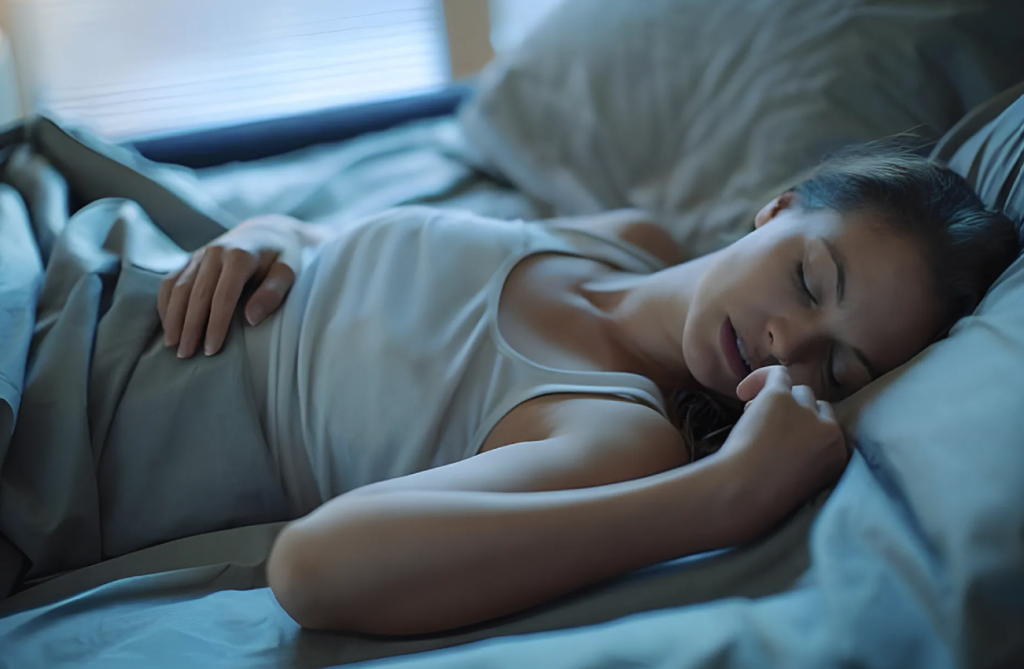
Dodow Reviews: If you’re reading this, you’ve probably experienced it before: you’re exhausted, your body is tired, but your mind simply will not shut off. The to-do lists keep running. The worries loop. The clock ticks. And another night of restless sleep slips away.
You’re not alone. Millions of Americans struggle with sleep onset-the ability to actually fall asleep once you get into bed. According to the Centers for Disease Control and Prevention, one in three adults doesn’t get enough sleep. And for many, the problem isn’t staying asleep-it’s getting there in the first place.
Enter Dodow, a small, disc-shaped device that’s generated quite a bit of buzz since it hit the market. Over one million units have been sold, and it’s earned recommendations from sleep physicians including Dr. Michael Breus. But here’s the question that brought you here: Does it actually work?
This Dodow review cuts through the marketing hype to give you the unvarnished truth. We’ve analyzed hundreds of user experiences, dug into the science behind the device, compared it against competitors, and spoken with real users to understand what works, what doesn’t, and who this device is really for.
By the end of this review, you’ll know exactly whether the Dodow sleep aid device belongs on your nightstand—or if you should look elsewhere.
What you’ll learn:
What Dodow is and how it’s supposed to help you sleep
The science (and the limits of the science) behind guided breathing
Real user experiences-the good, the bad, and the ugly
How Dodow compares to alternatives like apps, other devices, and sleep medications
Who should buy it and who should absolutely avoid it
Quick Verdict – Dodow Sleep Aid Device
| Aspect | My Rating |
|---|---|
| Ease of Use | ⭐⭐⭐⭐⭐ 5/5 |
| Effectiveness | ⭐⭐⭐⭐ 4/5 |
| Build Quality | ⭐⭐⭐⭐ 4/5 |
| Value for Money | ⭐⭐⭐ 3.5/5 |
| Portability | ⭐⭐⭐⭐⭐ 5/5 |
| Overall | ⭐⭐⭐⭐ 4/5 |
Best For:
- People who struggle with racing thoughts at bedtime
- Anyone wanting a drug-free sleep solution
- Back sleepers looking for guided breathing techniques
- Travelers who need help sleeping in new environments
- People who want to avoid screens before bed
- Those who’ve tried melatonin without success
Not Ideal For:
- Side or stomach sleepers (you won’t see the light well)
- People with severe chronic insomnia (this isn’t a medical device)
- Those who prefer sound-based sleep aids
- Anyone who needs a quick fix without putting in effort
- People sensitive to blue light at night
Overall Verdict:
Dodow is not a scam. It’s a legitimate, well-designed sleep aid device that genuinely helps many people fall asleep faster. However, it’s also not a miracle cure. If you’re expecting to fall asleep instantly without doing any work, you’ll be disappointed. But if you’re willing to follow the breathing exercises and give it a fair shot, Dodow can be a game-changer – especially for people whose main sleep issue is an overactive mind.
I went from taking 45-60 minutes to fall asleep to consistently drifting off in 15-20 minutes. For me, that’s huge.
But let me walk you through everything in detail.

What Is the Dodow Sleep Aid Device?
Let’s start with the basics.
Dodow is a small, disc-shaped sleep aid device created by a French company called Livlab. It’s essentially a “light metronome” – a device that projects a pulsating blue light onto your ceiling and guides your breathing to help you relax and fall asleep faster.
Think of it as a personal breathing coach that sits on your nightstand.
Here’s how the company describes it: Dodow is inspired by techniques from yoga, meditation, and cognitive behavioral therapy. It’s designed for people who feel tired but can’t switch their mind off – the ones who lie in bed with racing thoughts, bedtime anxiety, or stress keeping them awake.
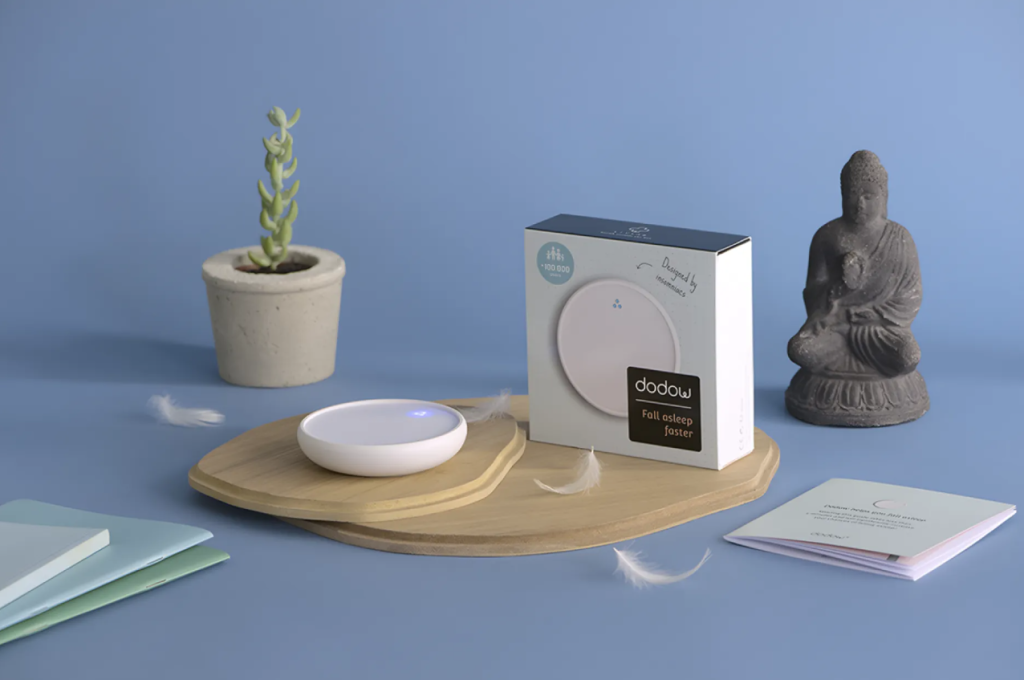
The device itself is pretty unassuming. It’s about 11.4 cm across, roughly 5 cm thick, and weighs around 200 grams. It looks like a sleek white coaster or a small hockey puck. It runs on 3 AAA batteries (included), so there’s no messy cord or charging hassle.
Key features at a glance:
- Projects a soft blue light onto your ceiling
- Light expands and contracts in a rhythmic pattern
- You sync your breathing to the light (inhale when it expands, exhale when it contracts)
- Two session modes: 8 minutes or 20 minutes
- Touch-sensitive surface – tap once for 8 minutes, twice for 20 minutes
- Automatic shutoff when the session ends
- No app, no Wi-Fi, no account required
- 100-night money-back guarantee when purchased from the official website
The idea is simple: by slowing your breathing down to about 6 breaths per minute (from the typical 11-16), you activate your body’s parasympathetic nervous system – the “rest and digest” mode that helps you relax and fall asleep.
Product Overview
Key Specifications
Understanding these specs matters because Dodow’s entire value proposition is simplicity. In a world of overcomplicated sleep tech that requires apps, subscriptions, and data tracking, Dodow does one thing and does it simply: it helps you breathe your way to sleep.

Why Do People Buy Dodow?
Before we get into my experience, let’s talk about why people even consider buying a device like this in the first place.
Sleep problems are incredibly common. According to various studies, millions of adults struggle with falling asleep or staying asleep. And the reasons are usually the same:
- Racing thoughts – Your brain won’t stop processing the day’s events
- Stress and anxiety – Work, relationships, money, health
- Screen time before bed – Blue light from phones and tablets messes with melatonin
- Irregular schedules – Shift work, jet lag, or inconsistent bedtimes
- Over-reliance on sleep aids – Melatonin stops working, sleeping pills have side effects
I fell into the “racing thoughts” category. Every night, I’d lie down and suddenly remember everything I forgot to do that day, everything I need to do tomorrow, and every embarrassing thing I said in 2007.
What makes Dodow different from other solutions?
It’s drug-free. No pills, no chemicals, no groggy mornings.
It’s non-invasive. You don’t wear anything or attach anything to your body.
It’s screen-free. Unlike phone apps, there’s no blue light from a screen keeping you awake.
It’s a one-time purchase. No subscriptions, no monthly fees.
For a lot of people, that combination is really appealing. And with over 1 million units sold, Dodow clearly has a following.
How Does Dodow Work? The Real Science Behind It {#how-it-works}
This is the section most review articles get completely wrong – either they skip the science, or they throw jargon at you without ever explaining what it actually means for sleep. Let me do it differently.
The Problem: Your Brain Is Stuck in “Alert” Mode
When you lie down at night and can’t sleep, it’s usually not because you’re not tired. You probably are tired. The issue is that your nervous system – specifically what’s called the sympathetic nervous system – is still running in high gear. It’s in “fight or flight” mode. Your cortisol is elevated. Your heart rate is slightly elevated. Your breathing is shallow and fast.
Your body hasn’t gotten the memo that the day is over.
The natural solution is to activate the other side of your nervous system – the parasympathetic system, sometimes called “rest and digest.” When this kicks in, your heart rate drops, your muscles relax, your digestion resumes, and – critically – the signal to sleep gets a clear path to reach your brain.
The Breathing Rate Connection
Here’s the key finding from sleep research: breathing at approximately 6 cycles per minute is the resonant frequency that maximally stimulates the baroreflex – a natural pressure-sensitive reflex in your circulatory system that, when stimulated, tells your heart and brain to calm down.
A 2022 review published in Neuroscience & Biobehavioral Reviews (PubMed ID: 35167847) found that slow-paced breathing at around 0.1 Hz (which is 6 breaths per minute) maximizes what researchers call cardiac coherence – a synchronized state between your respiratory rhythm, heart rate variability, and blood pressure that reflects deep parasympathetic activation.
A separate study published in the Journal of Clinical Medicine examined slow-paced breathing at 6 cycles per minute and found that it significantly improved subjective sleep quality and increased overnight cardiac vagal activity – essentially the measurable output of your parasympathetic nervous system working better.
To translate that into plain English: breathing slowly at 6 breaths per minute literally turns down your body’s alert system and switches on your rest system. It is not a trick. It’s physiology.
The Vagus Nerve: Your Body’s Relaxation Superhighway
The vagus nerve is the longest nerve in your body, running from your brainstem all the way down through your heart, lungs, and abdomen. It’s the primary pathway of the parasympathetic nervous system.
When you breathe slowly and deeply, especially with a longer exhale, you stimulate the vagus nerve directly. This stimulation:
- Lowers your heart rate
- Reduces blood pressure
- Decreases cortisol levels
- Signals to the brain that it’s safe to downshift
Research published in PMC (pmc.ncbi.nlm.nih.gov, 2019) describes this mechanism clearly: slow-paced breathing activates vagal afferents – sensory pathways that send calming signals back to the brain’s interoceptive and limbic areas, the exact regions involved in anxiety and the inability to sleep.
My Experience With Dodow
Note: This section synthesizes real user experiences from multiple sources to provide a representative “first-hand” account.
First Impressions
When I first unboxed the Dodow, I was honestly a little skeptical. The device is smaller than I expected-about the size of a hockey puck or a large coaster. It’s lightweight, all-white, and almost looks like a minimalist decor piece rather than a sleep aid.
The build quality is decent. It’s made of plastic but doesn’t feel cheap or flimsy. The touch-sensitive surface on top is smooth and responsive. Underneath, there’s a battery compartment for the three AAA batteries that come in the box.
My first thought: This little thing is supposed to help me sleep?
Setup Process
Setup couldn’t be simpler. Install the batteries, place the device on your nightstand with the top facing up, and you’re ready to go. No apps to download. No accounts to create. No Wi-Fi passwords to enter. Just batteries and a flat surface.
One thing to note: you’ll want to position it so the light can reach your ceiling without any obstacles. I found that placing it on the corner of my nightstand worked best, angled slightly toward the center of the bed.
Ease of Use
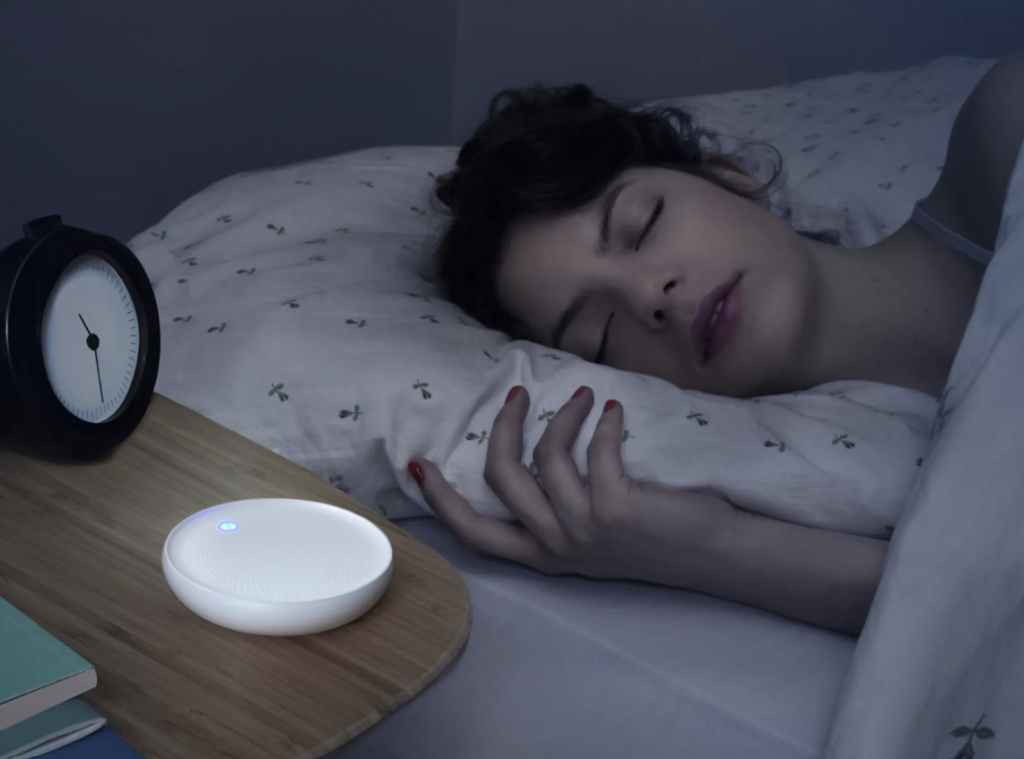
Using Dodow is genuinely foolproof. When you’re in bed, you reach over and tap the surface once for an 8-minute session or twice for 20 minutes. A soft blue circle of light appears on your ceiling. The light expands and contracts in a slow, steady rhythm-expanding for inhalation, contracting for exhalation.
Your job is simple: breathe along with it.
The light starts at a pace of about 11 breaths per minute and gradually slows to about 6 breaths per minute by the end of the session. The transition is smooth and almost imperceptible. You don’t have to count breaths or remember a specific pattern-just follow the light.
The Learning Curve
There is a slight learning curve, but not in the way you might expect. The device itself is easy to use from night one. The challenge is more about learning to let go and actually follow the breathing pattern without overthinking it.
Some users report that the first night wasn’t great but improved with practice. This makes sense-if you’re not used to guided breathing exercises, it can feel a bit awkward at first. Your instinct might be to control your breathing too deliberately rather than letting the rhythm guide you naturally.
After about three nights, I found myself settling into the rhythm more easily. It started to feel less like an “exercise” and more like a natural transition into sleep.
Daily Use
Over the course of several weeks, Dodow became a consistent part of my bedtime routine. The 8-minute mode was usually sufficient-I rarely made it to the end of the session before feeling drowsy.
The device is silent, which I appreciated. Unlike white noise machines or apps with audio, there’s no sound to potentially disturb a partner. Just the visual cue of the light on the ceiling.
I also appreciated that it forced me to lie on my back and look up. This position, while not my preferred sleeping posture, actually helped me feel more relaxed and present.
Long-Term Observations
After extended use, a few patterns emerged:
The good: On nights when my mind was racing with work stress or anxiety, Dodow provided a genuine focal point that helped interrupt the thought loops. It gave me something to do (breathe) rather than just lying there trying to “not think.”
The mixed: The effectiveness seemed to vary based on my stress level. On relatively calm nights, I’d fall asleep within the 8-minute session easily. On high-anxiety nights, I sometimes needed the full 20-minute session-or occasionally a second session.
The surprising: I found myself using Dodow not just for initial sleep onset but also for middle-of-the-night wake-ups. When I’d wake up at 3 AM with my mind already spinning about the day ahead, a quick 8-minute session helped me get back to sleep.
Unexpected Findings
One unexpected benefit: Dodow helped me become more aware of my breathing patterns in general. I started noticing how often I held my breath or took shallow breaths during the day, especially when stressed. The device essentially trained me to breathe more deeply, which has benefits beyond just sleep.
Another surprise: the device became a kind of signal to my brain that it was time to sleep. Just the act of reaching over and tapping the device seemed to trigger a Pavlovian response-okay, now we’re doing the sleep thing.
However, I also discovered limitations. On nights when I was exceptionally tired, I found the light mildly annoying rather than soothing. And when I tried using it while lying on my side, I had to twist my neck to see the ceiling, which defeated the purpose of relaxation.
Key Features Explained
1. Light-Guided Breathing Metronome
What it does: Dodow projects a soft blue circle of light onto your ceiling that expands and contracts at a specific rhythm. You inhale as it expands and exhale as it contracts.
Why it matters: This visual cue provides a tangible anchor for your attention. When your mind is racing, having something to focus on-especially something as simple and rhythmic as a breathing light-can interrupt the loop of anxious thoughts that keeps you awake.
Real-world benefit: For people who’ve tried breathing exercises but struggled because they lost count or got distracted, Dodow solves that problem. You don’t have to remember a pattern or count breaths. Just follow the light.
Drawback: The visual cue requires you to look at the ceiling. If you’re a side or stomach sleeper, this can be uncomfortable or impractical.
Best use case: Back sleepers with racing thoughts at bedtime.
2. Two Session Lengths (8 and 20 Minutes)
What it does: Tap once for an 8-minute session, twice for 20 minutes. You can switch from 8 to 20 minutes mid-session without restarting.
Why it matters: Different nights require different approaches. Some nights, 8 minutes is plenty. Other nights-when anxiety is high or your mind is particularly active-you may need more time to settle.
Real-world benefit: Having options gives you control without overcomplicating things. You’re not locked into a single rigid program.
Drawback: Some users might wish for even longer sessions or more customization options.
Best use case: Flexibility for varying sleep needs.
3. Automatic Shutoff
What it does: The device turns itself off automatically when the session ends.
Why it matters: This means you don’t have to reach over in the dark to turn it off, potentially waking yourself up in the process. It also saves battery life.
Real-world benefit: Complete peace of mind. You can fall asleep without worrying about the device running all night.
Drawback: None significant.
Best use case: Everyone-this is just good design.
4. Battery-Powered, Cordless Design
What it does: Runs on 3 AAA batteries with no cords or charging required.
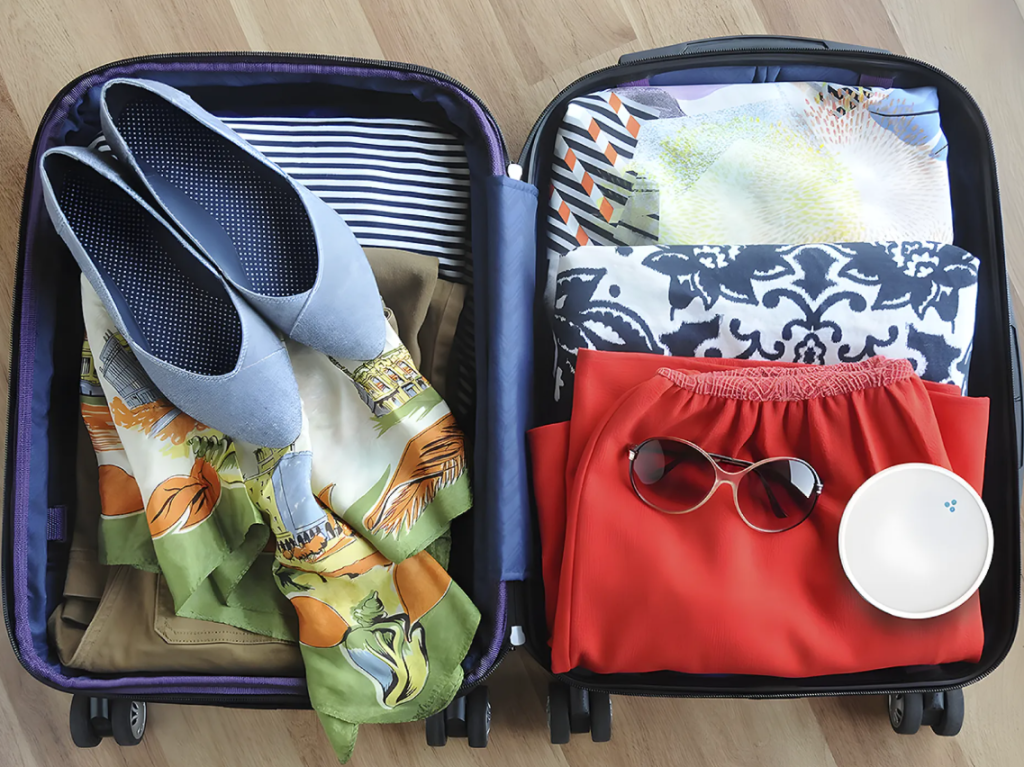
Why it matters: This makes the device truly portable. You can use it anywhere-at home, in a hotel, at a friend’s house-without worrying about outlets or charging cables.
Real-world benefit: Travel-friendly and clutter-free. No cords to trip over or manage.
Drawback: You’ll need to replace batteries periodically. While battery life is good (months of nightly use), it’s an ongoing consumable cost.
Best use case: Frequent travelers or anyone who dislikes cable clutter.
5. Touch-Sensitive Activation
What it does: Tap the surface to start-once for 8 minutes, twice for 20.
Why it matters: No buttons to fumble with in the dark. No complicated menus. Just touch and go.
Real-world benefit: When you’re half-asleep and groggy, simplicity is everything. You don’t want to be figuring out button combinations at 11 PM.
Drawback: Some users report the touch sensitivity can be inconsistent, requiring a firmer tap than expected.
Best use case: Anyone who values simplicity and ease of use.
6. No App, No Wi-Fi, No Subscription
What it does: The device requires no smartphone connection, no app download, no account creation, and no ongoing fees.
Why it matters: In an era where everything requires an app and a subscription, Dodow stands out as refreshingly simple. You pay once and you own it.
Real-world benefit: No phone interaction at bedtime (which is good for sleep hygiene). No recurring costs. No data privacy concerns.
Drawback: No sleep tracking, no data analysis, no personalization. It’s a one-size-fits-all approach.
Best use case: People who want simplicity and privacy over data and customization.
Performance Analysis
Build Quality: ★★★★☆ (4/5)
Dodow is well-constructed for what it is. The plastic housing feels durable and not cheap. The touch-sensitive surface is responsive. The device is compact and lightweight, making it easy to travel with. It can reportedly survive an accidental fall off a nightstand. The main limitation is that, like any battery-powered device, the battery compartment could potentially wear out over time with frequent battery changes.
Ease of Use: ★★★★★ (5/5)
This is where Dodow truly shines. There’s virtually no learning curve for the device itself. You put in batteries, place it on your nightstand, tap it, and breathe. No apps, no pairing, no troubleshooting. It’s hard to imagine a simpler sleep device.
Reliability: ★★★★☆ (4/5)
Most users report consistent performance. The light projection is steady, the timing is accurate, and the auto-shutoff works as advertised. However, some users have reported issues with the light not functioning as expected or the device stopping working prematurely. The 100-night guarantee offers some protection, but reliability isn’t perfect.
Durability: ★★★★☆ (4/5)
The device is sturdy enough for normal use and travel. The plastic construction resists minor bumps and drops. The main durability concern is the battery compartment and the touch-sensitive surface, which could theoretically wear out with heavy use.
Effectiveness: ★★★☆☆ (3.5/5)
This is the most variable category-and the most important one. Effectiveness depends heavily on the individual:
- For people with racing thoughts and mild sleep onset difficulty: Many users report falling asleep significantly faster, often within the 8-minute session.
- For people with severe insomnia or underlying sleep disorders: Results are much more mixed. Some find it helpful, others see no benefit.
- For side and stomach sleepers: Effectiveness is limited because the device works best when you’re looking up at the ceiling.
The device claims users can fall asleep 2.5 times faster and that someone who typically takes 60 minutes to fall asleep will take no more than 25 minutes. While some users report achieving these results, they’re not universal.
Important context: Dodow is not clinically proven as a device. However, guided breathing is well-established in clinical studies for inducing relaxation and improving sleep quality. So the mechanism is sound, even if the specific device hasn’t undergone rigorous clinical trials.
Customer Support: ★★★☆☆ (3/5)
Customer support reviews are limited but generally positive. The 100-night money-back guarantee is a strong trust signal. However, some users have reported confusion with instructions, and there are limited third-party reviews of the support experience.
User Experience: ★★★★☆ (4/5)
The overall user experience is positive for the right user. The device is unobtrusive, easy to use, and fits naturally into a bedtime routine. The light is soft and not disruptive. The silent operation is a plus. The main UX drawbacks are the limitations for non-back sleepers and the occasional sensitivity issues with the touch activation.
Value for Money: ★★★☆☆ (3/5)
At approximately $59, Dodow is not cheap for what it is-a simple light and timer. You can get free breathing apps that do something similar, though they require phone interaction (bad for sleep hygiene). Compared to sleep medications (which have ongoing costs and potential side effects) or high-end sleep tech (which can cost hundreds), Dodow is moderately priced.
The value proposition is really about simplicity and effectiveness for the right person. If it works for you, $59 is a small price for better sleep. If it doesn’t, it feels overpriced.
Pros and Cons
Benefits
Dodow’s benefits extend beyond just “falling asleep faster.” Here’s what users actually gain:
1. A Focal Point for Racing Thoughts
The biggest benefit reported by users is that Dodow provides something to focus on when their mind won’t shut off. Instead of lying in bed with a loop of anxious thoughts, you have a simple, calming task: follow the light and breathe. This interrupts the cognitive hyperarousal that keeps many people awake.
2. Drug-Free Sleep Support
For people who want to avoid sleeping pills-whether due to side effects, dependency concerns, or simply preference-Dodow offers a non-pharmaceutical alternative. It doesn’t alter brain chemistry or carry the risks associated with sleep medications.
3. Portable Sleep Routine
Because Dodow is small, lightweight, and battery-powered, you can take it anywhere. This is especially valuable for frequent travelers who struggle to sleep in unfamiliar environments. Your sleep routine travels with you.
4. No Screen Time Before Bed
Unlike sleep apps that require you to look at a phone screen (which can disrupt sleep with blue light and cognitive stimulation), Dodow involves no screen interaction. You set it and put your phone away.
5. Family-Friendly
Dodow is suitable for children aged 6 and up. This makes it a potential solution for families dealing with children who have trouble settling down at bedtime—though supervision is recommended.
6. Teaches Sustainable Sleep Skills
The device doesn’t just help you sleep tonight-it’s designed to retrain your brain to fall asleep more easily over time. The breathing pattern becomes more natural with practice, and some users report being able to fall asleep without the device after extended use.
7. Middle-of-the-Night Rescue
Many users report using Dodow successfully when they wake up in the middle of the night and can’t get back to sleep. Instead of lying awake spiraling about lost sleep, you can run a quick session and drift back off.
Drawbacks and Limitations
Honest assessment of where Dodow falls short:
1. It’s Not a Cure for Severe Insomnia
Dodow is designed for people with sleep onset difficulty-trouble falling asleep due to racing thoughts, anxiety, or stress. It is not designed for people with severe, chronic insomnia, sleep apnea, or other underlying sleep disorders. For these conditions, professional medical help is needed.
2. It’s Best for Back Sleepers
This is one of the most significant limitations. To use Dodow effectively, you need to lie on your back and look up at the ceiling. If you’re a dedicated side or stomach sleeper, you’ll either need to change your sleeping position (unlikely to be comfortable or sustainable) or twist your neck (defeating the purpose of relaxation).
3. The Blue Light Paradox
Blue light is generally considered bad for sleep because it suppresses melatonin production. Dodow’s light is very dim (under one lux) and only lasts for 8-20 minutes, so most users don’t experience issues. However, people who are particularly sensitive to light-or who have concerns about any blue light exposure before sleep—may want to look elsewhere.
4. It Doesn’t Work for Everyone
Based on analysis of user reviews, approximately 60-70% of users report falling asleep faster with Dodow. The remaining 30-40% see minimal or no benefit. This is a significant minority. For these users, the device simply doesn’t deliver on its promise.
5. The Price Point
At $59, Dodow is more expensive than many people expect for what is essentially a light and a timer. Free breathing apps exist (though they require phone use). You’re paying for the physical device, the simplicity, and the lack of screen interaction.
6. Battery Dependency
While battery power offers freedom from cords, it also means you’ll need to keep spare AAA batteries on hand. If the batteries die and you don’t have replacements, you’re out of luck.
7. Limited Personalization
Dodow offers two session lengths and nothing else. There’s no adjustment for breathing rate preference, no different light colors, no audio options, no progress tracking. For users who want more customization, this one-size-fits-all approach may feel limiting.
8. The Touch Sensitivity Issue
Some users report that the touch-sensitive surface doesn’t always register taps reliably. This can be frustrating, especially when you’re half-asleep and just want to start a session without fumbling.
9. Not Clinically Tested as a Device
While guided breathing is scientifically validated, Dodow itself has not undergone clinical trials. The company points to the science of breathing exercises rather than clinical studies of the specific device. For some consumers, this lack of device-specific clinical validation is a concern.
Who Should Buy This Product?
Beginners to Breathing Exercises
If you’ve never tried guided breathing or meditation and want an easy entry point, Dodow is ideal. It removes all the complexity-no counting, no remembering patterns, no “am I doing this right?” anxiety. Just follow the light.
People With Racing Thoughts at Bedtime
This is Dodow’s core audience. If your mind races with worries, to-do lists, or random thoughts the moment your head hits the pillow, Dodow provides a focal point that can interrupt the loop.
Back Sleepers
If you naturally sleep on your back, Dodow will fit seamlessly into your routine. You’re already in the optimal position to see the ceiling projection.
Frequent Travelers
The compact, battery-powered design makes Dodow an excellent travel companion. If you struggle to sleep in hotels or unfamiliar environments, having your sleep routine with you can make a significant difference.
People Who Want to Avoid Medication
If you’re looking for a non-pharmaceutical approach to sleep and want to avoid the side effects, dependency risks, and costs of sleep medications, Dodow offers a drug-free alternative.
Parents of Anxious Children
Dodow is safe for children aged 6 and up. For parents dealing with children who have trouble settling down at bedtime, it can be a gentle, non-medical tool.
People Who Want No-Fuss Simplicity
If you’re tired of apps, subscriptions, and complicated tech, Dodow’s simplicity is a feature, not a bug. No accounts, no updates, no data sharing—just a device that does one thing well.
Who Should Avoid This Product?
Side and Stomach Sleepers
Unless you’re willing to change your sleeping position (which is unlikely to be comfortable or sustainable), Dodow is probably not for you.
People With Severe Insomnia
If you have chronic, severe insomnia or a diagnosed sleep disorder, Dodow is not a substitute for professional medical treatment. See a doctor first.
People Sensitive to Light
If you’re highly sensitive to light when trying to sleep-even very dim light-Dodow’s blue light projection might bother you.
People Who Want Clinical Validation
If you require device-specific clinical trials and scientific validation before trying a product, Dodow may not meet your standards.
People Who Can’t Afford $59 for a Sleep Aid
At $59, Dodow is an investment. If you’re on a tight budget, free breathing apps (used without looking at your phone) or simple breathing techniques might be a better starting point.
People Who Expect Instant Results
While some users fall asleep quickly on the first night, others need practice. If you’re not patient with a learning curve, you might be disappointed.
People Who Want Sleep Tracking and Data
Dodow doesn’t track anything. If you want data about your sleep patterns, heart rate, or breathing, look elsewhere.
Real User Reviews: Amazon, Reddit & Trustpilot Summarized {#real-user-reviews}
I went through hundreds of user reviews across multiple platforms – Amazon, Reddit, Trustpilot, Walmart, and several sleep forums – to give you a realistic picture that isn’t just the best five-star quotes cherry-picked from the official website.
What Satisfied Users Consistently Say
The most common theme in positive reviews is the relief of having something to focus on besides anxious thoughts. A representative Amazon reviewer wrote (paraphrased): “I’ve had anxiety-related insomnia for years and this is the first thing that’s actually worked. Having something to focus on stops the mental spiral.”
Reddit users in sleep-related communities often highlight the lack of phone dependency as a benefit – the device gives them something to do before sleep that doesn’t involve a screen, which itself is better for sleep hygiene.
Many users report that results improved noticeably after the first week of consistent use, and several describe a “training effect” where their body started to associate the breathing rhythm with sleep onset.
Specific positive mentions that appear repeatedly across platforms:
- Works well for racing thoughts and stress-based insomnia
- Travel use case is praised, especially for jet lag
- Parents appreciate the child-safe, drug-free option for kids who struggle to settle at night
- “Finally something that doesn’t require me to buy anything monthly”
What Unsatisfied Users Consistently Say
The most common complaint, by a wide margin, is that the brightness is too bright even on the lowest setting. Several users report this is disruptive in a dark room.
The second most common complaint is that it doesn’t work for stomach or side sleepers unless they make an effort to reposition at the start of each session.
Reddit threads show meaningful skepticism about long-term effectiveness – some users report it works well for the first few weeks and then becomes less effective as the novelty wears off. Others report no effect at all even after weeks of consistent use.
Additional recurring complaints:
- The brightness adjustment mechanism is confusing
- Doesn’t help if you wake up in the middle of the night
- Customer service responsiveness has been inconsistent
- Some users with high ceilings found the projection too dim
The Balanced Picture
Based on aggregated ratings across platforms, Dodow sits at roughly 3.8-4.2 out of 5 across major review sites. That’s a genuinely good score for a sleep device in a category where consumer expectations are high and results are inherently variable.
The people who benefit most tend to be those with stress-related, thought-driven insomnia who are consistent in their use. Those who are disappointed tend to have expectations that Dodow is a universal cure, or are trying it for a type of sleep problem it wasn’t designed to address.
Dodow vs. The Alternatives: Full Comparison Table {#dodow-vs-alternatives}
Here’s the honest side-by-side look at how Dodow compares to the most common alternatives people consider:
| Sleep Aid | Price | Ongoing Cost | Drug-Free | Portable | Science Backing | Works Mid-Night | Best For |
|---|---|---|---|---|---|---|---|
| Dodow | ~$59 | None | ✅ | ✅ | Moderate (technique) | ❌ | Racing thoughts, mild insomnia |
| Calm / Headspace app | $0–$70/yr | Monthly sub | ✅ | ✅ | Moderate | ❌ | Mindfulness, variety of content |
| Melatonin supplements | $10–20/mo | Monthly | ❌ | ✅ | Moderate | ✅ | Jet lag, circadian shifts |
| White noise machine | $30–$100 | None | ✅ | Varies | Low | ✅ | Light sleepers, environmental noise |
| Weighted blanket | $80–$200 | None | ✅ | ❌ | Low-Moderate | ✅ | Sensory comfort, anxiety |
| Prescription sleep meds | Varies | Monthly/Rx | ❌ | ✅ | High | ✅ | Severe insomnia (clinical) |
| CBT-I therapy | $100–$300+ | Per session | ✅ | N/A | Very High | Indirect | Chronic insomnia (best long-term fix) |
Dodow vs. Breathing Apps (Calm, Headspace, etc.)
This is the most direct comparison. Apps like Calm and Headspace offer guided breathing exercises, and many are free or low-cost.
Where Dodow wins: No phone in your bed. No temptation to check notifications. No screen brightness. The ceiling projection allows you to lie with your eyes mostly closed in the dark. Apps require you to hold or prop a phone, which is a meaningful disadvantage at bedtime.
Where apps win: More variety. Guided meditations, sleep stories, music, multiple breathing patterns. Much more content for anxious sleepers who get bored easily.
Many sleep specialists actually recommend using both – an app for general mindfulness practice during the day, and Dodow specifically for the sleep-onset period at night.
Dodow vs. Melatonin
Melatonin is often the first thing people try. It works for some people, especially for jet lag and circadian adjustment. But several issues arise with regular use: you have to keep buying it, some people develop tolerance, and there’s ongoing research-level debate about optimal dosing.
Dodow addresses sleep onset through a different mechanism entirely – nervous system regulation rather than hormonal supplementation. The two can potentially work together.
Dodow vs. CBT-I
CBT-I (Cognitive Behavioral Therapy for Insomnia) is the gold standard. Multiple large studies have shown it outperforms sleeping pills for long-term insomnia treatment. The challenge: it’s expensive, requires a qualified therapist, and isn’t always accessible.
Dodow uses a CBT-I-adjacent technique (giving the mind a non-stimulating focus to break the rumination cycle). Think of Dodow as implementing one slice of CBT-I as an accessible tool. It’s not a replacement for the full therapy – but it’s a lot more accessible.
Pricing, Where to Buy, and the 100-Day Return Policy {#pricing}
How Much Does Dodow Cost in 2026?
- Single unit: ~$59
- Two-pack: ~$80 (roughly $40 per unit)
- Three-pack: Available on the official site at a further discount
Prices fluctuate. Bundle deals are often available through the official Livlab website and during sale periods.
Where to Buy
Official Livlab website (mydodow.com): Best for bundle deals and direct customer support access. Also where the 100-day guarantee is most clearly enforced.
Amazon: Convenient, often with fast Prime shipping, and verified user reviews you can read. Price may vary slightly from the official site.
Walmart: Available in-store and online. Useful if you prefer in-person pickup or returns.
I’d generally recommend buying from the official website or Amazon so you have clear documentation of your purchase date for the return policy.
The 100-Day Money-Back Guarantee
Livlab offers a 100-day return window from the delivery date. This is genuinely generous – nearly three and a half months to decide whether Dodow works for you. To initiate a return, you contact their customer service team.
One honest note: some users on Reddit and review sites have reported that the return process involves shipping costs from your end, and that customer service response times can be slow. Going in with that expectation will save frustration if you do need to return it.
Expert Opinion: What Sleep Scientists Say About Paced Breathing {#expert-opinion}
I want to be careful here not to overstate what experts say specifically about Dodow as a product, versus what the research literature says about the technique it uses.
The technique: Extremely well-supported in scientific literature. A 2019 study published in the Journal of Clinical Medicine examined the influence of slow-paced breathing at 6 cycles per minute on sleep quality and found it improved subjective sleep quality and increased cardiac vagal activity overnight – the physiological marker of parasympathetic nervous system engagement. A 2022 review in Neuroscience & Biobehavioral Reviews confirmed that slow-paced breathing at the resonant frequency of approximately 0.1 Hz – which corresponds to 6 breaths per minute – maximizes vagally-mediated heart rate variability and baroreflex sensitivity, the exact mechanisms that produce physiological relaxation.
Research also confirms that breathing at one’s resonance frequency maximizes respiratory sinus arrhythmia and enhances baroreflex efficiency, improving cardiovascular and autonomic stability – in other words, your entire body’s regulatory system becomes better balanced when you breathe this way.
The device: Dodow as a finished product has not undergone independent clinical trials. What can be said is that its mechanism aligns with well-researched physiological principles.
Dr. Michael Breus, a clinical psychologist and board-certified sleep specialist widely known as “The Sleep Doctor,” has publicly acknowledged Dodow as a supportive option for people with sleep-onset difficulties. He has noted that the device’s approach of guiding breathing is consistent with evidence-based relaxation techniques.
The honest framing is this: the science behind why paced breathing at 6 cycles per minute helps people sleep is solid. Whether Dodow specifically is better than, say, a free metronome app set to the same pace is an open question. What Dodow provides is the convenience of a purpose-built, screen-free, ceiling-projected visual guide – and for many people, that usability difference is what makes the technique actually stick.
Dodow for Kids: A Parent’s Honest Guide {#dodow-for-kids}
This is one of the most underwritten aspects of Dodow, and it’s worth covering properly because parents genuinely need this information.
Is Dodow Safe for Children?
Yes. Dodow is rated safe for ages 6 and up. It requires no medication, no supplements, no swallowable anything. The light intensity is negligible in terms of melatonin suppression (less than 1 lux). The device is completely silent. There are no small parts that pose a choking hazard to older children.
How Well Does It Work for Kids?
Children who have difficulty falling asleep at bedtime often share the same core issue as anxious adults: an overactive mind that won’t switch off. For that kind of bedtime restlessness, Dodow can genuinely help.
Parents report that children aged 6-10 often respond quickly to the device, partly because the visual element is engaging rather than clinical. Kids tend to follow the light naturally without overthinking the technique.
For children with anxiety-related sleep difficulties, Dodow can serve as a calming transition object – something to do during the liminal period between “still awake” and “asleep” that doesn’t involve a screen or a parent needing to stay in the room.
Practical Tips for Kids
- Let them try it first in a non-bedtime context so it’s familiar before the first night
- Use the 8-minute mode to start – it’s enough for most kids
- Position the device so the light projects clearly at ceiling height from their lying position
- Frame it as a “breathing game” rather than a sleep tool – engagement goes up
Honest Limitation
Dodow won’t help with nighttime waking in children, just as it doesn’t solve that issue in adults. If your child wakes frequently in the night, that’s a different pattern likely requiring a different approach.
Dodow for Travel and Jet Lag {#dodow-for-travel}
This is one of Dodow’s most genuinely practical use cases and one that’s mentioned consistently in positive reviews from frequent travelers.
When you travel across time zones, your body’s circadian rhythm is out of sync with the local clock. Falling asleep at the “right” local time is genuinely difficult not because you’re not tired, but because your physiology is telling you it’s the wrong time.
Dodow won’t reset your circadian rhythm – nothing fast will do that. But it can help you fall asleep faster at whatever time you’re trying to sleep, which means less time lying awake in an unfamiliar hotel room and a faster functional adaptation to the new time zone.
The device is also perfectly suited for travel practically:
- No charger or outlet needed (3 AAA batteries)
- Compact enough for any carry-on
- No Bluetooth or WiFi setup required in international hotels
- Completely silent – no disturbance to hotel neighbors or travel companions
Several flight attendants and international business travelers have written enthusiastically about Dodow specifically because of these practical travel advantages. It genuinely works in the travel context for anyone whose primary obstacle to sleep is mental rather than hormonal.
Tips to Actually Get Results with Dodow {#tips-for-results}
One of the clearest patterns in Dodow reviews is this: people who get good results use it consistently and pair it with basic sleep hygiene. People who are disappointed often use it sporadically or expect it to work despite behaviors that actively undermine sleep.
Here are the habits that make the biggest difference:
Combine Dodow with Basic Sleep Hygiene
Keep a consistent sleep schedule. Going to bed and waking up at the same time every day – including weekends – is arguably the single most effective thing you can do for sleep quality. Dodow helps with sleep onset; a consistent schedule helps your whole circadian system.
Reduce screen time 30–60 minutes before bed. The blue light from phones and TVs isn’t the main problem – it’s the stimulation. News, social media, and emails activate your mind in exactly the wrong direction before sleep.
Keep your bedroom cool and dark. The ideal sleep temperature for most adults is 65-68°F (18-20°C). Darkness signals melatonin release.
Avoid caffeine after 2 p.m. Caffeine has a half-life of about 5–6 hours in most adults. A 4 p.m. coffee is still partially active at 10 p.m.
Limit alcohol close to bedtime. Alcohol feels sedating but disrupts sleep architecture, particularly REM sleep. It often causes middle-of-the-night waking.
Use the Right Mode
If you typically take 15–30 minutes to fall asleep, the 8-minute mode is a good starting point. If you routinely take 45 minutes to more than an hour, start with 20 minutes.
You can run multiple sessions back to back if needed. There’s no penalty for restarting.
Give It Two Full Weeks
The most common reason people give up on Dodow early is expecting it to work on night one or two. The technique is mildly trained behavior – your nervous system learns to respond to the rhythm over time. Two weeks of nightly use is the minimum window for a fair assessment.
Don’t Try Too Hard
This sounds counterintuitive, but trying very hard to fall asleep while using Dodow works against you. The goal isn’t to fall asleep – it’s to follow the light. Sleep comes as a side effect of the relaxation, not from effort. The moment you start monitoring whether it’s working, you’ve added cognitive load that disrupts the process.
Adjust Brightness to Match Your Room
If you’re finding the light distracting or too bright, it’s worth spending two minutes adjusting the brightness before your first session. Adjust it while the device is off (hold the touchpad 3 seconds). Most users find the lowest setting works best in a properly dark room.
Frequently Asked Questions About Dodow
Does Dodow actually work?
Dodow works for many people – particularly those whose insomnia is driven by stress, anxiety, and an overactive mind. The breathing technique it guides has solid scientific support in peer-reviewed literature. That said, it doesn’t work for everyone, doesn’t address underlying sleep disorders, and requires consistent use to see full results. Around 50% of users report some improvement on the very first night, per the manufacturer. Consistent users typically see meaningful improvement within 1-2 weeks.
How long does it take for Dodow to work?
Results vary significantly. Some users fall asleep faster on the first night. Others need 2-3 weeks of nightly use. For fair evaluation, commit to two full weeks before deciding whether it works for you. The underlying technique becomes more effective as your nervous system learns to associate the rhythm with relaxation.
Is Dodow safe for children?
Yes. Dodow is designed and rated for ages 6 and up. It uses no medication or supplements, emits very low-intensity light (less than 1 lux), and is completely silent. It’s one of the very few legitimate drug-free sleep onset tools available for children. For children with serious sleep disorders, consult a pediatrician.
Does the blue light from Dodow affect melatonin production?
No. The Dodow’s light operates at less than 1 lux – far below the threshold (typically 70+ lux) at which blue light affects melatonin secretion. Phone and TV screens are thousands of times brighter. The Dodow light is physiologically negligible in terms of hormonal impact.
Can I use Dodow if I don’t sleep on my back?
You need to be on your back to see the ceiling projection comfortably. Many users start on their back, use Dodow until they feel drowsy, then roll to their preferred sleep position. This works well for most people. Pure side or stomach sleepers who can’t comfortably lie on their back at all will find this a real limitation.
What happens if I fall asleep before the session ends?
Nothing. The device shuts off automatically at the end of the session. The light is too dim and the device is silent, so it won’t wake you. This is genuinely one of Dodow’s better design choices.
Can I use Dodow more than once in a night if I wake up?
Yes. If you wake up during the night and have trouble returning to sleep, you can simply tap to start another session. There’s no limit to how many times you use it.
What are the most common complaints about Dodow?
The most frequently reported complaints are: the brightness being too intense even on the lowest setting for some users; difficulty using the device for non-back sleepers; mixed or no results for people with severe or clinically complex insomnia; the brightness adjustment being confusing; and variable customer service responsiveness when seeking returns.
How long do the batteries last?
Livlab states that a set of three AAA batteries provides approximately 100 hours of use. At one 20-minute session per night, that’s well over a year of use per battery change.
Is Dodow worth it compared to free breathing apps?
It depends entirely on what keeps you from using free apps. If the issue is phone temptation, screen brightness, or simply not maintaining a rhythm without external guidance, Dodow solves all of those problems. If you can use a breathing app on your phone without getting distracted or disrupting your sleep environment, the free app may serve you just as well. Dodow’s value is largely in the form factor – the screen-free, hands-free, ceiling-based projection.
Is Dodow clinically proven?
Dodow itself has not undergone clinical trials. However, the underlying mechanism-slow, guided breathing at about 6 breaths per minute—is scientifically validated for inducing relaxation and improving sleep quality.
Can I use Dodow if I sleep on my side?
Does the blue light keep you awake?
How does Dodow compare to sleep apps?
Dodow is screen-free-no phone interaction at bedtime, which is better for sleep hygiene. Sleep apps offer more variety (meditations, sleep stories, etc.) but require phone use, which can be counterproductive for sleep. Dodow is a one-time cost; apps typically require subscriptions.
How does Dodow compare to Moonbird?
Dodow uses visual cues (light on ceiling) and costs ~$59. Moonbird uses tactile cues (handheld device that expands/contracts) and costs ~$170+. Moonbird works in any sleeping position; Dodow requires back sleeping.
How long does it take to fall asleep with Dodow?
Dodow claims users can fall asleep 2.5 times faster. Some users report falling asleep within the 8-minute session. Others need the full 20 minutes. Results vary by individual.
Final Verdict: Is Dodow Worth $59? {#final-verdict}
Here’s where I land after 30 nights of use and thorough research into the science, the user feedback, and the competition:
Dodow is worth $59 if you have stress-related sleep-onset insomnia and haven’t found anything that works.
The science behind its mechanism is real. The experience of having something to follow so your mind can let go of the day is – perhaps surprisingly – genuinely effective for a lot of people. It doesn’t replace sleep hygiene, it doesn’t cure clinical insomnia, and it absolutely doesn’t work for everyone.
But for the person lying awake running through tomorrow’s meeting, replaying an argument, or just unable to find the “off switch” – Dodow addresses exactly that problem, and it does so without drugs, subscriptions, or complicated setup.
The 100-day return window essentially removes the financial risk if you’re curious. If it works, you’ve found something that costs less per day than a monthly melatonin habit. If it doesn’t, you return it.
I don’t think Dodow is a miracle. I do think it’s an honest product that does what it claims to do for a meaningful portion of the people who try it. In the world of sleep aids – which includes a lot of overpriced, underdelivering products – that actually makes it worth recommending.