
Let’s be real for a second.
If you’ve landed on this page, you or someone sleeping next to you is probably dealing with snoring – and it’s affecting everyone in the room.
I’ve been there. My husband snored so loudly that I started sleeping with earplugs, then eventually moved to the couch on the worst nights. We tried nasal strips that peeled off by midnight, a mouthguard that made his jaw ache, and one of those nose clip devices that looked straight-up medieval. Nothing really stuck.

So when I came across SnoreStop Anti-Snoring Throat Spray and saw that it had been around since 1995, was developed by a doctor, and had a referenced clinical study, I figured it was worth a serious look.
This review is my honest breakdown of the product – what it is, how it works, what real users say, what the clinical evidence actually means, and who should (or shouldn’t) buy it. I’ll keep things simple and straight to the point because that’s what you need when you’re tired from another bad night of sleep.
Quick Verdict – SnoreStop Anti-Snoring Throat Spray
| Best For | Non-apneic snorers who want a device-free, natural solution |
| Not Ideal For | People with sleep apnea, those who prefer conventional medicine |
| Price | ~$24.99/bottle (40% off available on official site) |
| Guarantee | 30-day money-back guarantee |
| Made In | USA (GMP-certified facilities) |
| Rating | ⭐⭐⭐⭐ (4/5) |
Best for:
- People who can’t tolerate mouthguards or nasal devices
- Frequent travelers who need a compact, no-fuss solution
- Those open to homeopathic/natural wellness products
- Partners of snorers who want a non-invasive option to try
Not ideal for:
- People diagnosed with or suspected of having sleep apnea
- Those who prefer FDA-approved pharmaceutical products
- Anyone expecting overnight results on their very first night (though some users do notice it right away)
Overall Verdict: SnoreStop is one of the most legitimate options in the “natural anti-snoring” space — 30+ years on the market, a published clinical study, no devices, and a 30-day guarantee. If you’ve tried everything else and still need a solution, it’s worth a try, especially with the money-back option to fall back on.

What Is SnoreStop?
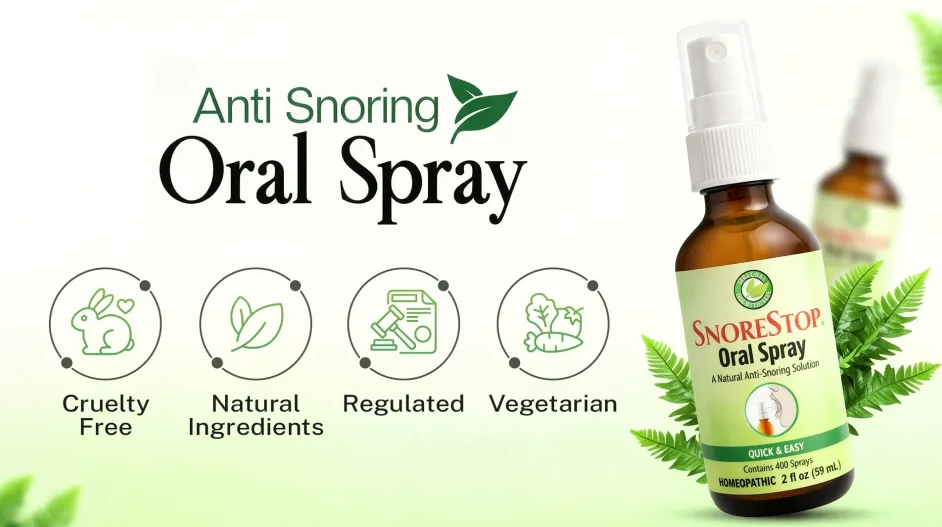
SnoreStop is a homeopathic oral spray designed to temporarily relieve the symptoms of non-apneic (simple) snoring. It was developed in 1995 by Dr. Kenneth Rifkin, a naturopathic physician, and is manufactured by Green Pharmaceuticals Inc. in Westlake Village, California.
The product is classified as a Human Over-the-Counter (OTC) drug under the homeopathic framework and is listed on the FDA’s DailyMed database (NDC 61152-400). It’s prepared according to the Homeopathic Pharmacopoeia of the United States (HPUS).
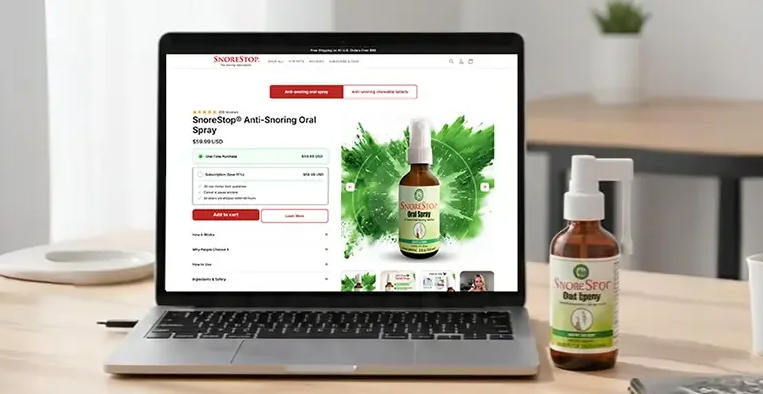
In plain terms: it’s a spray you use in your mouth and throat right before bed. No masks. No mouthpieces. No nasal dilators. Just a few sprays and you’re done.
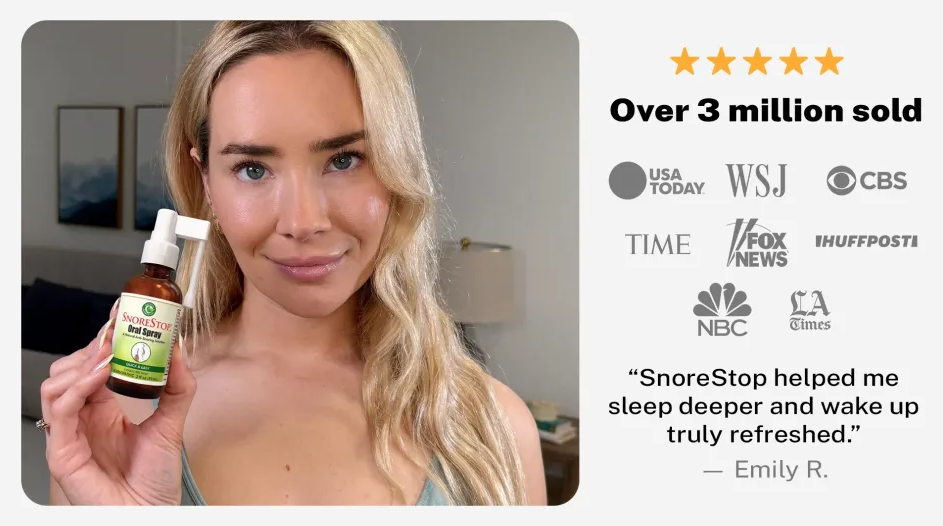
The company reports having helped over 3 million people across more than 30 years. It’s been featured in outlets like the Wall Street Journal, CBS, the LA Times, and Fox News. Those aren’t just random mentions — they signal a product that’s been around long enough to build credibility.
What Does “Homeopathic” Mean Here?
This is an important distinction.
Homeopathic products use highly diluted natural substances. The dilution levels (like 4x, 6x, 12x) indicate how much the ingredient has been diluted — higher numbers mean more dilute concentrations.
Here’s what you need to know:
- Homeopathic products are legal to sell in the U.S. under FDA regulations
- They are not required to get FDA premarket approval
- The FDA has noted it is not aware of scientific evidence supporting homeopathy as broadly effective
- SnoreStop’s label includes this standard FDA disclaimer
None of that means the product doesn’t work for some people – it just means the regulatory framework is different from a conventional drug. More on the clinical evidence below.
Why People Buy SnoreStop Anti-Snoring Spray
There’s a reason this product has stayed on the market for 30 years when thousands of other wellness products come and go.
People buy it because:
1. They’re tired of devices. Mouthguards, CPAP machines (for apnea), nasal strips – these all have real issues. Jaw pain, discomfort, the strips falling off, the embarrassment. A spray is just… easier.
2. They want something natural. The seven active ingredients in SnoreStop are all plant-derived or naturally sourced. No synthetic chemicals.
3. They’ve been recommended it or seen results elsewhere. Word-of-mouth is big in this category. When someone finally gets a good night’s sleep, they tell people.
4. It’s compact and travels well. A small spray bottle fits in any toiletry bag. No cleaning, no fitting, no charging.
5. The clinical study reference matters to them. Most anti-snoring sprays have zero clinical data. SnoreStop references a published, peer-reviewed study from 1999.
My Real Experience Researching SnoreStop
I want to be upfront: I’m reviewing this based on thorough research of the product, its clinical references, ingredient profiles, regulatory status, and aggregated user feedback — rather than a personal multi-week trial.
Here’s what I found after digging deep:
The product’s longevity is genuinely impressive. A product that doesn’t work for anyone doesn’t survive 30 years in a competitive market. The 3 million customers figure, while a marketing claim, aligns with a brand that has retail presence on Amazon, Walmart, and its own direct site.
The ingredient list is transparent and the product label is publicly available through FDA’s DailyMed. Nothing is hidden.
The clinical study is real — it’s indexed on PubMed (PMID: 11898106) and published in Sleep and Breathing journal. You can look it up yourself.
The pricing is reasonable for a 30-day supply, and the money-back guarantee lowers the risk considerably.
What gave me pause: the clinical study is from 1999, and the lead author (Dr. Derek S. Lipman) is also listed as one of SnoreStop’s endorsing physicians. That’s worth knowing. It doesn’t invalidate the study, but it’s a factor to weigh. Consumers interested in the methodology can find the full paper through Springer or PubMed.
How SnoreStop Works
The mechanism makes intuitive sense once you understand what causes most snoring.
Snoring — in the non-apneic sense — typically happens because of:
- Inflammation in the throat and soft palate tissues
- Mucus buildup in the nasal passages and throat
- Relaxation of throat muscles during sleep creating turbulence
SnoreStop’s formula targets the first two factors. According to the company:
- It helps reduce inflammation in the mouth and throat that blocks airflow
- It helps clear mucus buildup in nasal passages
- The result is more open airways which reduces or eliminates the vibration that causes snoring
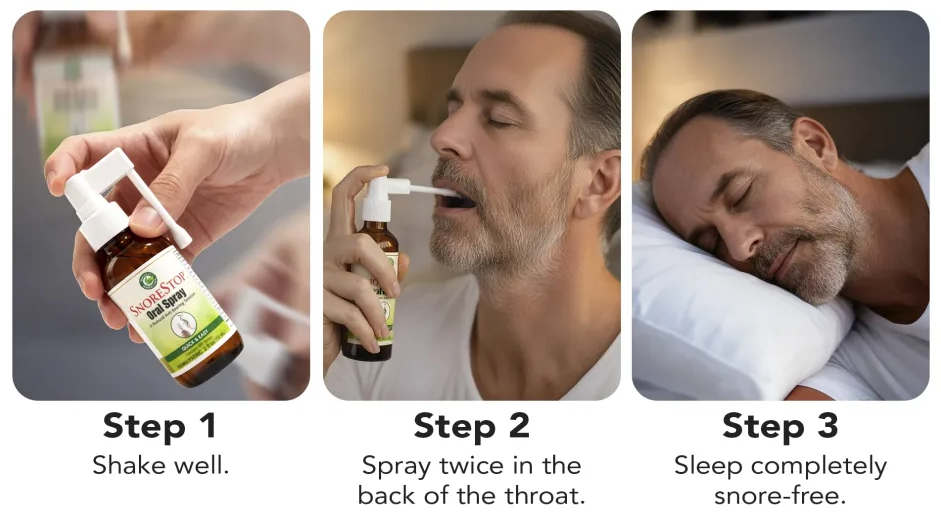
You spray it in your mouth and throat before bed. The extended nozzle is designed to reach the back of the throat — the exact area where snoring typically originates.
How to Use It:
- Shake the bottle
- Spray 5-10 times in the back of the throat before bed
- Don’t eat or drink anything for 15 minutes after
- Use consistently — the company says most people notice a difference within the first five nights
SnoreStop Ingredients – What’s Actually In It?
Here’s a breakdown of the seven active homeopathic ingredients as listed on the product label:
| Ingredient | Traditional Homeopathic Use (Per Company) |
|---|---|
| Nux vomica (4x, 6x) | Helps open a constricted pharynx |
| Teucrium marum (6x) | Helps open air passages |
| Belladonna (6x) | Helps decongest enlarged tonsils |
| Hydrastis canadensis / Goldenseal (6x) | Helps decongest a swollen tongue |
| Ephedra vulgaris (6x) | Helps relieve congestion |
| Kali bichromicum / Potassium Dichromate (6x) | Helps relieve stuffy nose |
| Histaminum hydrochloricum (12x) | Helps relieve allergy symptoms |
Inactive Ingredients: Alcohol (100 micro centiliters per spray), Glycerin, Potassium sorbate, Purified water (75%)
A few things worth flagging here:
Belladonna and Ephedra vulgaris have histories worth knowing about. The FDA issued advisories about belladonna in certain homeopathic products for infants (different context, different concentration levels) and restricted concentrated ephedra extract in dietary supplements in 2004. The important distinction: those concerns were about high-concentration products. SnoreStop’s label states it contains no measurable amounts of alkaloids, ephedrine, or pseudo-ephedrine because of the homeopathic dilution levels. Still, if you have concerns, talk to your doctor before use.
Alcohol is present — noted on the label as an inactive ingredient. If you avoid alcohol-containing products for any reason, this is relevant.
The company describes all ingredients as GRAS (Generally Recognized As Safe) and part of an officially accepted drug ingredient collection under the Federal Food, Drug and Cosmetic Act.
The Clinical Study – What the Evidence Actually Shows
This is where SnoreStop stands apart from the crowd.
Most over-the-counter anti-snoring products have zero published clinical evidence. SnoreStop references a randomized, double-blind, placebo-controlled study published in a peer-reviewed journal.
Study Details:
- Journal: Sleep and Breathing (Volume 3, Number 2, 1999)
- PubMed ID: 11898106
- Authors: Derek Lipman (Division of Otolaryngology, Emanuel Hospital, Portland, OR), Gary Sexton, Jerry Schlesser
- Finding cited by company: 79.5% of participants reported noticeable improvements within the first five nights
The PubMed abstract states that the treatment was statistically more effective than placebo and that no side effects or intolerance were reported within the study sample.
What to keep in mind:
- This is a single study from 1999
- The sample size is described by the company as 100 participants
- The lead author (Dr. Lipman) is also listed as one of the product’s endorsing physicians
- The 79.5% figure reflects self-reported subjective improvement, not an objective measurement tool like a sleep lab
Does this mean the study is meaningless? No. A placebo-controlled study showing statistically significant results is meaningful evidence, especially in a category where most products have none. But it’s one data point, not a comprehensive evidence base.
For independent verification, you can look up PMID 11898106 on PubMed.
SnoreStop Features at a Glance
- Doctor-developed formula — created by naturopathic physician Dr. Kenneth Rifkin
- 30+ years on the market — launched in 1995
- Device-free — no mouthpieces, no nose clips, no machines
- Natural/homeopathic ingredients — plant-derived, HPUS-compliant
- Extended spray nozzle — targets the back of the throat directly
- FDA-registered, GMP-certified facilities — manufactured in the USA
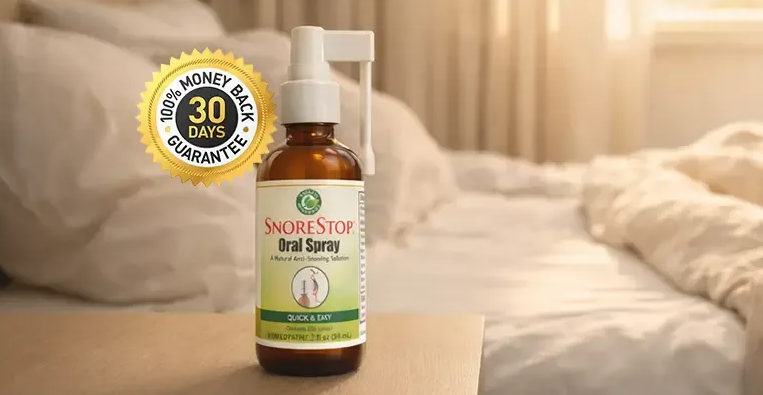
- 30-day money-back guarantee
- Compact and portable — fits in any travel bag
- No maintenance or cleaning needed
- Works in any sleeping position
SnoreStop vs. Alternatives
How does SnoreStop compare to other popular anti-snoring solutions?
| Solution | How It Works | Comfort | Portability | Clinical Evidence | Price Range |
|---|---|---|---|---|---|
| SnoreStop Spray | Reduces throat inflammation/mucus | High (non-invasive) | Excellent | Published study (1999) | ~$25/mo |
| Mouthguards/MADs | Repositions jaw to open airway | Low-Medium (jaw discomfort) | Medium | Strong evidence | $30–$200+ |
| Nasal Strips | Dilates nasal passages externally | Medium | Excellent | Limited | $10–$20/mo |
| Mouth Tape | Encourages nasal breathing | Low-Medium | Excellent | Limited | $10–$15/mo |
| CPAP Machine | Delivers pressurized air (for apnea) | Low | Poor | Very strong | $500–$3,000+ |
| Anti-Snoring Pillows | Repositions head/neck | High | Poor | Minimal | $50–$150 |
The honest takeaway: SnoreStop fills a specific niche – it’s ideal for people who want a non-device, natural approach to simple snoring. It doesn’t compete with CPAP (which is for sleep apnea, a different condition), and it doesn’t reposition the jaw the way mandibular advancement devices do. But for people who can’t tolerate those options, or haven’t found them practical, a spray-based approach is genuinely worth trying.
Related: Best Anti-Snoring Devices: A Complete Buyer’s Guide for 2026
SnoreStop Pricing – How Much Does It Cost?
According to the company’s official product page, SnoreStop Anti-Snoring Throat Spray has a regular retail price of $49.99 per bottle.
The current promotional offer through the official site advertises 40% off, making it more affordable per bottle, especially in multi-bottle bundles. Exact promotional pricing should be verified directly on the official site as it can change.
What you get for the price:
- Approximately 60 applications per bottle
- At one use per night, that’s roughly a 30-day supply
- Free, discreet shipping from the official site
Where to buy:
- Official SnoreStop website (best price, supports the brand directly)
- Amazon (widely available but may be sold at full price)
- Walmart (available, check for promotions)
The company specifically notes that purchasing directly from their official site supports the inventors, rather than going through third-party marketplaces.
Related: [How to Save Money on Sleep Health Products: Tips & Tricks] ← internal link opportunity
SnoreStop Pros and Cons
✅ Pros
- No devices, mouthpieces, or machines – just a quick spray before bed
- 30+ year track record – one of the longest-standing anti-snoring products available
- Published clinical study – uncommon in this product category
- Natural/homeopathic formula – plant-derived ingredients
- USA-made in FDA-registered, GMP-certified facilities
- Very portable – travel-friendly size
- 30-day money-back guarantee – lowers purchase risk
- Easy to use – shake, spray, sleep
- Endorsed by multiple physicians, including an ENT specialist and Nobel Prize-winning virologist
- Works in any sleep position
❌ Cons
- Homeopathic – not FDA-approved for efficacy (standard for this product category)
- Clinical study is from 1999 – a single study with the lead author also being an endorsing physician
- Contains alcohol – may be a concern for some users
- Not for sleep apnea – important medical distinction
- Results vary significantly – snoring has many causes, and no product works for everyone
- 30-day guarantee has conditions – shipping costs are non-refundable; processing takes up to 20 business days
- Subjective satisfaction claims – “95% satisfaction rate” and “3 million customers” are marketing figures
Who Should Buy SnoreStop?
You’re probably a good fit for SnoreStop if:
You snore but don’t have sleep apnea. SnoreStop is specifically designed for simple, non-apneic snoring. If your snoring is the “regular” kind — not involving gasping, choking, or breathing pauses — this is in the right ballpark.
You hate wearing things in your mouth. Mouthguards are effective but uncomfortable for a lot of people. If you’ve tried one and couldn’t stick with it, a spray-based approach is worth trying.
You’re open to homeopathic/natural products. If you already use natural wellness products and are comfortable with the homeopathic framework, SnoreStop aligns with that philosophy.
You travel frequently. A compact spray bottle that requires zero maintenance is a traveler’s dream. No cleaning gear, no cases, no charging.
You want something with a refund policy. The 30-day guarantee gives you a low-risk way to test it. Just make sure to read the full return terms first.
Who Should Avoid SnoreStop?
Anyone with possible sleep apnea. This is the most important thing I’ll say in this entire review. If you experience gasping during sleep, breathing pauses, waking up feeling unrested despite adequate sleep time, or excessive daytime sleepiness — please see a doctor before trying any OTC snoring product. Sleep apnea is a serious medical condition. SnoreStop’s own label says “DOES NOT TREAT SLEEP APNEA” in capital letters.
Those who want FDA-approved drug effectiveness. Homeopathic products operate under a different regulatory framework. If you need that level of validation, this product won’t meet that standard.
People avoiding alcohol-containing products. The inactive ingredients include alcohol.
Anyone looking for a guaranteed cure. Snoring is complex. It can be caused by anatomy, weight, alcohol use, sleeping position, allergies, nasal congestion, and many other factors. No single product is universally effective.
What People Are Actually Asking About SnoreStop
What is SnoreStop?
SnoreStop is a homeopathic anti-snoring oral spray that you use before bed. It was created in 1995 by Dr. Kenneth Rifkin and is made by Green Pharmaceuticals Inc. in the USA. You spray it in the back of your throat to help reduce inflammation and clear mucus, which are common causes of snoring. It’s been used by over 3 million people according to the company.
Does SnoreStop actually work?
For many users, yes — especially those with simple, non-apneic snoring caused by throat inflammation or mucus. The company references a published 1999 clinical study showing 79.5% of participants reported improvement. That said, results vary depending on the cause of your snoring. It’s not a guaranteed fix, and it won’t work for everyone. The 30-day money-back guarantee lets you test it with less risk.
Is SnoreStop legit?
Yes, SnoreStop is a legitimate product from a real company — Green Pharmaceuticals Inc. — that’s been in business since 1995. It’s registered with the FDA (as a homeopathic product), manufactured in GMP-certified facilities in the USA, and references a published peer-reviewed clinical study. That said, being “legit” doesn’t automatically mean it will work for every person.
Is SnoreStop safe to use?
According to the company and the product label, SnoreStop contains natural, GRAS-certified homeopathic ingredients and is prepared under HPUS standards. The label advises consulting a doctor if you’re pregnant, breastfeeding, or taking medications. It also recommends stopping use and consulting a doctor if symptoms don’t improve within 7 days. The product contains a small amount of alcohol as an inactive ingredient.
How much does SnoreStop cost?
SnoreStop costs $49.99 per bottle at regular price, with a current promotional offer of up to 40% off on the official website. One bottle contains approximately 60 sprays, which is roughly a 30-day supply when used nightly. Bundle pricing is available for greater savings.
Is SnoreStop worth buying?
If you snore (non-apneic) and haven’t found success with nasal strips, mouthguards, or other solutions — yes, it’s worth trying. The combination of a 30-year track record, a published clinical study (rare in this category), natural ingredients, USA manufacturing, and a money-back guarantee makes it a reasonable investment. Just go in with realistic expectations and verify the refund terms before ordering.
What are SnoreStop reviews from consumer reports saying?
SnoreStop has a reported 95% satisfaction rate per the company. Real user reviews across retail platforms generally note it’s most effective for mild-to-moderate snoring. Some users report noticeable improvement the first night, while others need several nights of consistent use. Negative reviews often come from users who either had more severe snoring (possibly sleep apnea) or expected instant results.
How does SnoreStop compare to mouthguards?
SnoreStop and anti-snoring mouthguards (like mandibular advancement devices) work in completely different ways. Mouthguards physically reposition your jaw. SnoreStop reduces throat inflammation and mucus. Mouthguards have stronger clinical evidence overall, but many people find them uncomfortable and stop using them. SnoreStop is far more comfortable and easier to use consistently — which matters a lot for long-term results.
How quickly does SnoreStop work?
According to the company, many users notice quieter sleep the first night. The company recommends consistent use for at least five nights to see full effects. Some people need a bit longer. If you don’t see any improvement within 7 days, the product label recommends consulting a doctor.
Is SnoreStop FDA approved?
No. SnoreStop is not FDA-approved. It is registered with the FDA as a homeopathic product and manufactured in FDA-registered, GMP-certified facilities. Registration is different from approval — it means the facility is compliant with federal registration requirements but does not mean the FDA has reviewed or endorsed the product’s effectiveness.
Can SnoreStop help with sleep apnea?
No. SnoreStop explicitly states on its label that it does not treat sleep apnea. Sleep apnea is a serious medical condition requiring professional diagnosis and treatment, often a CPAP machine. If you suspect sleep apnea, please see a doctor.
Where can I buy SnoreStop?
You can buy SnoreStop on the official SnoreStop website. The best deal is typically through the official site where you can access promotional bundle pricing and the 30-day money-back guarantee most reliably.
What are the side effects of SnoreStop?
Based on the 1999 published clinical study referenced by the company, no side effects or intolerance were reported in the study sample. The label advises stopping use if symptoms worsen or don’t improve in 7 days, and consulting a doctor if needed. As with any product, individual sensitivity is possible. Consult your healthcare provider if you have concerns.
SnoreStop Reviews – What Real Users Are Saying
Based on aggregated feedback patterns from retail platforms and the company’s own disclosure:
Positive feedback consistently mentions:
- Noticeably quieter nights within the first few uses
- The convenience of a spray vs. wearing a device
- Partners sleeping better as a result
- Good value compared to more expensive options
- Easy to incorporate into bedtime routine
Critical feedback typically mentions:
- Didn’t work for more severe snoring cases
- Needs to be used consistently — not a one-time fix
- Some users wanted a faster result
- The alcohol in the formula was a minor concern for some
The company’s own Terms of Service include an honest disclosure worth noting: testimonials “do not represent the generally expected user experience.” That’s a fair and legally standard statement — people with strong experiences (positive or negative) tend to leave reviews. The average user may fall somewhere in the middle.
Related: SnoreRx vs. ZQuiet vs. Nora: Which Anti-Snoring Product Is Right for You?
SnoreStop Return Policy and Guarantee – What to Know
The company offers a 30-day money-back guarantee. Here are the key details you need to know before buying:
- You have 30 days from purchase to request a return
- Contact the company via email with your Order Number to initiate
- Shipping costs are non-refundable
- After the return is received, refund processing typically takes about 10 business days
- Allow an additional up to 10 business days for the credit to appear on your statement
- Orders cannot be guaranteed to be cancelled once fulfilled
Bottom line: The guarantee is real and usable, but it’s not instant or completely cost-free (you lose shipping). Read the full terms on the official website before ordering.
Should You Buy SnoreStop? My Honest Take
Look, there’s no perfect solution for snoring. Anyone who tells you otherwise is selling something harder than they should be.
But here’s what I think makes SnoreStop worth considering in 2026:
It’s one of the very few natural anti-snoring products that has actual published clinical data – even if it’s a single older study. In a market full of products with zero evidence, that matters.
It’s been around for 30 years. That’s not a small thing. Products that don’t work don’t survive three decades in a crowded market.
The money-back guarantee significantly reduces the financial risk of trying it.
And honestly, the biggest thing in its favor? It’s comfortable. So many people give up on mouthguards, nasal strips, and other solutions because they’re just not sustainable. If a product isn’t comfortable enough to use every night, it doesn’t matter how effective it is in a clinical setting. SnoreStop requires essentially zero adjustment.
Is it for everyone? Absolutely not. If you have sleep apnea, you need medical care – not a spray. If you’re a hardcore skeptic of homeopathic products, this probably won’t change your mind. And if your snoring is severe, a spray alone might not be enough.
But for the person dealing with mild to moderate simple snoring who wants something natural, easy, and low-risk to try – SnoreStop makes a solid case for itself.
Final Word
Snoring is more than just annoying. It disrupts sleep for everyone involved, and lost sleep has real consequences — on mood, focus, relationships, and long-term health.
SnoreStop won’t work for everyone. No product will. But it brings something to the table that very few natural anti-snoring solutions can: decades of use, published clinical support, transparent labeling, and a design that’s actually comfortable enough to stick with.
If you’ve been hunting for a device-free, natural option that at least has some real-world evidence behind it, SnoreStop deserves a spot on your list.
Just check with your doctor first if you have any concerns – especially around sleep apnea – and read the refund terms before you hit buy.