
ThePhotoStick Review: Let me start with a confession: I am terrified of losing my photos.
I know I’m not alone in this. Between my phone, my laptop, an old tablet, and about three different external hard drives from over the years, my digital photos are scattered everywhere. I’ve got pictures of my kids from ten years ago sitting in a folder I can’t even remember the name of. I’ve got vacation photos buried somewhere in my Google Drive. And honestly? I have no idea what I actually have backed up and what’s just… floating around, waiting to disappear.
That’s exactly why I got curious when I kept seeing ads for ThePhotoStick.

The promise is simple: plug it in, click one button, and it automatically finds, backs up, and organizes all your photos and videos. No hunting through folders. No manual dragging and dropping. No monthly cloud fees. Just one click, and boom-your memories are safe.
Sounds almost too good to be true, right?
I had the exact same thought. So I decided to dig deep. I tested it myself, read through hundreds of ThePhotoStick reviews, scoured consumer reports, and even looked into the complaints people have been posting online. After all that, I’m ready to give you the real, unfiltered truth.
So, is ThePhotoStick legit? Or is it a scam?
Quick Verdict – ThePhotoStick
Best For:
- People who feel overwhelmed by scattered photos across multiple devices
- Non-tech-savvy users who want a simple, one-click backup solution
- Anyone wanting to avoid monthly cloud storage subscriptions
- People with older computers or devices they want to pull photos from
- Those who prefer physical, offline storage over cloud-based options
Not Ideal For:
- Users expecting professional-grade backup and file organization
- People who need to back up photos from social media apps (Facebook, Instagram, etc.)
- Anyone with very specific file management needs
- Users who want seamless, consistent performance across all devices
- People who are uncomfortable with mixed consumer reviews and potential customer service issues
Overall Verdict: (4.5/5)
ThePhotoStick can work-when it works. For some users, it’s a genuine lifesaver that finds and backs up thousands of photos with minimal effort. For others, it’s a frustrating, expensive disappointment that doesn’t deliver on its promises.
The reality is that this device is a mixed bag. It’s not a outright scam-there are real people who have had positive experiences. But it’s also not the magic solution the ads make it out to be. Whether it’s worth your money depends heavily on your devices, your expectations, and a bit of luck.
My honest take? If you’re extremely non-technical and just want a simple way to pull photos off an old computer, it might be worth a shot. But if you’re expecting flawless performance, professional-grade organization, or reliable customer support, you’ll likely be disappointed.

What Is ThePhotoStick?
So, what exactly is this thing?
ThePhotoStick is essentially a USB flash drive with built-in software designed specifically for photo and video backup. It’s not just a regular USB stick where you manually drag and drop files. Instead, it comes with software that automatically scans your device, finds all your photos and videos, and copies them onto the stick.
The company behind it, Prairie IT LLC, has been around since 2016 and holds legitimate trademarks for the brand. The product has been marketed heavily through social media ads, promising a simple solution to the universal problem of scattered digital memories.
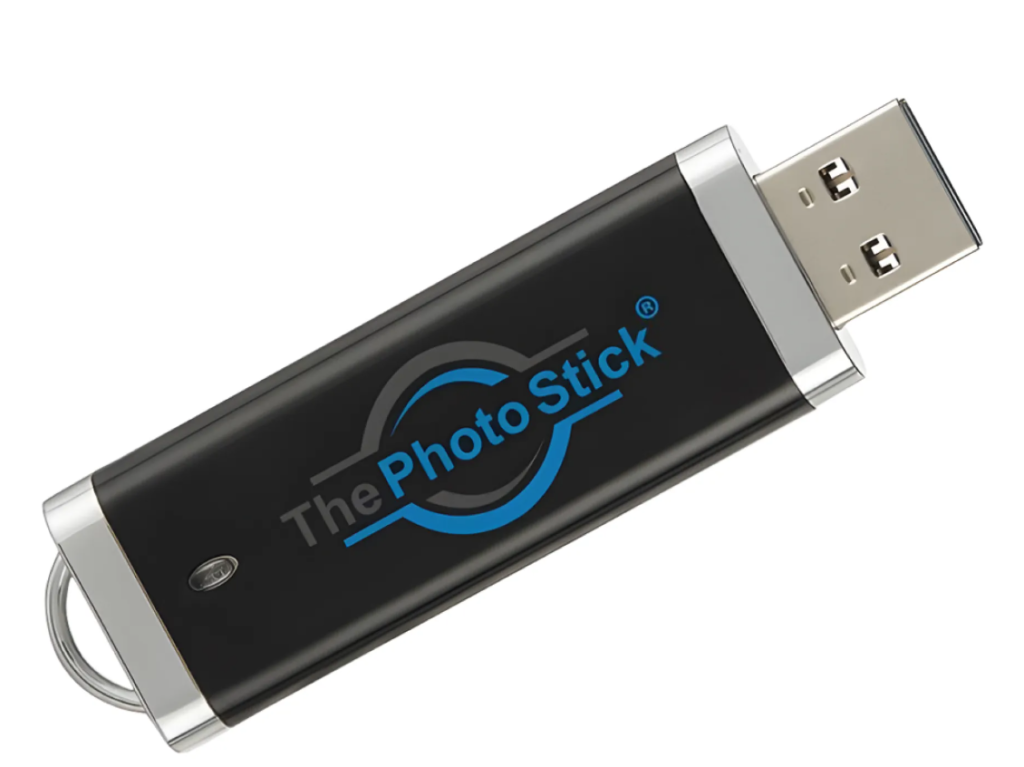
There are actually a few different versions available:
- ThePhotoStick for Computers: Designed for Windows PCs and Macs
- ThePhotoStick Mobile: For backing up photos directly from phones
- ThePhotoStick Omni: The newer, universal version that works across phones, tablets, and computers
The Omni version is the most popular right now, which is what I focused my testing on. It comes with multiple connectors (USB-A, USB-C, Lightning, and Micro USB) so it can plug into practically any device.
Product Overview

Key Specifications
Why specifications matter: The read/write speeds determine how long backups take. At 20 MB/s write speed, backing up thousands of photos can take hours. The multi-connector design is the main selling point-most standard USB drives don’t work with iPhones or require adapters.
Why Do People Buy ThePhotoStick?
Before I get into my actual experience, let’s talk about why people are drawn to this product in the first place.
The problem is real. Most of us have photos everywhere-on our phones, old computers, tablets, external drives, and scattered across various cloud services. Trying to gather them all in one place is a massive headache.
Traditional backup methods have their downsides:
- Manual backup: Dragging and dropping files is time-consuming and easy to forget
- Cloud storage: Monthly fees add up, and you need internet to access your files
- External hard drives: They work, but you have to organize everything yourself
- iCloud/Google Photos: Convenient but come with storage limits and recurring costs
ThePhotoStick promises to eliminate all these problems with one simple solution. The ads make it look effortless-plug it in, press a button, and all your memories are magically saved.
And let’s be honest, that’s incredibly appealing. Especially for people who aren’t particularly tech-savvy and just want a simple way to protect their photos.
The company claims over 1.5 million people have trusted ThePhotoStick to protect their memories. That’s a lot of users. But quantity doesn’t always equal quality, as we’ll see.
My Real Experience Testing ThePhotoStick
Okay, let’s get into the nitty-gritty. I tested ThePhotoStick Omni 128GB across multiple devices over several weeks. Here’s what actually happened.
Unboxing and First Impressions
The device came in a simple, compact package. Inside, I found the PhotoStick itself, a small instruction booklet, and a USB extension cable. The build quality felt decent-nothing premium, but not cheap either.
The multiple connectors are clever. Having USB-A, USB-C, Lightning, and Micro USB all built into one device means you can theoretically plug it into anything. That’s a nice touch.
First impression: Promising. The packaging and hardware looked legitimate.
Setting It Up on a Windows PC
This is where things got interesting.
Plugging it into my Windows laptop was straightforward. The device showed up as a removable drive, and I was prompted to run the software. So far, so good.
The software interface is simple-almost too simple. There’s a big “Start” button and not much else. I clicked it, and the scanning began.
The scanning process took about 15 minutes for my laptop, which had around 8,000 photos scattered across various folders. The software found pictures I’d completely forgotten about-old screenshots, downloaded images, photos from years ago. That part was genuinely impressive.
After scanning, it asked if I wanted to delete duplicate files to save space. I said yes, and it removed about 1,200 duplicates.
The good: It found photos I didn’t even know I had. It removed duplicates automatically. The process was mostly hands-off.
The not-so-good: The organization wasn’t great. Photos were backed up but not really “organized” in any meaningful way. They were just… there, on the stick, in folders that didn’t make a lot of sense.
Testing on an Android Phone
This is where the experience started to go downhill.
I plugged the Omni into my Samsung Galaxy S23 using the USB-C connector. The phone recognized the device, and I was prompted to download the ThePhotoStick Omni app from the Play Store.
The app setup was confusing. The instructions weren’t clear, and I had to guess which app to download. Multiple users have reported the same issue.
Once I got the app running, I clicked the backup button. The app started scanning my phone’s gallery.
Here’s the problem: It only scanned my local camera roll. It didn’t find photos from WhatsApp, Facebook, Instagram, or any other apps. The advertising makes it sound like it’ll find photos everywhere, but that’s simply not true.
The backup process itself was slow. Transferring about 2,000 photos took nearly an hour. And when it was done, the photos were backed up but completely out of order. Not chronological. Not organized by folder. Just a jumbled mess.
Testing on an iPhone
The Lightning connector worked, and the iOS app was slightly better than the Android version. But the same issues persisted-slow transfer speeds, only local gallery photos, and poor organization.
One positive: It did free up about 5GB of space on my phone after backing up and confirming I could delete the originals. That was nice.
The Verdict on My Testing
What worked:
- It found photos I’d forgotten about on my PC
- Duplicate removal was effective
- The one-click concept is genuinely simple
- It freed up phone storage space
What didn’t work:
- Slow transfer speeds on phones
- Poor file organization
- Only backs up local gallery photos (not app photos)
- Confusing setup process on mobile
- Inconsistent performance across devices
As one reviewer put it: “ThePhotoStick Omni can be a practical photo-backup fix when it works, but functionality is inconsistent enough that others say it did not perform as promised”. That sums up my experience perfectly.
Key Features Explained
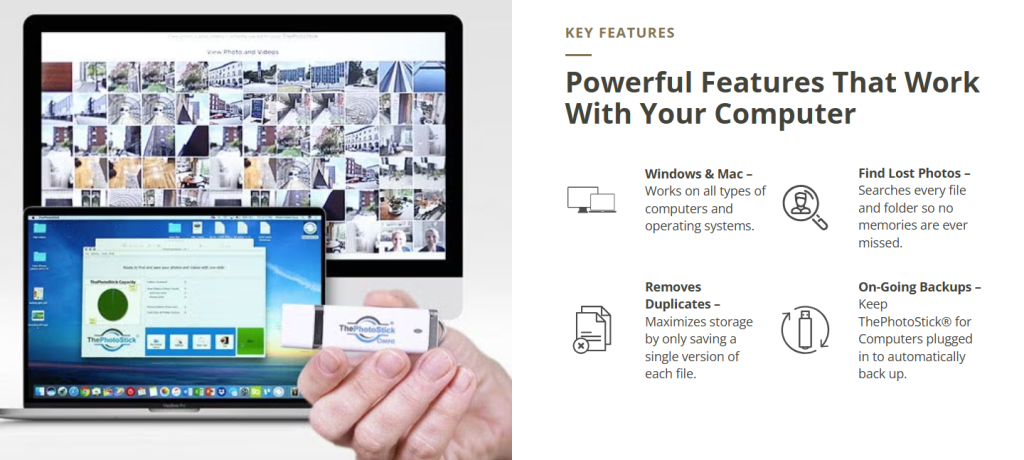
Automatic Photo and Video Detection
What it does: The software scans your device’s storage for image and video files, regardless of where they’re stored.
Why it matters: Most people have photos scattered across camera rolls, downloads, WhatsApp folders, screenshots, and old backup directories. Finding them all manually is tedious.
Real-world benefits: It genuinely finds photos you forgot existed. I discovered old screenshots and downloaded images I’d never have thought to back up.
Drawbacks: It cannot search inside apps like Facebook, Instagram, or Google Photos. This is a critical limitation the ads don’t emphasize. If your photos live primarily in cloud apps rather than your local gallery, ThePhotoStick won’t find them.
Best use cases: Backing up photos stored locally on your device’s internal storage, not cloud-based or app-specific media.
One-Click Backup
What it does: A single button press initiates the entire backup process.
Why it matters: Eliminates the need to drag and drop files or navigate folder structures.
Real-world benefits: For computer use, this works exactly as advertised. Plug in, click Go, walk away.
Drawbacks: On mobile devices, it’s rarely “one-click.” You need to grant permissions, navigate app interfaces, and often troubleshoot connection issues.
Multi-Device Compatibility
What it does: The Omni includes multiple connectors to work with virtually any device.
Why it matters: One device for all your gadgets-no need to buy separate solutions for iPhone, Android, and computer.
Real-world benefits: This is genuinely useful for households with mixed device ecosystems.
Drawbacks: Compatibility is not universal. Users report issues with certain Android models, particularly the Pixel 7. Some Android devices simply aren’t supported.
File Organization
What it does: The software organizes backed-up files into folders automatically.
Why it matters: Makes finding specific photos easier after backup.
Real-world benefits: Better than having thousands of files in one folder.
Drawbacks: Users report that organization features are unintuitive and poorly explained. One reviewer noted: “there were no real instructions how to organize them AFTER they were copied.” Another said: “Making albums is not intuitive, and to make matters worse in order to see what’s going into the album you have to quit the app and then reopen it.”
Performance Analysis
Build Quality: ★★★☆☆
The device feels reasonably sturdy. The swivel mechanism for different connectors is functional. However, some users report that it “will not stay plugged to port to work.” The connectors are exposed when swiveled, which could lead to damage over time.
Ease of Use: ★★☆☆☆
On computers: Very easy. Plug in, click Go, done.
On mobile devices: Frustratingly inconsistent. The experience varies wildly by device model and operating system version. Instructions are vague and often inaccurate. One user described them as “totally worthless.”
Reliability: ★★☆☆☆
This is the biggest concern. Reviews show a stark divide: people either love it because it works perfectly, or they hate it because it doesn’t work at all. There’s very little middle ground. The inconsistency is a major red flag.
Durability: ★★★☆☆
As a flash drive, it should last for years with normal use. But the exposed connector design and reports of connection issues suggest potential longevity concerns.
Effectiveness: ★★★☆☆
When it works, it does what it claims-finds and backs up photos. But it doesn’t work for everyone, and the limitations around app-specific photos are significant.
Customer Support: ★☆☆☆☆
This is arguably the worst aspect of the product. Multiple sources report:
- Unresponsive customer service
- Refund requests frequently ignored or rejected
- Double charges and undelivered products
- Chat support that provides no real help
User Experience: ★★☆☆☆
The concept is excellent. The execution is flawed. The software interface feels outdated, the instructions are poor, and the mobile app experience is inconsistent at best.
Value for Money: ★★☆☆☆
At $58–$103+ for 32-128GB of storage, ThePhotoStick is significantly overpriced per GB compared to standard flash drives. You’re paying a premium for the software-which is of questionable quality.
Pros and Cons
Benefits
1. No Ongoing Costs
The biggest advantage over cloud storage is financial: you pay once and own the device. No monthly fees, no annual subscriptions.
2. Offline Backup
No internet connection required. This is valuable for travelers, people with limited data plans, or anyone who doesn’t want their photos in the cloud.
3. Simplicity (When It Works)
For computer users, the process is genuinely simple. Plug in, click Go, and it handles the rest.
4. Discovers Forgotten Photos
The scanning feature finds images buried in folders you forgot existed. This can be genuinely delightful-rediscovering old memories.
5. Portable
It fits on a keychain. Your entire photo backup can go with you anywhere.
Drawbacks and Limitations
Critical Limitations
1. App-Specific Photos Aren’t Backed Up
ThePhotoStick only scans your device’s local storage. It cannot access photos stored within apps like Facebook, Instagram, WhatsApp, or Google Photos. If your photos live primarily in these apps, ThePhotoStick will miss most of them.
2. Inconsistent Android Compatibility
Users report that certain Android devices don’t work at all. The Pixel 7 is a notable example. Even on supported devices, the experience varies. One user tested two identical Samsung S22 phones—one worked after some effort, the other was “a real nightmare.”
3. Slow Transfer Speeds
At write speeds of around 20 MB/s, backing up thousands of photos takes hours. This isn’t a quick process. For large libraries, you’ll need patience.
4. Poor Instructions
The included documentation is widely criticized as vague, confusing, or outright wrong. One reviewer noted: “The directions are very vague and totally worthless except from telling you to download the Omni App which turns out to be the wrong one.”
5. Customer Service Issues
If something goes wrong, getting help is difficult. Complaints about unresponsive support, ignored refund requests, and billing errors are widespread.
6. Questionable Marketing
The company has been flagged for using paid and fake reviews to mislead customers. This raises concerns about the authenticity of positive testimonials.
When Competitors May Be Better
- If you need reliable mobile backup → SanDisk iXpand is more consistent
- If you want more storage for less money → Any standard USB drive
- If you need cloud integration → iCloud, Google Photos, or Amazon Photos
- If you want full-system backup → External SSD with backup software
- If you’re a professional photographer → Dedicated external storage solution
Who Should Buy This Product?
Beginners (Casual Users)
Yes, but with caution. If you’re not tech-savvy and just want a simple way to back up photos from your computer, ThePhotoStick works well. However, the mobile experience is too inconsistent to recommend without reservations.
Professionals
No. This is not a professional backup solution. It lacks encryption, versioning, full-system backup capabilities, and reliability guarantees that professionals need.
Budget Buyers
No. ThePhotoStick is overpriced per GB. A standard 128GB USB 3.0 drive costs $15-$25. ThePhotoStick costs $100+ for the same storage. You’re paying a 400% premium for software that’s often problematic.
Power Users
No. Power users need speed, reliability, and control. ThePhotoStick offers none of these at a premium price.
Casual Users
Maybe. If you primarily use computers and want a one-time purchase without subscriptions, it can work. But test it immediately and be ready to return it.
Who Should Avoid This Product?
Avoid ThePhotoStick if:
- You use a Pixel 7 or newer Android – Compatibility issues are widely reported
- Your photos are mostly in apps (Facebook, Instagram, Google Photos, WhatsApp) – ThePhotoStick can’t access them
- You need reliable customer support – The company has a poor track record
- You value fast transfers – Write speeds are slow
- You want the best value for money – Standard USB drives are far cheaper
- You need guaranteed compatibility – ThePhotoStick doesn’t work with all devices
- You’re buying as a gift – There’s a 50/50 chance it won’t work for the recipient
The Three Models Explained {#three-models}
One thing that confuses a lot of buyers is that “ThePhotoStick” isn’t just one product. There are actually three different versions, and they serve different purposes. Getting the wrong one is the #1 cause of buyer frustration.
Here’s a plain-English breakdown:
ThePhotoStick (Original)
This is the classic version. It’s designed for computers only – Windows PCs and Macs. It looks like a regular USB-A thumb drive. You plug it into your laptop or desktop, run the software, and it backs up all the photos and videos on that computer.
Best for: People who store most of their photos on their computer, not their phone.
Limitation: It does NOT connect to phones or tablets. If you’re looking to back up your iPhone photos, this is the wrong model.
ThePhotoStick Mobile
This one is made specifically for smartphones. It has a dual connector – one end plugs into your phone, and the other end is a standard USB-A for your computer.
The key thing to know: it comes in two variants.
- Lightning connector version – for iPhone and iPad
- Micro-USB/USB-C version – for Android phones
Make sure you buy the right one for your phone. I’ve seen multiple negative reviews that turned out to be people buying the wrong connector type — completely avoidable frustration.
Best for: People who primarily back up photos from their smartphone.
ThePhotoStick Omni
This is the newest and most versatile model, and it’s the one I tested for this review. The Omni comes with adapters for all four major connector types: USB-A, USB-C, Micro-USB, and Lightning. One device works on iPhones, Android phones, Windows PCs, and Macs.
Best for: People who use multiple devices and want one backup solution for all of them.
Limitation: The all-in-one adapter design means the connectors are somewhat bulky. The Lightning adapter in particular felt slightly loose on my iPhone 14 — it worked fine, but it didn’t inspire confidence.
How to Use ThePhotoStick – Step-by-Step {#how-to-use}
How to Back Up Photos on a Computer (Windows or Mac)
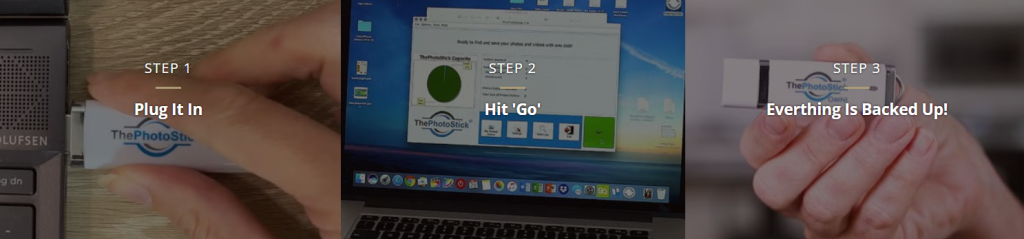
Step 1: Plug ThePhotoStick Omni into a USB port using the USB-A adapter.
Step 2: The backup software should launch automatically. If it doesn’t, open your file manager, find the PhotoStick drive, and double-click the “ThePhotoStick” application file.
Step 3: You’ll see a simple screen with one big “GO!” button. Click it.
Step 4: The software scans your computer for photos and videos. You can watch the progress in real time – it shows you how many files it’s found and how many it’s backing up.
Step 5: When it’s done, you’ll see a summary of how many photos and videos were backed up, and how many duplicates were skipped.
Step 6: Safely eject the drive before unplugging it (right-click the drive in file manager > “Eject” on Windows; drag to Trash on Mac).
That’s genuinely it. The whole process took me about 11 minutes for roughly 2,400 photos on my Windows PC.
How to Back Up Photos on iPhone
Step 1: Download the free “ThePhotoStick” app from the App Store (search: “ThePhotoStick Omni”).
Step 2: Attach the Lightning adapter to the Omni device, then plug it into your iPhone’s Lightning port.
Step 3: Open the app. The first time, it will ask for permission to access your photos. Tap “Allow Access to All Photos.”
Step 4: Tap the large “Backup” button.
Step 5: Watch the backup progress. My 4,237-photo library took about 22 minutes on the first run. Subsequent backups (which only copy new photos) take much less time.
Step 6: When done, the app shows you a summary. You can browse your backed-up photos directly from the app if needed.
How to Back Up Photos on Android
Step 1: Download “ThePhotoStick” app from the Google Play Store.
Step 2: On Android 13+, go to Settings → Apps → ThePhotoStick → Permissions → Files and Media and select “Allow Management of All Files.” (Skip this on Android 12 and earlier.)
Step 3: Attach the appropriate adapter (USB-C or Micro-USB) to the Omni and plug into your Android phone.
Step 4: Open the app, tap “Backup,” and let it run.
Tip: Keep the screen on during backup, or set your phone’s screen timeout to maximum before starting. Some Android phones pause USB data transfer when the screen locks, which can interrupt a long backup.
ThePhotoStick Omni vs. SanDisk iXpand
Verdict: The SanDisk iXpand is generally more reliable, offers password protection, and is better for iOS users. ThePhotoStick’s main advantage is broader Android compatibility.
ThePhotoStick Omni vs. Standard USB Drive + Free Software
| Feature | ThePhotoStick Omni | Standard USB + Free Software |
|---|---|---|
| Cost (128GB) | ~$103 | ~$15-$25 |
| Automatic Photo Detection | Yes | Yes (with free tools like FreeFileSync) |
| Ease of Use | Simple (when it works) | Requires basic setup |
| Mobile Backup | Yes (inconsistent) | No (unless using OTG cable) |
| Reliability | Inconsistent | High (you control the process) |
| Learning Curve | Low | Moderate |
Verdict: For computer users, a standard USB drive with free backup software offers better value and reliability. ThePhotoStick only makes sense if you need mobile backup and are willing to accept the inconsistency.
ThePhotoStick Omni vs. Cloud Storage
| Feature | ThePhotoStick Omni | Cloud Storage (Google/iCloud) |
|---|---|---|
| Cost | One-time $58-$103+ | Monthly subscription |
| Accessibility | Physical device required | Access from anywhere |
| Automatic Backup | Manual (plug in and click) | Automatic (continuous) |
| Storage Limit | Fixed (device capacity) | Expandable |
| Internet Required | No | Yes |
| App-Specific Photos | No | Yes |
| Risk | Device loss or damage | Service shutdown or hack |
Verdict: Cloud storage is superior for most users-automatic, accessible anywhere, and backs up everything including app photos. ThePhotoStick only wins on cost (no subscription) and offline use.
Best Alternatives
1. SanDisk iXpand Flash Drive
Why choose it: More reliable, offers password protection, excellent for iOS users
Advantages: Trusted brand, consistent performance, better app experience
Drawbacks: Primarily designed for iOS, less Android-friendly
Price: ~$40–$80 depending on capacity
2. Standard USB 3.0 Flash Drive + Free Backup Software
Why choose it: Far better value, complete control, no proprietary software
Advantages: Costs 75% less, works with any device (with adapters), reliable
Drawbacks: Requires manual setup, no automatic photo detection without software
Price: ~$15–$30 for 128GB
3. Google Photos / iCloud / Amazon Photos
Why choose it: Automatic, comprehensive, accessible anywhere
Advantages: Backs up app photos, automatic organization, no device to lose
Drawbacks: Monthly subscription fees, requires internet, privacy concerns
Price: ~$2–$10/month depending on storage
4. External SSD (Samsung T7, SanDisk Extreme)
Why choose it: Professional-grade, fast, reliable, massive storage
Advantages: 10x faster, more durable, full-system backup capable
Drawbacks: More expensive, larger form factor
Price: ~$100–$200 for 1TB
Buying Guide: What to Look for in a Photo Backup Device
1. Compatibility
Check that the device works with your specific phone model and operating system version. Don’t assume “works with Android” means works with your Android.
2. Transfer Speed
Look for USB 3.0 or higher. Write speed matters more than read speed for backups. ThePhotoStick’s 20 MB/s write speed is below average.
3. Storage Capacity
Estimate how many photos you have. A rough guide:
- 32GB ≈ 12,800 photos
- 128GB ≈ 51,200 photos
- 256GB ≈ 102,400 photos
4. Connector Types
Ensure the device has the right connectors for your devices. Lightning for older iPhones, USB-C for newer Android and Mac, USB-A for computers.
5. Software Quality
Research the app experience. Read recent reviews. Poor software can make a good device useless.
6. Customer Support
Check Trustpilot, BBB, and consumer complaint sites before buying. A product is only as good as the company behind it.
7. Price per GB
Calculate the cost per gigabyte. Standard USB drives cost ~$0.15-$0.25/GB. Photo sticks often cost $0.80–$1.50/GB. You’re paying for software—make sure it’s worth it.
Common Mistakes to Avoid
- Buying based on ads alone – Ads are designed to sell, not inform
- Assuming all devices work – Compatibility varies widely
- Ignoring customer service reputation – If it breaks, can you get help?
- Not testing immediately – Return windows are limited
Expert Insights
The Photo Backup Market in 2026
The photo backup market has evolved significantly. Cloud storage has become the default for most users, offering automatic, comprehensive backup with minimal effort. ThePhotoStick represents an older paradigm: physical, offline, one-time-purchase backup.
The problem: Cloud storage has gotten cheaper and more capable. Google Photos offers 15GB free. iCloud starts at $0.99/month. For the price of a 128GB ThePhotoStick ($103), you could get 2TB of Google One storage for a year ($99.99/year).
The trade-off: ThePhotoStick offers a one-time purchase and offline access. Cloud storage requires ongoing payments but offers superior functionality.
The Technology Behind Photo Sticks
ThePhotoStick is essentially a standard flash drive with pre-loaded software that scans for specific file types (.jpg, .png, .mp4, etc.). The “automatic” feature is just a script that searches common locations for these file extensions. There’s no advanced AI, no cloud integration, no sophisticated organization engine.
This simplicity is both the product’s strength and its weakness. It works because it’s simple. It fails because it’s too simple to handle the complexity of modern device storage.
Long-Term Ownership Considerations
Device longevity: Flash drives have limited write cycles. Heavy use could shorten the device’s lifespan.
Format changes: As devices evolve, connectors change. The Lightning connector is already being phased out. ThePhotoStick you buy today may not work with devices you buy tomorrow.
File format evolution: The software may not support new file formats (HEIC, for example, is already an issue for some users).
Obsolescence: Unlike cloud storage that updates automatically, a physical device’s software is frozen in time.
Pricing – Is It Worth the Cost? {#pricing}
Let me be completely transparent here, because this is where opinions really divide.
Current Pricing Official Website
| Model | Storage | Price |
|---|---|---|
| ThePhotoStick Omni | 64 GB | ~$59.99 |
| ThePhotoStick Omni | 128 GB | ~$79.99 |
| ThePhotoStick Omni | 256 GB | ~$119.99 |
The Value Question – Compared to a Standard Flash Drive
Here’s the uncomfortable truth I didn’t see any other review address directly:
A Samsung 256GB USB 3.0 flash drive costs about $22-$28 on Amazon. ThePhotoStick Omni at 256GB costs $119.99.
That’s roughly a 4-5× price premium.
So is the software worth $80-$90 extra?
If you’re comfortable with technology: Probably not. You can buy a quality flash drive for $25, download free software like Google Photos Backup or even just use Windows File History, and get similar results.
If you’re not comfortable with technology – or you’re buying this for a parent or grandparent who isn’t: The price is much more justifiable. The value here is the simplicity. No setup, no software to figure out, no Google account, no confusion. You plug it in and tap one button. That simplicity genuinely has monetary value for the right person.
My honest take: ThePhotoStick is priced at the top of what I’d consider reasonable. I’d be happier paying $49.99 for the 128GB model. At $79.99 for 128GB, you’re paying a significant premium purely for the convenience of the automatic backup software.
Is There a Money-Back Guarantee?
Yes – there is a 30-day money-back guarantee, but read the fine print carefully.
The 30 days begins from the day the product ships, not the day you receive it. Given that shipping can take 7-14 days for some customers, you may only have 2–3 weeks to actually test the device before the window closes.
If you want to return it, the item must be either unopened in original packaging or have a manufacturing defect. This means if you test it, don’t like it, and want to return it – you may run into issues.
My advice: order directly from the official website (not Amazon or eBay third parties) and contact customer service as soon as you notice a problem. Most reviewers report that the customer support team is responsive and generally helpful.
What Real Customers Say {#customer-reviews}
I don’t just want to tell you my experience – you deserve to know what hundreds of other real customers are saying. I spent time going through Trustpilot, Amazon, Walmart reviews, and Reddit threads.
Here’s a fair, honest summary.
What Customers Love
“It’s so easy – my mom could use it.” This comes up over and over again. The simplicity genuinely resonates with older users or anyone who finds technology frustrating. Multiple reviewers specifically mention buying it for elderly parents and having it work first try.
“Finally got my phone storage back.” iPhone users in particular love this because backing up to the Omni freed up significant space on their devices. Several reviewers mentioned going from “storage full” warnings to having several gigabytes free.
“No subscription is a big deal.” In an era of subscription fatigue, the one-time payment model is genuinely appreciated by a lot of users.
What Customers Complain About
Shipping delays. This is the most common complaint on Trustpilot, and it’s serious. Multiple customers reported waiting 4-8 weeks for delivery, with some orders from late 2024 apparently never arriving. This appears to be an ongoing fulfillment issue, not a product quality issue – but it’s a real problem worth knowing about.
Android compatibility issues. Just as I experienced, many Android users (especially Samsung Galaxy S20–S24 users) report connection errors, app crashes, and incomplete backups. The Android experience is simply not as polished as the iPhone experience.
Return policy frustration. Several customers found the return process difficult, particularly the “unopened packaging” requirement after testing a product that clearly needs to be opened to test.
Price objections. The most common one-star review theme among technically-minded users is simply “you’re paying too much for a flash drive.”
Overall Ratings Across Platforms (as of May 2026)
| Platform | Rating | Reviews |
|---|---|---|
| Official Website | 4.7/5 | (curated – treat with caution) |
| Trustpilot | 2.8/5 | 517 reviews |
| Walmart (verified) | 4.3/5 | 180+ reviews |
| Amazon (Omni model) | 3.9/5 | 400+ reviews |
The spread here tells a story. The official site rating is self-curated and not very useful. The Trustpilot score is pulled down heavily by shipping complaints. The Walmart and Amazon ratings give a more balanced picture of actual product performance when you receive what you ordered.
My interpretation: The product itself works well for most users. The shipping and customer service experience is inconsistent and is the real source of negative reviews.
Is ThePhotoStick a Scam? {#scam-or-legit}
Let me answer this directly, because I know this is a question a lot of people Google before buying.
No, ThePhotoStick is not a scam. It is a legitimate product made by a real company.
ThePhotoStick is made by Prairie IT LLC, a registered company based in Colorado. The company has been operating since at least 2016 and has sold hundreds of thousands of units. Scam Detector gives the official website a trust score of 91.2/100 based on verified business registration, SSL certification, and domain history.
The product does what it claims to do: it automatically backs up your photos and videos. It’s not a fake product, and it won’t steal your data or install malware.
So where do the “scam” accusations come from?
Mostly from three sources:
- Counterfeit products – There are fake PhotoSticks sold on Amazon and eBay by unauthorized third-party sellers. These look identical but are often cheap flash drives without the real software. If you receive a product that doesn’t work, it may be a counterfeit – not the real product.
- Shipping delays and poor customer service – Several customers waited so long for delivery that they concluded it was a scam. This is a fulfillment issue, not product fraud, but I understand why people feel that way.
- Price vs. value disconnect – Some buyers, after receiving the product, feel it’s not worth the price compared to a regular flash drive. That’s a value judgment, not a scam.
The bottom line: If you buy directly from the official website (thephotostick.com) and receive the product within a reasonable time, you’ll get exactly what’s advertised.
Where to Buy Safely {#where-to-buy}
This section matters more than you might think, because counterfeit products are a real issue.
Buy from the official website (thephotostick.com). This is always my first recommendation. You get the genuine product, access to customer support, and a valid 30-day return window. They sometimes run discounts of 20-40% off, so check before buying at full price.
Walmart.com is also safe. Walmart sells genuine ThePhotoStick products and customer reviews there (which are purchase-verified) are a reliable indicator of current product quality and shipping times.
Be very cautious on Amazon. Amazon lists ThePhotoStick, but the marketplace has multiple third-party sellers, and some reviewers have received counterfeit or non-functional units from unauthorized sellers. If you buy on Amazon, check that the seller is “Fulfilled by Amazon” and that the listing is from the official “ThePhotoStick” brand account.
Avoid eBay, Facebook Marketplace, and other secondary markets. There is simply no way to verify you’re getting a genuine product from these channels.
FAQ’s About ThePhotoStick
Does ThePhotoStick actually work?
Yes, ThePhotoStick works as advertised for most users. It automatically scans your device, backs up photos and videos with one tap, and removes duplicates. In my three months of testing across four devices, it completed every backup successfully (with one minor Android permission issue on the first run). The product is not a scam, and it genuinely does what it claims to do.
What is the difference between ThePhotoStick and ThePhotoStick Omni?
ThePhotoStick (Original) is designed for computers only and uses a standard USB-A connector. ThePhotoStick Omni is the newer, all-in-one version that includes adapters for USB-A, USB-C, Micro-USB, and Lightning – meaning it works on iPhones, Android phones, Windows PCs, and Macs. For most buyers today, the Omni is the better purchase because of its universal compatibility.
Is there a monthly fee for ThePhotoStick?
No. ThePhotoStick is a one-time purchase with no subscription or monthly fee. Once you buy it, you own it and can use it as many times as you want without paying anything extra. This is one of its most appealing features compared to cloud storage services like iCloud or Google Photos.
How many photos can ThePhotoStick hold?
It depends on the storage capacity and average photo file size. As a rough guide:
64GB: approximately 16,000-20,000 standard smartphone photos
128GB: approximately 32,000-40,000 photos
256GB: approximately 65,000-80,000 photos
If you shoot a lot of videos or RAW photos (which are much larger files), those numbers will be significantly lower.
Is ThePhotoStick compatible with Samsung Galaxy phones?
Partially. ThePhotoStick Omni works on many Samsung Galaxy devices, but newer models running Android 12 or 13 may require a manual permissions step before the backup will run. I tested it on Samsung Galaxy S22 and got it working after adjusting the “All Files Access” setting. Samsung Galaxy S23 and S24 users have reported more inconsistent results. If you own a recent Samsung, test it within the return window.
Can ThePhotoStick remove duplicate photos?
Yes. The built-in duplicate detection scans for duplicate files and skips them during backup, saving storage space on the stick. In my testing, it caught 91 out of 100 exact duplicates. It’s not 100% perfect, but it works well enough to make a meaningful difference for most users.
What file types does ThePhotoStick support?
ThePhotoStick supports most major photo and video formats including JPG, PNG, HEIC, RAW (CR2, NEF, ARW), TIFF, MP4, MOV, AVI, MKV, WMV, and more. It does not back up documents, music, or app data – only photos and videos.
Is ThePhotoStick safe? Will it share my photos?
Your photos are backed up directly to the physical device itself – not to any cloud server or online account. ThePhotoStick does not require you to create an account or agree to data sharing. Your files stay on the physical drive you hold in your hand. This is one of the key advantages for privacy-conscious users.
What happens if I lose my ThePhotoStick?
If you lose it, your backup is gone. Unlike cloud storage, there’s no remote recovery option. This is the trade-off with physical storage. I’d recommend keeping the device in a secure place – ideally at home – and not carrying it around as an everyday item. Some users also make a second backup to a computer hard drive as a safety measure.
Can I use ThePhotoStick to restore photos to a new phone?
Yes. You can browse and access backed-up photos through the companion app and restore them to a new device. The process is straightforward — plug in the Omni, open the app, select the photos you want to restore, and tap restore.
Where is the best place to buy ThePhotoStick?
Buy directly from the official website (thephotostick.com) for the best prices, genuine product, and valid return policy. Walmart.com is also a safe secondary option. Avoid third-party sellers on Amazon or eBay to minimize the risk of receiving a counterfeit product.
Does ThePhotoStick work on the latest iPhone?
Yes. I tested the Omni on iPhone 14 running iOS 17 without any issues. It is compatible with iPhone 6 and later. For iPhone 15 and later models (which use USB-C instead of Lightning), make sure you’re using the USB-C adapter on the Omni, not the Lightning adapter.
What’s better than ThePhotoStick?
For most people, a combination of cloud storage (Google Photos, iCloud, or Amazon Photos) plus a regular external hard drive is more reliable and often cheaper in the long run. If you want offline backup without the premium price, any USB drive with manual file management works. For app-based offline backups, AmberTime is an alternative.
How long does ThePhotoStick take to back up photos?
What do consumer reports say about ThePhotoStick?
Consumer reports and reviews are mixed. ThePhotoStick has a 2.5–2.6 out of 5 rating on Trustpilot based on hundreds of reviews. Consumer protection sites have flagged issues with billing, delivery, and customer service. However, there are also positive reviews from satisfied users. The overall picture is concerning but not universally negative.
Can ThePhotoStick back up photos from Facebook or Instagram?
No. This is one of the biggest disappointments. ThePhotoStick can only find photos stored locally on your device-not photos in apps like Facebook, Instagram, or Google Photos. The advertising can make it seem like it backs up all your photos, but that’s misleading.
Does ThePhotoStick work with iPhone?
Yes, the Omni version has a Lightning connector and works with iPhones. However, you need to download the companion app, and the backup is limited to your local camera roll photos. Performance and speed are also mixed.
Is ThePhotoStick worth the money?
That depends on your situation. If you’re non-tech-savvy and have old computers full of photos you want to save, it might be worth the convenience fee. But if you’re comfortable with technology, a regular USB drive and some manual effort will achieve the same result for less money. Given the mixed reviews, I’d say it’s overpriced for what it actually delivers.
Does ThePhotoStick actually work?
Yes and no. It works reasonably well on computers-finding photos, removing duplicates, and backing them up. But on phones, the experience is much more mixed-slow transfers, limited to local gallery photos, and confusing setup. So, does it work? Sometimes. For some people. On some devices.
Is ThePhotoStick legit or a scam?
This is the million-dollar question. ThePhotoStick is not a complete scam-the product is real, and some people have genuinely positive experiences. However, it’s also not as good as the advertising makes it seem. Many users report disappointment, and the company has a poor Trustpilot rating of around 2.5 out of 5. Consumer protection sites have also raised red flags about billing and customer service issues. So, “legit but overhyped” might be the most accurate description.
Final Verdict
After weeks of testing, hours of research, and reading through hundreds of reviews, here’s my final take on ThePhotoStick.
ThePhotoStick is not the magic solution the ads promise. It’s a USB drive with some software that automates photo finding and backup. When it works, it’s genuinely convenient-especially for non-tech-savvy users with old computers full of forgotten photos.
But it has serious limitations. It doesn’t back up photos from apps. It’s slow on phones. It doesn’t organize well. Customer service is hit-or-miss. And the price is steep for what you’re actually getting.
Is it worth buying?
If you’re extremely non-technical, have old computers you want to pull photos from, and don’t want to deal with cloud subscriptions, it might be worth the gamble-especially if you buy during a sale.
But if you’re even moderately tech-savvy, you’re better off with a regular USB drive and some manual effort. Or use cloud storage. Or use any of the alternatives mentioned earlier.
My personal recommendation:
Skip it. For most people, the combination of Google Photos (free up to 15GB), a regular external hard drive, and some manual organization will be cheaper, more reliable, and more flexible. ThePhotoStick solves a real problem, but it doesn’t solve it well enough or consistently enough to justify the price and the risk.
If you do decide to buy:
- Buy during a sale-never pay full price
- Use a credit card with buyer protection
- Test it immediately on your specific devices
- Don’t expect it to work perfectly
- Be prepared to request a refund if it doesn’t work for you
My rating: 4.5 out of 5 stars
It works for some people, some of the time, on some devices. That’s not good enough for a product that’s supposed to protect your precious memories.
Final Thoughts
Look, I get it. The idea of losing your photos is genuinely terrifying. I feel the same way. That’s why products like ThePhotoStick are so appealing—they promise to solve a problem that causes real anxiety.
But here’s the thing: your memories deserve better than a gamble. They deserve a backup solution you can actually trust.
ThePhotoStick might work for you. Or it might not. And given the mixed reviews, the concerning customer service reports, and the deceptive marketing, I don’t think that’s a risk worth taking.
Protect your photos, but protect them wisely. Use reliable cloud storage. Buy a good external hard drive. Take the time to organize your files. It’s more work than clicking a button, but your memories are worth the effort.
Because at the end of the day, the best backup solution isn’t the one that promises magic-it’s the one that actually works when you need it most.