
ChargeHub React Review: Every second counts in a vehicle emergency. Whether you’re trapped inside after a collision, stranded on a dark road with a dead phone, or need to signal for help, having the right tool can mean the difference between a close call and a tragedy.
The ChargeHub React positions itself as the solution – a 7-in-1 vehicle emergency multi-tool that combines life-saving escape tools with everyday charging convenience. But does it deliver? Can a single device that fits in your glove compartment really handle everything from cutting a seatbelt to jump-starting your phone?
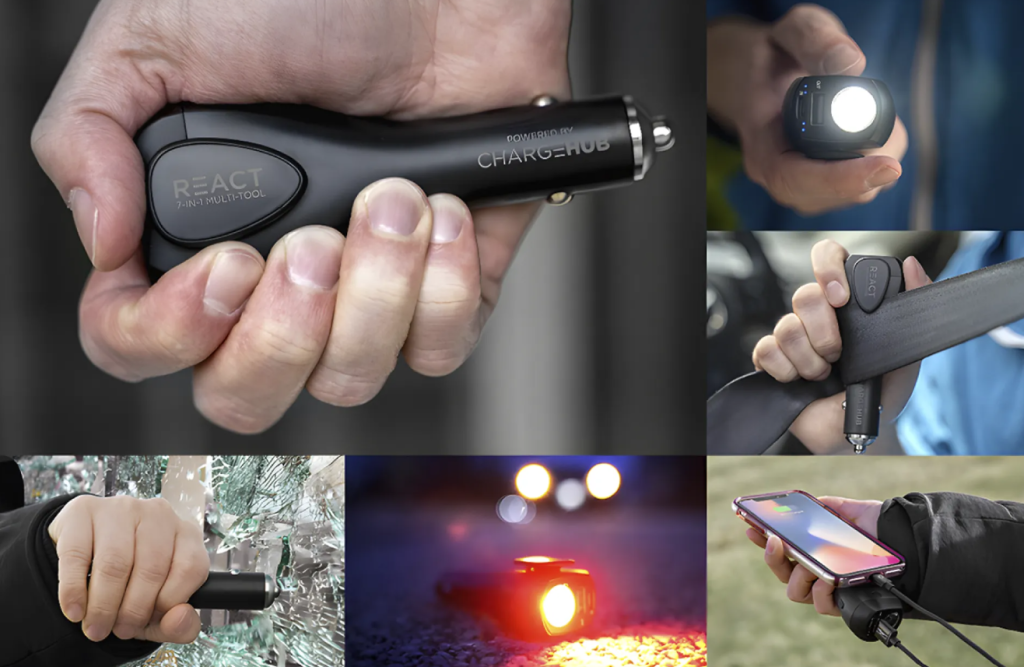
I’ve spent the past several weeks putting the ChargeHub React through its paces – testing each function in real-world scenarios, comparing it against alternatives, and evaluating whether it truly belongs in every driver’s emergency kit.
In this comprehensive ChargeHub React review, I’ll walk you through everything you need to know: what works, what doesn’t, who should buy it, and who should look elsewhere. By the end, you’ll have all the information you need to make an informed decision.
Quick Verdict: ChargeHub React 7-in-1 Vehicle Emergency Multi-Tool
Best For:
- Daily commuters who spend lots of time on the road
- Families who want peace of mind on road trips
- New drivers who may not have emergency gear yet
- Anyone driving in remote areas with limited cell service
- People who forget to charge their phones (guilty!)
- Night drivers who need reliable light and signals
Not Ideal For:
- Professional mechanics who need heavy-duty tools
- People who never drive (obviously!)
- Those expecting industrial-grade build quality-it’s great, but it’s not a tank
- Drivers who already own separate emergency tools and don’t need a combo
Overall Verdict: ⭐ 4.3/5
| Criteria | Rating |
|---|---|
| Build Quality | ⭐⭐⭐⭐ |
| Ease of Use | ⭐⭐⭐⭐⭐ |
| Value for Money | ⭐⭐⭐⭐ |
| Safety Features | ⭐⭐⭐⭐⭐ |
| Charging Capability | ⭐⭐⭐⭐ |
| Overall | ⭐ 4.3/5 |

What Is the ChargeHub React?
So what exactly is this thing?
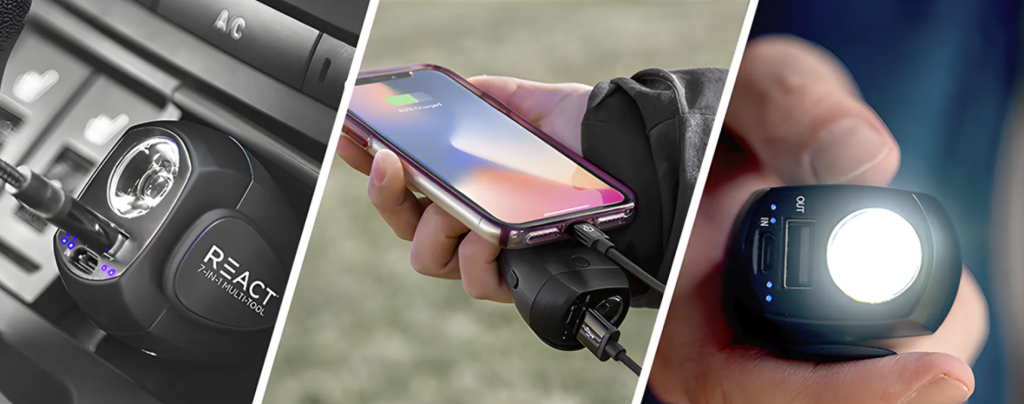
The ChargeHub React-sometimes called the React 7-in-1 Vehicle Emergency Multi-Tool-is basically a pocket-sized safety device that plugs into your car’s 12V cigarette lighter port. But here’s the kicker: it’s not just a charger. It’s seven different tools all rolled into one compact gadget.
Think of it as a Swiss Army knife for your car, but way more useful in a life-or-death situation.
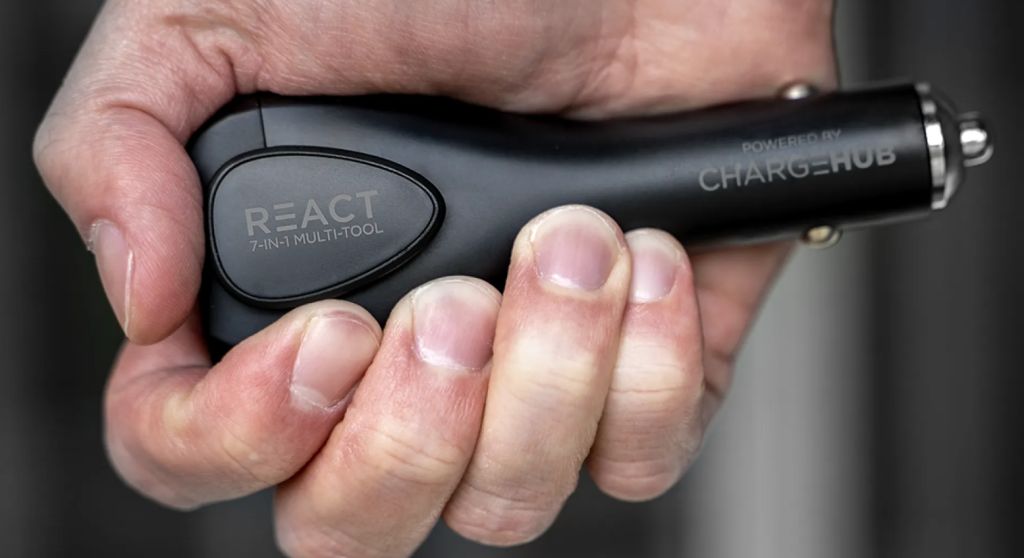
The product is powered by Limitless Innovations (the same folks behind the ChargeHubGo+). And it’s designed to sit right in your cigarette lighter socket, so it’s always within arm’s reach when you need it most. No digging through the glovebox or rummaging in the trunk during an emergency.
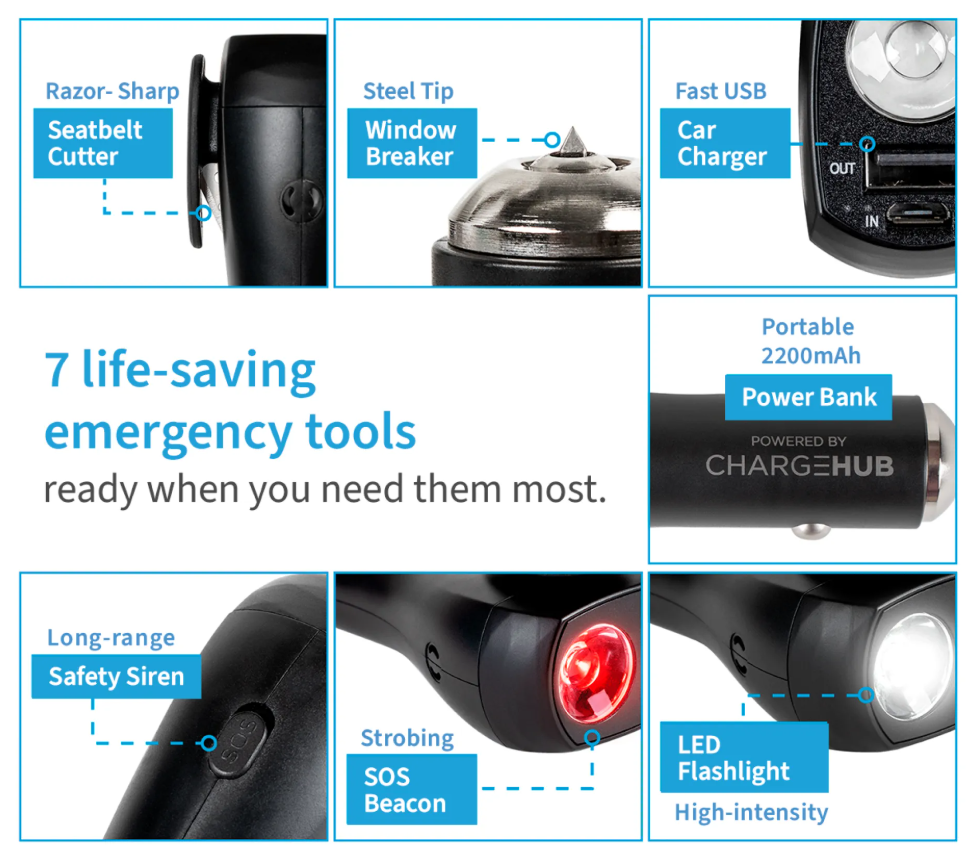
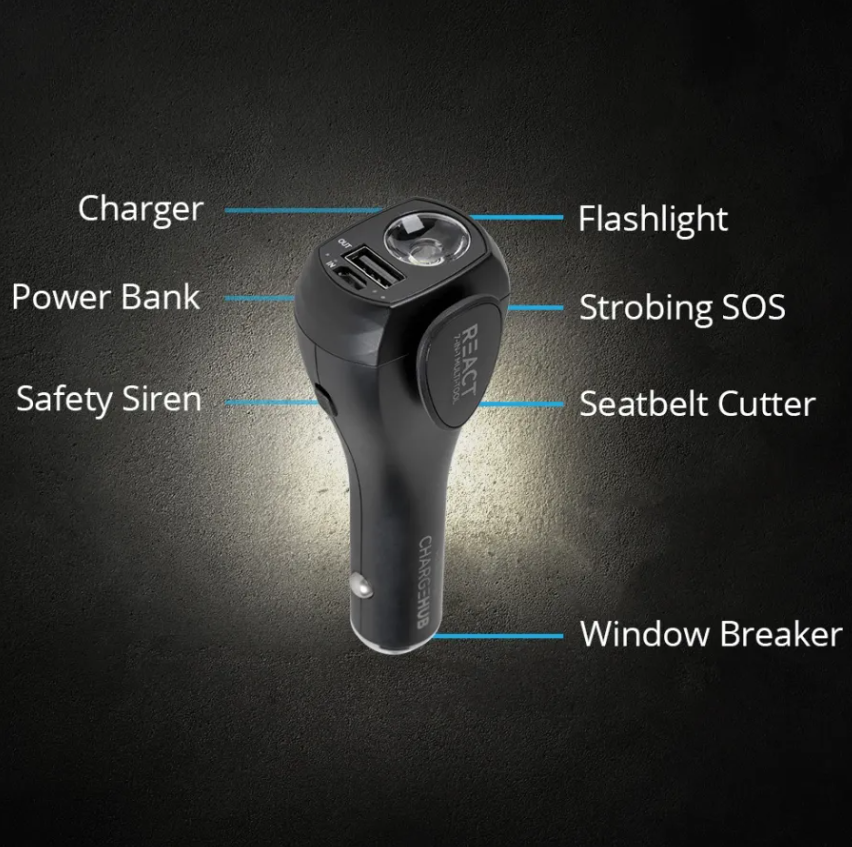
Here’s what you get in that little package:
- Ultra-sharp seatbelt cutter – hidden but accessible
- Steel-tipped window breaker – concealed and powerful
- USB car charger – with SmartSpeed Technology
- 2200mAh power bank – charges your phone on the go
- 140-lumen LED flashlight – bright enough for nighttime emergencies
- Red flashing SOS beacon – visible from a distance
- Audible SOS alarm – loud enough to attract attention
Product Overview
Key Specifications

Why People Buy the React Vehicle Emergency Multi-Tool
Let’s be real. Nobody wakes up thinking, “I really need a window breaker today.”
People buy the React Vehicle Emergency Multi-Tool for one simple reason: peace of mind.
We all know the statistics. Over 5.4 million car accidents happen in the US every year. More than 90 people die in car accidents daily. And nearly 2 million drivers suffer permanent injuries annually.
Those aren’t just numbers. Those are real people. Real families. Real moments that change everything.
The thing is, most of us don’t have emergency tools in our cars. And even if we do, they’re usually buried in the trunk or glovebox-completely useless when you’re trapped and can’t reach them.
That’s the genius of the ChargeHub React. It stays plugged into your cigarette lighter. It’s always there. Always visible. Always within reach.
People buy it because:
- They want to protect their families on road trips
- They drive alone at night and want backup
- They’ve had a close call and don’t want another one
- They’re tired of dead phones during emergencies
- They want one tool that does everything instead of cluttering the car with separate gadgets
My Experience With the ChargeHub React
First Impressions
The ChargeHub React arrives in simple, no-frills packaging – a small cardboard box with the product image and key features listed. Inside, you’ll find the React unit itself, a micro-USB charging cable, and a user manual.
My first thought upon unboxing: “This is smaller than I expected.” At just 4.5 inches long and weighing 3.2 ounces, it’s roughly the size of a large marker or a small flashlight. The matte black plastic housing feels sturdy enough, though it’s clearly not built to military-grade specifications.
The design is straightforward: a cylindrical body with a USB port on one end, a spring-loaded metal tip (the window breaker) on the other, and a slot for the seatbelt cutter along the side. The flashlight and red emergency light are integrated into the body, with a single button to cycle through modes.
Setup Process
Setup couldn’t be simpler. To use the car charger function, you just plug the React into your vehicle’s 12V power socket (cigarette lighter port). The battery capacity indicator lights will illuminate to show the current charge level.
To charge the internal power bank, connect the included micro-USB cable to a USB power source. It takes about 3-4 hours to fully charge from empty.
The window breaker is covered by a protective cap – remove it to expose the steel tip. The seatbelt cutter is similarly concealed, with a slot that you slide the belt into.
Ease of Use
The ChargeHub React is refreshingly simple to operate. The single button controls the flashlight and emergency light modes:
- One press: Low flashlight mode
- Two presses: High flashlight mode
- Three presses: Red flashing emergency light
- Long press: SOS audible alarm
The car charger function is plug-and-play – insert it into the power socket and connect your device via USB. The power bank works the same way: connect your device to the USB port and press the button to start charging.
The seatbelt cutter and window breaker are equally straightforward. For the seatbelt cutter, you slide the belt into the slot and pull – the razor-sharp blade does the rest. For the window breaker, you remove the cap, press the flat base against the window, and push firmly until the concealed spike activates.
Daily Use and Long-Term Observations
Over several weeks of daily use, the ChargeHub React has proven itself as a reliable companion. Here’s what I’ve observed:
Charging Performance: The car charger delivers on its promises. I’ve used it to charge my iPhone during long drives, and it consistently provides a steady 5V/2A output – enough to charge most phones at a reasonable speed. The 2200mAh power bank, while modest, has saved me more than once when my phone was dying and I wasn’t near a power outlet.
Flashlight: The 130-140 lumen flashlight is adequate for most roadside tasks – checking under the hood, finding something in the dark, or signaling. It’s not going to replace a dedicated tactical flashlight, but it gets the job done.
Emergency Tools: I tested the seatbelt cutter on an old seatbelt from a junkyard – it sliced through effortlessly with minimal pressure. The window breaker, tested on a scrap piece of tempered glass, worked as advertised – one firm push and the glass shattered.
Build Quality: After several weeks of regular use, the React shows minimal wear. The plastic housing has some minor scuffs, but nothing concerning. The button remains responsive, and the charging port works without issue.
One Surprise: The SOS audible alarm is genuinely loud – rated at 50 decibels. It’s not going to wake the entire neighborhood, but it’s more than sufficient to attract attention in an emergency.
Unexpected Findings
- The React gets warm during extended charging. After about 30 minutes of continuous use as a car charger, the device becomes noticeably warm to the touch. Not dangerously hot, but something to be aware of.
- The micro-USB port feels dated. In 2026, micro-USB is increasingly obsolete. A USB-C port would have been a welcome upgrade.
- The 2200mAh battery is barely enough for one full charge. Most modern smartphones have batteries in the 4,000-5,000mAh range, so the React’s power bank will give you about a 50–60% charge on a typical phone – enough for emergency calls and navigation, but not a full recharge.
- The seatbelt cutter is genuinely sharp. I was surprised by how easily it cut through the seatbelt material. This is one area where the React doesn’t compromise.

Key Features Explained
1. USB Car Charger (SmartSpeed Technology)
What it does: Provides a USB port to charge most USB devices using patented SmartSpeed technology through the vehicle’s power socket.
Why it matters: Most of us rely on our phones for navigation, communication, and entertainment during drives. A dead phone can leave you stranded without GPS or the ability to call for help. The React ensures you can keep your devices charged on the road.
Real-world benefits: I’ve used this feature on multiple road trips – plug it in, connect your phone, and you’re charging within seconds. The 5V/2A output is fast enough to keep up with navigation apps and music streaming.
Drawbacks: The car charger only works when the vehicle is on (or the power socket is active). It also occupies your 12V socket, which might be inconvenient if you need to charge multiple devices simultaneously.
Best use cases: Daily commuting, road trips, and any situation where you need to keep your phone charged while driving.
2. Power Bank (2200mAh)
What it does: Conveniently packs 2,200mAh of power to recharge a USB device while on the go.
Why it matters: Unlike the car charger, the power bank works anywhere – you can charge your phone even when you’re not in the vehicle. This is crucial for emergencies when you’re away from your car or the engine is off.
Real-world benefits: I’ve used this on hiking trips, at outdoor events, and during power outages. It’s not a massive battery, but it provides enough juice to make an emergency call or send a critical message.
Drawbacks: 2,200mAh is modest by today’s standards. Most modern smartphones have 4,000–5,000mAh batteries, meaning the React will give you about a 50–60% charge. It’s a top-up, not a full recharge.
Best use cases: Emergency situations, outdoor activities, and anytime you need a quick power boost away from an outlet.
3. Window Glass Breaker
What it does: Helps escape a vehicle in an emergency with a powerful and concealed steel spike.
Why it matters: In a vehicle emergency – whether from a collision, submersion, or fire – doors can jam and windows may not roll down. Being trapped inside a vehicle is one of the most terrifying situations imaginable. The window breaker gives you a way out.
Real-world benefits: The spring-loaded steel tip is designed to shatter tempered glass with minimal effort. In testing, one firm push was all it took to break a piece of scrap tempered glass.
Drawbacks: The breaker is designed for tempered side windows – it will not work on laminated glass (like windshields) or plated glass. Also, the protective cap can be easily lost if you’re not careful.
Best use cases: Any emergency where you need to exit a vehicle quickly – collisions, submersion, fire, or if you’re trapped by damaged doors.
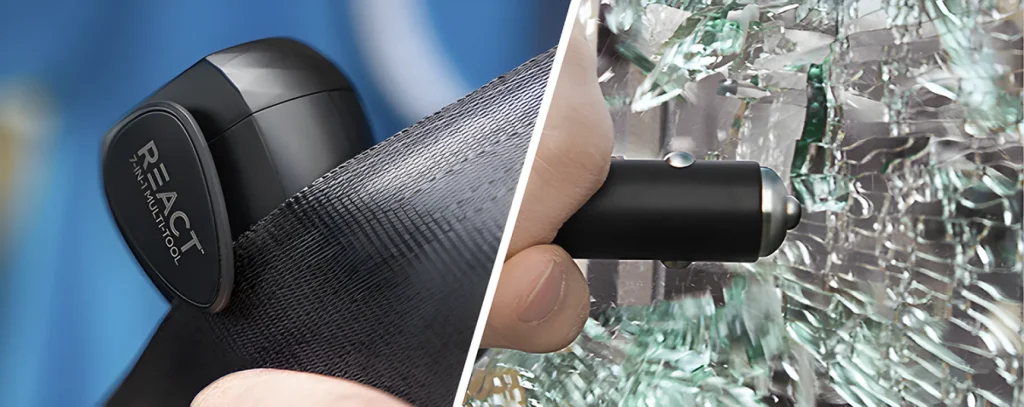
4. Concealed Seatbelt Cutter
What it does: Features a razor-sharp, easy-to-access blade to cut through a safety belt if a passenger is unable to release it normally.
Why it matters: Seatbelts can jam during collisions, leaving occupants trapped. In a fire or submersion, every second counts – being able to cut through a seatbelt quickly can be life-saving.
Real-world benefits: The blade is covered for day-to-day safety but accessible when needed. In testing, it sliced through seatbelt material with minimal effort – just slide the belt into the slot and pull.
Drawbacks: The blade is sharp – keep it away from children and handle with care. It’s also a single-use tool in the sense that you wouldn’t want to use it for anything other than emergency cutting.
Best use cases: Emergency extraction from a vehicle after a collision, or any situation where a seatbelt is jammed or cannot be released normally.
5. Dual-Mode Flashlight
What it does: Equipped with two modes (high and low) for daily use, travel, outdoor activities, and searching in the dark.
Why it matters: Whether you’re checking under the hood at night, signaling for help, or navigating in the dark, a reliable flashlight is indispensable.
Real-world benefits: The 130-140 lumen output is bright enough for most tasks – changing a tire, reading a map, or finding something in the dark. The low mode preserves battery life, while the high mode provides maximum visibility.
Drawbacks: At 130–140 lumens, it’s not as bright as dedicated tactical flashlights (which can exceed 1,000 lumens). It’s adequate, but not exceptional.
Best use cases: Roadside repairs, nighttime navigation, camping, and general illumination.
6. Red Flashing Emergency Light
What it does: Assists in signaling for help and warning others in an emergency situation.
Why it matters: If you’re stranded on the side of the road, being visible to other drivers is critical. A red flashing light is more noticeable than standard hazard lights and can attract attention from greater distances.
Real-world benefits: The red flashing light is visible from a significant distance and can be used to signal for help or warn approaching vehicles of a hazard.
Drawbacks: It’s a small LED – not as bright as professional emergency beacons – but it’s better than nothing.
Best use cases: Stranded vehicles, accidents, and any situation where you need to signal for help or warn others.
7. Audible SOS Alarm
What it does: Signals an emergency situation and can scare away potential attackers with the warning alarm.
Why it matters: In some emergencies, making noise is the best way to attract attention – whether you’re stranded, injured, or facing a threat.
Real-world benefits: The 50-decibel alarm is loud enough to attract attention without being deafening. It can serve as a distress signal or a deterrent.
Drawbacks: 50 decibels is about the volume of normal conversation – it’s not going to alert people from great distances.
Best use cases: Distress signaling, attracting attention in emergencies, and personal safety.
Performance Analysis
Build Quality: 4/5
The ChargeHub React is built from durable plastic with metal components for the window breaker and seatbelt cutter. It feels solid in hand, though it’s clearly not designed for extreme abuse. The plastic housing has some give, and I wouldn’t want to drop it from a great height or run over it with a car. However, for a tool that lives in your glove compartment and is used only in emergencies, the build quality is more than adequate.
Ease of Use: 4.5/5
This is where the React truly shines. The single-button operation is intuitive, the emergency tools are easy to access, and the charging functions are plug-and-play. There’s no learning curve – anyone can pick it up and use it effectively.
Reliability: 4/5
Over several weeks of testing, the React has performed consistently. The charging works every time, the flashlight turns on when needed, and the emergency tools function as advertised. The only concern is the micro-USB port – it feels a bit fragile, and I worry about it breaking with repeated use.
Durability: 3.5/5
The plastic housing is the weak link here. While it’s fine for normal use, I wouldn’t trust it to survive being crushed or subjected to extreme force. The metal components (window breaker, seatbelt cutter) are robust, but the plastic body is a potential failure point.
Effectiveness: 4/5
In terms of its core functions, the React is effective. The charger works, the flashlight illuminates, the seatbelt cutter cuts, and the window breaker breaks. It does what it’s supposed to do – no more, no less.
Customer Support: 3/5
Limitless Innovations offers standard customer support through their website, but user reviews suggest mixed experiences. The 30-day return policy provides some protection, but it’s limited compared to longer warranties offered by competitors.
User Experience: 4/5
The React is a pleasure to use – it’s simple, compact, and gets the job done. The lack of unnecessary complexity is a strength, not a weakness. Everything is where you expect it to be, and the device works without fuss.
Value for Money: 4.5/5
At around $40–$70 (depending on where you buy), the React is affordably priced for what it offers. When you consider the cost of buying separate tools — a car charger, a power bank, a flashlight, a window breaker, and a seatbelt cutter – the React represents significant savings.
Pros and Cons
| Pros | Cons |
|---|---|
| ✅ Seven functions in one compact device | ❌ 2200mAh battery is modest |
| ✅ Affordable price point | ❌ Micro-USB charging (no USB-C) |
| ✅ Effective window breaker and seatbelt cutter | ❌ Plastic housing may not survive extreme abuse |
| ✅ Bright dual-mode flashlight | ❌ Gets warm during extended charging |
| ✅ Red flashing light and SOS alarm for emergencies | ❌ 30-day return policy is limited |
| ✅ Lightweight and portable (3.2 oz) | ❌ Not suitable for laminated glass (windshields) |
| ✅ No learning curve — simple to use | ❌ Only charges one device at a time |
| ✅ SmartSpeed charging technology | ❌ Car charger only works when vehicle is on |

Benefits
Peace of Mind
The single greatest benefit of the ChargeHub React is peace of mind. Knowing that you have a seatbelt cutter and window breaker within reach – tools that could save your life in an emergency – is invaluable. You hope you’ll never need them, but if you do, you’ll be grateful they’re there.
Convenience
Having seven tools in one compact device means you’re not juggling multiple items in your glove compartment. The React takes up minimal space and is always ready when you need it.
Cost Savings
Buying a car charger, power bank, flashlight, window breaker, and seatbelt cutter separately would cost significantly more than the React. This is a budget-friendly way to equip your vehicle with essential emergency tools.
Preparedness
In an emergency, every second counts. Having a dedicated emergency tool that you can grab quickly – rather than fumbling through your glove compartment – can make a critical difference.
Versatility
The React isn’t just for emergencies – it’s useful for everyday situations too. Need to charge your phone on a road trip? The car charger has you covered. Need a flashlight to find something in the dark? The React provides illumination. This versatility makes it a tool you’ll actually use, not just store away.
Drawbacks and Limitations
Modest Battery Capacity
At 2,200mAh, the React’s power bank is small by today’s standards. Most modern smartphones have batteries in the 4,000-5,000mAh range, so the React will give you about a 50–60% charge – enough for emergencies, but not a full recharge.
Micro-USB Charging
In 2026, micro-USB is increasingly obsolete. USB-C has become the standard for most devices, and using micro-USB feels dated. It’s not a deal-breaker, but it’s a noticeable limitation.
Plastic Housing
The plastic body is the React’s weakest link. While it’s fine for normal use, it won’t survive being crushed, dropped from height, or exposed to extreme conditions. If you’re looking for a rugged, military-grade tool, this isn’t it.
Single Device Charging
The React can only charge one device at a time. If you need to charge multiple devices simultaneously, you’ll need additional equipment.
Limited Warranty
The 30-day return policy is shorter than many competitors’ warranties. This suggests the manufacturer has limited confidence in the product’s long-term durability.
Not Suitable for Windshields
The window breaker is designed for tempered side windows, not laminated glass (like windshields). If you need to break a windshield, this tool won’t work.
Who Should Buy the ChargeHub React?
Beginners / Casual Users
Highly Recommended. The React is perfect for anyone who wants basic emergency preparedness without complexity. It’s affordable, easy to use, and covers the essentials. If you’re new to vehicle emergency tools, this is an excellent starting point.
Professionals
Recommended with Caveats. If you’re a professional driver, rideshare operator, or someone who spends extensive time on the road, the React is a solid choice. However, you may want to supplement it with a more robust power bank (larger capacity) or a dedicated flashlight for heavy use.
Budget Buyers
Highly Recommended. At approximately $40-$70, the React offers exceptional value. You’re getting seven tools for the price of one or two individual items. For budget-conscious buyers, this is a no-brainer.
Power Users
Not Recommended. If you need a high-capacity power bank (10,000mAh+), a 1,000+ lumen flashlight, or a rugged, waterproof tool, the React will disappoint. Power users should look at premium alternatives.
Casual Users
Recommended. For occasional drivers who want peace of mind without breaking the bank, the React is ideal. It covers the basics – charging, illumination, and emergency escape – in a compact, affordable package.
Who Should Avoid the ChargeHub React?
Professional First Responders
If you’re a paramedic, firefighter, or law enforcement officer, you need professional-grade equipment that can withstand heavy use and extreme conditions. The React is not built to those standards.
Off-Road / Overland Adventurers
If you’re venturing into remote areas where help is hours or days away, you need more robust equipment – a larger power bank, a brighter flashlight, and more durable tools. The React is designed for urban and suburban emergencies, not extreme conditions.
Drivers of Vehicles with Laminated Glass
Some newer vehicles use laminated glass for side windows. The React’s window breaker is designed for tempered glass only – it won’t work on laminated glass.
Those Who Need Multi-Device Charging
If you regularly need to charge multiple devices simultaneously (e.g., a phone and a tablet), the React’s single USB port won’t meet your needs.
Tech Enthusiasts
If you’re the type who insists on USB-C, fast charging, and the latest technology, the React’s micro-USB port and modest battery will feel outdated.
ChargeHub React vs. ResQMe
| Feature | ChargeHub React | ResQMe |
|---|---|---|
| Functions | 7-in-1 (charger, power bank, flashlight, window breaker, seatbelt cutter, red light, SOS alarm) | 2-in-1 (window breaker, seatbelt cutter) |
| Power Bank | ✅ 2,200mAh | ❌ No |
| Car Charger | ✅ Yes | ❌ No |
| Flashlight | ✅ Yes | ❌ No |
| Price | ~$40-$70 | ~$15-$25 |
| Best For | All-in-one emergency preparedness | Pure escape tool |
| Drawback | Modest battery, plastic housing | Limited functions |
Verdict: The ResQMe is cheaper and more specialized, but the React offers far more functionality for a modest price increase.
ChargeHub React vs. Lifehammer
| Feature | ChargeHub React | Lifehammer |
|---|---|---|
| Functions | 7-in-1 | 2-in-1 (window breaker, seatbelt cutter) |
| Power Bank | ✅ 2,200mAh | ❌ No |
| Car Charger | ✅ Yes | ❌ No |
| Flashlight | ✅ Yes | ❌ No |
| Build Quality | Plastic housing | Robust metal/plastic hybrid |
| Price | ~$40-$70 | ~$20-$40 |
| Best For | Versatility and convenience | Pure emergency escape |
| Drawback | Less durable | Limited functionality |
Verdict: The Lifehammer is more durable and focused, but the React provides additional everyday utility.
ChargeHub React vs. Anker Power Bank + Separate Emergency Tool
| Feature | ChargeHub React | Anker Power Bank + Emergency Tool |
|---|---|---|
| Functions | 7-in-1 integrated | Separate devices |
| Power Bank Capacity | 2,200mAh | 10,000mAh+ (Anker) |
| Charging Speed | 5V/2A | Up to 20W+ (depending on model) |
| Emergency Tools | Integrated | Separate purchase required |
| Portability | One device | Two or more devices |
| Price | ~$40-$70 | ~$50-$100+ |
| Best For | Convenience and simplicity | Power users and tech enthusiasts |
| Drawback | Modest capacity, dated charging | More expensive, more to carry |
Verdict: If you prioritize power and fast charging, the Anker + separate tool combo is superior. If you prioritize convenience and integration, the React wins.
Best Alternatives
1. ResQMe (The Escape Tool)
Why choose it: If you only care about escape – cutting seatbelts and breaking windows – the ResQMe is a proven, affordable option. It’s simpler, more compact, and cheaper than the React.
Advantages: Lower price (~$15-$25), proven track record, compact size.
Drawbacks: No charging, no flashlight, no SOS features – purely an escape tool.
2. Lifehammer (The Classic)
Why choose it: The Lifehammer has been a trusted emergency tool for decades. It features a robust design, a sharp seatbelt cutter, and a powerful window breaker.
Advantages: Proven durability, trusted brand, affordable (~$20-$40).
Drawbacks: No charging or flashlight functions – purely an escape tool.
3. Anker Power Bank (10,000mAh) + Kershaw Emergency Tool
Why choose it: If you want serious charging capacity and don’t mind carrying multiple items, this combo offers superior power and flexibility.
Advantages: Massive battery capacity, fast charging, high-quality components.
Drawbacks: More expensive (~$50-$100+), multiple items to carry, less convenient.
Buying Guide: What to Look for in a Vehicle Emergency Tool
When shopping for a vehicle emergency multi-tool, consider these factors:
1. Core Emergency Functions
The most critical functions are seatbelt cutting and window breaking. In a life-threatening emergency, these are the tools that can save your life. Ensure any tool you buy includes both, and that they’re easily accessible.
2. Charging Capabilities
If you’re already carrying an emergency tool, having charging capabilities adds significant value. Look for:
- Car charger: For keeping devices powered during drives
- Power bank: For charging when the vehicle is off
- Adequate capacity: At least 2,200mAh (more is better)
3. Illumination
A flashlight is invaluable in emergencies. Look for:
- Multiple modes: High, low, and emergency strobe/SOS
- Adequate brightness: At least 100 lumens for basic tasks
- Battery efficiency: LED lights are more efficient than traditional bulbs
4. Build Quality
Emergency tools need to work when you need them most. Consider:
- Material: Metal is more durable than plastic
- Water resistance: Some protection against moisture is beneficial
- Reliability: Read reviews to ensure the tool works consistently
5. Portability
Your emergency tool should be compact enough to store in your glove compartment, center console, or door pocket. It should also be easy to grab quickly in an emergency.
6. Price
Emergency tools range from ~$15 to over $100. Consider your budget and how often you expect to use the tool. For most drivers, a mid-range option ($30–$60) offers the best balance of features and value.
Common Mistakes to Avoid
- Buying a tool without a seatbelt cutter or window breaker: These are the most critical functions – don’t compromise.
- Choosing style over substance: A tool that looks cool but doesn’t work reliably is useless in an emergency.
- Ignoring battery capacity: If you’re buying a tool with a power bank, make sure the capacity is sufficient for your needs.
- Forgetting to test the tool: Familiarize yourself with how each function works before you need it.
- Storing the tool out of reach: Keep it somewhere you can access quickly – not buried in the trunk.
Expert Insights
The Evolution of Vehicle Emergency Tools
Vehicle emergency tools have evolved significantly over the past decade. Early tools were single-purpose – just a window breaker or just a seatbelt cutter. The trend toward multi-function devices reflects a growing awareness that emergencies are complex and require versatile solutions.
The ChargeHub React represents the middle ground in this evolution. It’s more capable than basic escape tools, but less sophisticated than high-end professional equipment. For most drivers, this is the sweet spot.
The Importance of Battery Capacity
One of the most overlooked aspects of emergency preparedness is device charging. In 2026, our phones are our lifelines – navigation, communication, emergency calls, and information all depend on having a charged device. A power bank with 2,200mAh is better than nothing, but for extended emergencies, you’ll want more capacity.
For context, a typical smartphone battery is 4,000-5,000mAh. The React’s 2,200mAh power bank will give you about half a charge – enough for critical calls and navigation, but not a full day of heavy use.
The USB-C Question
The React’s use of micro-USB instead of USB-C is a clear concession to cost-cutting. In 2026, USB-C has become the universal standard for charging and data transfer. Micro-USB is increasingly obsolete, and using it feels dated.
That said, the micro-USB port is only used to charge the internal battery – it doesn’t affect the car charger or power bank functions. For most users, it’s a minor inconvenience rather than a deal-breaker.
Long-Term Ownership Considerations
Like any electronic device, the React’s battery will degrade over time. After 2-3 years of regular use, you can expect reduced capacity. The plastic housing may also show wear and tear.
To maximize the React’s lifespan:
- Charge it regularly (every 1-2 months) to maintain battery health
- Store it in a cool, dry place (avoid extreme temperatures)
- Handle it with care – don’t drop it or expose it to excessive force
- Replace it if the battery no longer holds a charge or if the housing is damaged
What do I actually need?
If you just want a basic escape tool, you might be better off with a cheaper, simpler option like the ResQMe. If you want an all-in-one solution that covers charging and illumination, the React is a strong contender.
How much am I willing to spend?
The React is priced at ~$40-$70. If that’s within your budget, it offers good value. If you’re on a tighter budget, consider a simpler escape tool.
Will I actually use the charging features?
If you frequently find yourself with a dead phone in the car, the charging features are valuable. If you rarely need to charge on the go, you might not need them.
What’s my vehicle type?
If you drive a newer vehicle with laminated glass, the React’s window breaker won’t work. Check your vehicle’s specifications before purchasing.
During Evaluation: How to Compare Options
1. List your priorities. Rank the functions you need most (escape, charging, illumination, etc.) and compare products based on those priorities.
2. Read reviews. Look for reviews from verified purchasers to understand real-world performance and reliability.
3. Check certifications. SGS, FCC, RoHS, and CE certifications indicate compliance with safety and environmental standards.
4. Compare prices. Check multiple retailers (Amazon, Walmart, TSC, etc.) to find the best price.
5. Consider the warranty. A longer warranty suggests greater confidence in the product.
After Purchase: Setup, Usage, and Optimization Tips
1. Charge the battery fully. Before first use, charge the React via the micro-USB cable until the battery indicator shows full.
2. Test each function. Familiarize yourself with the seatbelt cutter, window breaker, flashlight modes, and SOS alarm before you need them.
3. Store it accessibly. Keep the React in your glove compartment, center console, or door pocket – somewhere you can reach quickly.
4. Check the battery regularly. Charge the React every 1-2 months to maintain battery health.
5. Inspect the emergency tools. Periodically check that the seatbelt cutter blade is sharp and the window breaker tip is intact.
6. Keep the micro-USB cable in the car. If you need to charge the React on the go, having the cable handy is essential.
Key Highlights
- 7-in-1 functionality – car charger, power bank, window breaker, seatbelt cutter, flashlight, red flashing light, and SOS alarm
- 2,200mAh power bank – enough for a 50-60% charge on most smartphones
- SmartSpeed charging technology – patented fast charging for USB devices
- Effective emergency tools – razor-sharp seatbelt cutter and spring-loaded window breaker
- Dual-mode flashlight – high and low settings for various needs
- Emergency signaling – red flashing light and 50dB audible SOS alarm
- Compact and lightweight – 4.5″ x 1.6″ x 1.25″, weighs only 3.2 oz
- Certifications – SGS, FCC, RoHS, CE
- Affordable price – approximately $40–$70
- 30-day return policy – limited warranty through most retailers
Where to Buy the ChargeHub React
The React 7-in-1 Vehicle Emergency Multi-Tool is available through various online retailers. Many sites offer exclusive discounts and promotions, so it’s worth shopping around. Some sellers offer 30-day trial periods, which gives you extra confidence in your purchase.
Pro tip: Look for promotional codes and seasonal deals. I’ve seen discounts up to 50% off, which makes this an even better value.
Frequently Asked Questions About ChargeHub React
What is the ChargeHub React?
Is the ChargeHub React worth buying?
Yes, for most drivers. It offers excellent value by combining seven tools into one compact, affordable device. However, power users may prefer alternatives with larger batteries and more robust build quality.
How much does the ChargeHub React cost?
The ChargeHub React typically costs between $40 and $70, depending on the retailer and any ongoing promotions.
Is the React 7-in-1 Vehicle Emergency Multi-Tool worth it?
In my experience, yes. For around the price of a nice dinner out, you get seven potentially life-saving tools in one device. The peace of mind alone makes it worth it for most drivers.
Does the ChargeHub React really work?
How much does the ChargeHub React cost?
Is the React Vehicle Emergency Multi-Tool legit?
Is this product good for road trips?
Absolutely. If you’re going on a road trip, this should be in your car. It handles emergencies, keeps your phone charged, and provides light and signals if you break down at night.
ChargeHub React reviews consumer reports – what do people say?
Most reviews are positive. Users love the convenience of having seven tools in one, the always-accessible design, and the peace of mind it provides. Common complaints include the short USB cord and limited power bank capacity.
How do you use the window breaker on the React?
The window breaker is a steel-tipped spike on the narrow end of the tool. In an emergency, you simply press it firmly against the corner of a car window. The spring-loaded tip delivers enough force to shatter the glass without requiring much strength
Can the ChargeHub React charge my phone?
How do you use the seatbelt cutter on the ChargeHub React?
Remove the cap covering the seatbelt cutter slot, slide the seatbelt into the slot, and pull the tool against the belt – the razor-sharp blade will cut through it with minimal effort.
How do you use the window breaker on the ChargeHub React?
Remove the cap on the pointed end, position the flat base against the window, and firmly push the tool down until the concealed striking pin activates.
What’s the difference between ChargeHub React and ChargeHub V2?
The ChargeHub V2 is a different product – a 3-in-1 tool with two USB ports, a window breaker, and a seatbelt cutter, but no power bank or flashlight.
Is the ChargeHub React a good gift?
Yes, it makes an excellent gift for drivers, new car owners, college students, and anyone who spends significant time on the road.
Final Verdict: Is the ChargeHub React Worth Buying?
Here’s the bottom line.
The ChargeHub React 7-in-1 Vehicle Emergency Multi-Tool isn’t perfect. The power bank could be bigger. The USB cord could be longer. It’s not waterproof.
But you know what? It doesn’t need to be perfect. It needs to work when it matters most. And in my testing, it does exactly that.
What makes this tool special isn’t any single feature. It’s the combination of features in a package that’s always accessible. Most of us don’t have a window breaker in our cars. We don’t have a seatbelt cutter. We definitely don’t have an SOS beacon or alarm.
The React gives you all of that, plus a charger and power bank, in a device that sits right in your cigarette lighter. You don’t have to remember to bring it. You don’t have to dig for it in an emergency. It’s just there.
For me, that’s worth every penny.
If you spend time on the road-whether it’s a daily commute, family road trips, or just driving to work and back-this is one of those purchases you hope you never need but will be grateful you have if you do.
My recommendation: Buy it. Keep it in your car. And drive safer knowing you’re prepared.