
Do you ever feel like your mind is racing at a hundred miles per hour? Maybe your heart pounds before an important meeting, or anxiety keeps you awake at night. You’re not alone—stress affects millions of people every single day.
Here’s the good news: the solution to instant calm is literally right under your nose. Mindful breathing is a simple yet powerful practice that can reduce stress, lower anxiety, and bring peace to your mind in just a few minutes.
In this comprehensive guide, you’ll discover exactly how to practice mindful breathing for instant calm, with seven proven techniques that work whether you’re a complete beginner or looking to deepen your existing practice. No special equipment needed, no complicated rituals—just you and your breath.
Let’s dive in and transform the way you handle stress.
What Is Mindful Breathing and Why Does It Work?
Understanding Mindful Breathing
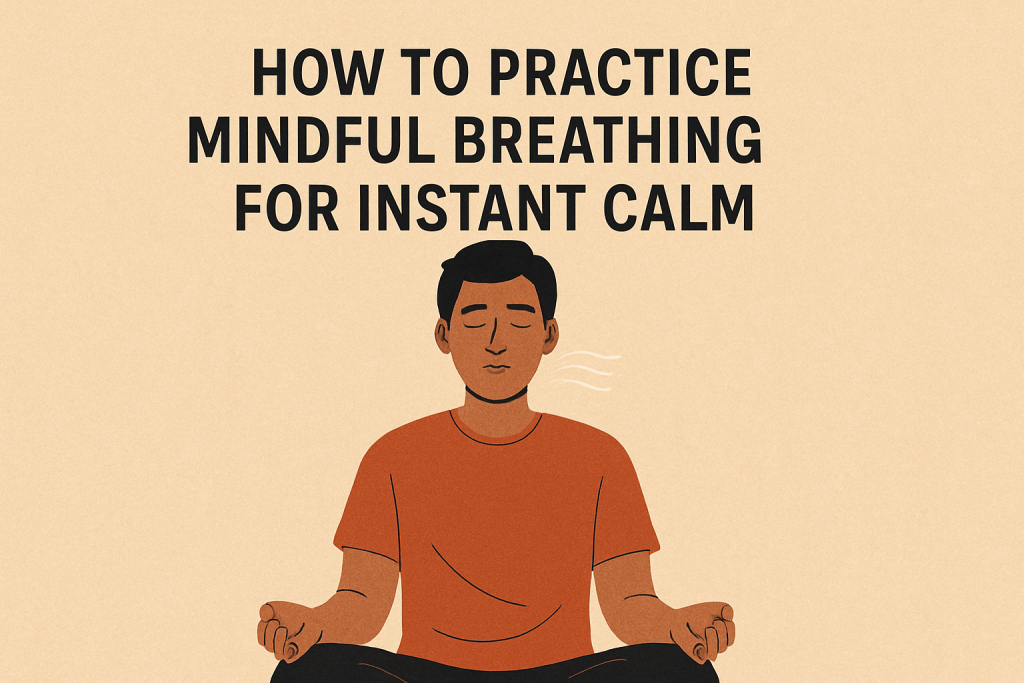
Mindful breathing is the practice of paying deliberate attention to your breath without trying to change it. It’s a form of mindfulness meditation that focuses specifically on breathing patterns, helping you anchor your awareness in the present moment.
Unlike regular breathing (which happens automatically), mindful breathing involves conscious observation of:
- The sensation of air entering and leaving your nostrils
- The rise and fall of your chest and abdomen
- The natural rhythm and pace of each breath
- The brief pause between inhalation and exhalation
The Science Behind Instant Calm
When you practice mindful breathing, remarkable things happen in your body and brain. Research shows that controlled breathing directly influences your nervous system, triggering what scientists call the “relaxation response.”
Here’s what happens physiologically:
- Activates the parasympathetic nervous system: This is your body’s natural “rest and digest” mode, counteracting the stress-induced “fight or flight” response.
- Reduces cortisol levels: The stress hormone cortisol decreases significantly during mindful breathing exercises.
- Lowers heart rate and blood pressure: Slow, deep breaths signal safety to your brain, promoting cardiovascular relaxation.
- Increases oxygen flow: Better oxygenation improves brain function, clarity, and emotional regulation.
Key Benefits of Mindful Breathing Practice
| Benefit Category | Specific Outcomes |
|---|---|
| Mental Health | Reduced anxiety, decreased depression symptoms, improved emotional balance |
| Physical Health | Lower blood pressure, better sleep quality, reduced chronic pain |
| Cognitive Function | Enhanced focus, better decision-making, increased mental clarity |
| Emotional Regulation | Greater self-awareness, improved stress management, emotional stability |
How to Practice Mindful Breathing: 7 Powerful Techniques for Instant Calm
1. Basic Awareness Breathing (Best for Beginners)
This foundational technique is perfect if you’re new to mindful breathing exercises.
Step-by-Step Instructions:
- Find a comfortable seated or lying position
- Close your eyes or maintain a soft gaze downward
- Bring your attention to your natural breathing pattern
- Notice the sensation of air flowing through your nostrils
- Feel your chest and belly expand with each inhale
- Observe the natural exhale without forcing anything
- When your mind wanders (it will!), gently return focus to your breath
- Continue for 3-5 minutes
Pro Tip: Don’t judge yourself when thoughts arise. Mind wandering is completely normal. The practice is in noticing and returning to your breath.
2. The 4-7-8 Breathing Technique (For Quick Stress Relief)
Developed by wellness expert Dr. Andrew Weil, this technique is often called a “natural tranquilizer for the nervous system.”
How to Do It:
- Exhale completely through your mouth, making a whoosh sound
- Close your mouth and inhale quietly through your nose for 4 counts
- Hold your breath for 7 counts
- Exhale completely through your mouth for 8 counts, making a whoosh sound
- Repeat this cycle 3-4 times
Best Used For: Falling asleep, managing acute anxiety, calming down before presentations
Why It Works: The extended exhale activates your vagus nerve, triggering immediate relaxation.
3. Box Breathing (Used by Navy SEALs)
Also called square breathing, this technique is used by military personnel and first responders to stay calm under pressure.
The Method:
- Inhale through your nose for 4 counts
- Hold your breath for 4 counts
- Exhale through your nose for 4 counts
- Hold empty lungs for 4 counts
- Repeat for 5-10 cycles
Visualization Tip: Imagine tracing the sides of a square as you count. This adds a visual anchor to your practice.
Perfect For: High-stress situations, improving focus before important tasks, managing panic attacks
4. Diaphragmatic Breathing (Belly Breathing)
This technique engages your diaphragm fully, promoting deeper relaxation and better oxygen exchange.
Instructions:
- Lie on your back or sit comfortably with straight posture
- Place one hand on your chest and the other on your belly
- Inhale deeply through your nose, allowing your belly to rise (chest should stay relatively still)
- Exhale slowly through pursed lips, feeling your belly fall
- The hand on your belly should move more than the one on your chest
- Practice for 5-10 minutes
Common Mistake to Avoid: Many people breathe shallowly into their chest. Focus on expanding your belly like a balloon.
5. Counted Breath Meditation
This technique combines mindfulness with counting to keep your attention focused.
How to Practice:
- Sit in a comfortable meditation posture
- Take a natural breath in
- As you exhale, silently count “one”
- Inhale naturally, then exhale while counting “two”
- Continue up to “ten,” then start over
- If you lose count, simply start again at “one”
- Practice for 10-20 minutes
Why Counting Helps: Gives your analytical mind a task, reducing random thoughts and increasing concentration.
6. Alternate Nostril Breathing (Nadi Shodhana)
This ancient yogic technique balances both hemispheres of your brain and creates deep calm.
Step-by-Step:
- Sit comfortably with an upright spine
- Use your right thumb to close your right nostril
- Inhale slowly through your left nostril
- Close your left nostril with your right ring finger
- Release your thumb and exhale through your right nostril
- Inhale through the right nostril
- Switch: close right nostril, exhale through left
- This completes one cycle—repeat 5-10 times
Caution: If you have nasal congestion or sinus issues, skip this technique and choose another.
7. Body Scan Breathing
This technique combines breath awareness with progressive body relaxation.
Complete Practice:
- Lie down in a comfortable position
- Take three deep, cleansing breaths
- Bring attention to your toes—notice any sensations
- As you breathe in, imagine sending breath to your toes
- As you exhale, release any tension there
- Move systematically upward: feet, calves, thighs, hips, abdomen, chest, arms, shoulders, neck, face
- Spend 2-3 breaths on each body part
- End by taking three full-body breaths, feeling completely relaxed
Best Time to Practice: Before sleep, during lunch breaks, or anytime you need full-body relaxation.
Creating Your Daily Mindful Breathing Practice
How Long Should You Practice?
The beauty of mindful breathing is its flexibility. Here’s a practical breakdown:
For Beginners:
- Start with 3-5 minutes daily
- Practice at the same time each day to build habit
- Gradually increase to 10 minutes
For Intermediate Practitioners:
- Aim for 10-15 minutes daily
- Add mini-sessions throughout the day (2-3 minutes each)
- Experiment with different techniques
For Advanced Practice:
- 20-30 minutes of focused practice
- Multiple shorter sessions integrated into daily life
- Combine with other mindfulness practices
Best Times to Practice Mindful Breathing
| Time of Day | Benefits | Recommended Technique |
|---|---|---|
| Morning (Upon Waking) | Sets positive tone for the day, increases alertness | Basic Awareness or Counted Breath |
| Mid-Morning (10-11 AM) | Combats mid-morning energy dip, refocuses attention | Box Breathing |
| Lunch Break | Resets stress accumulation, improves afternoon productivity | Diaphragmatic Breathing |
| Afternoon (3-4 PM) | Overcomes afternoon slump, maintains energy | Alternate Nostril Breathing |
| Before Stressful Events | Calms nerves, improves performance | 4-7-8 Technique or Box Breathing |
| Evening (Before Bed) | Promotes better sleep, releases daily tension | Body Scan Breathing or 4-7-8 |
Creating a Dedicated Practice Space
You don’t need a fancy meditation room, but a consistent space helps signal to your brain that it’s time to relax.
Essential Elements:
- Quiet location with minimal distractions
- Comfortable seating (chair, cushion, or mat)
- Proper temperature (not too hot or cold)
- Optional: calming elements like plants, soft lighting, or gentle background sounds
Common Mistakes and How to Avoid Them
Mistake 1: Forcing Your Breath
The Problem: Many beginners try to control or change their breathing pattern, which creates tension.
The Solution: Simply observe your natural breath. Let it be exactly as it is. Your breath knows what to do.
Mistake 2: Expecting Immediate Perfection
The Problem: Getting frustrated when your mind wanders constantly.
The Solution: Mind wandering is part of the process. Each time you notice and return to your breath, you’re actually succeeding at mindfulness.
Mistake 3: Practicing Only During Crisis
The Problem: Waiting until you’re extremely stressed to try mindful breathing.
The Solution: Build daily practice during calm moments. This trains your nervous system to respond better during actual stress.
Mistake 4: Breathing Too Deeply or Quickly
The Problem: Taking excessively deep breaths or breathing too fast can cause lightheadedness.
The Solution: Breathe naturally and comfortably. Gentle, steady breaths are more effective than dramatic ones.
Mistake 5: Practicing in Distracting Environments
The Problem: Trying to meditate with TV on, in loud spaces, or while multitasking.
The Solution: Choose quiet moments and dedicated time. Even 3 minutes of focused practice beats 10 minutes of distracted attempts.
Some of Trending Sleep Gadgets
Purisaki Berberine Patches Review
Sondur Travel Cushion Review
Vanish DrySerum Review
Hears Earplugs Review
Serenesitz Orthopedic Seat Cushion Review
Mindful Breathing for Specific Situations
For Anxiety and Panic Attacks
When anxiety strikes, your breath becomes shallow and rapid. Use these approaches:
Immediate Response:
- Acknowledge what you’re feeling without judgment
- Place one hand on your chest, one on your belly
- Focus on making your belly hand move with each breath
- Slow your exhale to be longer than your inhale
- Use the 4-7-8 technique for rapid calming
During a Panic Attack:
- The 4-7-8 breathing technique is particularly effective
- Focus on lengthening the exhale to activate calming responses
- Remind yourself: “This feeling is temporary and will pass”
For Better Sleep Quality
Mindful breathing before bed signals to your body that it’s time to rest.
Bedtime Breathing Routine:
- Lie in your preferred sleep position
- Practice the Body Scan Breathing technique (10-15 minutes)
- Transition to the 4-7-8 technique (4 cycles)
- Allow natural breathing as you drift to sleep
Tip: If you wake during the night, return to gentle counted breathing instead of checking your phone.
For Improved Focus and Concentration
Before important work or study sessions:
- Sit upright in your chair
- Practice Box Breathing for 5 minutes
- Set an intention for your work session
- Begin your task with refreshed mental clarity
Mini-Breaks: Every 45-60 minutes, take 2 minutes for Basic Awareness Breathing to reset attention.
For Anger Management
When anger rises, your breath becomes rapid and irregular.
Cooling Down Process:
- Remove yourself from the triggering situation if possible
- Take three very slow, deep breaths
- Practice Box Breathing for 3-5 minutes
- Notice the physical sensations calming down
- Return to the situation with more perspective
Integrating Mindful Breathing Into Daily Life
Micro-Practices Throughout Your Day
You don’t always need a formal session. Try these brief breathing moments:
While Waiting:
- In line at the store: 5 conscious breaths
- At red lights: Practice awareness breathing
- During commercials: 2-minute breathing break
During Transitions:
- Before entering your home: 3 deep breaths to shift from work mode
- Before meals: 5 breaths to promote mindful eating
- After closing your laptop: 10 counted breaths
In Social Situations:
- Before difficult conversations: 1 minute of calming breath
- During tense meetings: subtle diaphragmatic breathing
- After social interactions: release breath to decompress
Combining Mindful Breathing With Other Activities
Walking Meditation:
- Coordinate breathing with steps
- Inhale for 3-4 steps, exhale for 3-4 steps
- Notice both breath and movement simultaneously
Yoga and Stretching:
- Match breath with movement
- Inhale during expansion, exhale during contraction
- Use breath to deepen stretches safely
During Exercise:
- Maintain awareness of breathing during workouts
- Avoid holding your breath during exertion
- Use breath to find sustainable pace
Tools and Apps to Support Your Practice
Helpful Technology
While not necessary, these tools can support your mindful breathing journey:
Meditation Apps:
- Guided breathing exercises with timers
- Progress tracking and reminders
- Various techniques for different needs
Breathing Pace Guides:
- Visual breathing animations
- Customizable timing for different techniques
- Haptic feedback options
Simple Timers:
- Set intervals for practice sessions
- Bell sounds to mark beginning and end
- No need for constant clock-watching
Going Tech-Free
Remember, your most important tool is already with you—your breath. Consider:
- Setting simple alarms as reminders
- Using a physical journal to track progress
- Creating visual cues in your environment (sticky notes, objects that remind you to breathe)
Tracking Your Progress and Staying Motivated
Keeping a Breathing Practice Journal
Document your journey to notice patterns and improvements:
What to Record:
- Date and time of practice
- Duration and technique used
- How you felt before and after
- Any observations or insights
- Challenging moments and breakthroughs
Sample Entry Format:
Date: December 15, 2025 Time: 7:00 AM Duration: 10 minutes Technique: Box Breathing Before: Anxious about presentation (7/10) After: Calm and focused (3/10) Notes: Noticed it took 3 minutes to really settle. Mind wandered less today.
Measuring Your Results
While mindful breathing isn’t about achievement, noticing benefits keeps you motivated:
Short-Term Indicators (1-2 Weeks):
- Falling asleep faster
- Feeling calmer in stressful moments
- Improved ability to refocus when distracted
- Reduced physical tension
Medium-Term Benefits (1-3 Months):
- Lower baseline anxiety levels
- Better emotional regulation
- Improved stress resilience
- Enhanced overall well-being
Long-Term Transformation (3+ Months):
- Fundamentally different relationship with stress
- Automatic calming response in difficult situations
- Greater life satisfaction and presence
- Deeper self-awareness
Frequently Encountered Challenges and Solutions
“My Mind Won’t Stop Wandering”
Reality Check: This is completely normal and happens to everyone, even experienced meditators.
Solution Strategy:
- View thoughts as clouds passing through the sky
- Don’t judge yourself for thinking—it’s what minds do
- Gently redirect attention back to breath each time
- Celebrate each return to breath as a success
“I Don’t Have Time”
Reality Check: You have time for what you prioritize.
Solution Strategy:
- Start with just 3 minutes daily—everyone has 3 minutes
- Practice while doing things you already do (brushing teeth, commuting)
- Remember: 3 focused minutes beats 10 distracted ones
- View it as essential self-care, not optional extra
“I Feel More Anxious When I Focus on My Breath”
Reality Check: Some people experience increased awareness of anxiety initially.
Solution Strategy:
- Keep eyes open with soft gaze instead of closing them
- Practice for shorter periods (1-2 minutes)
- Focus on external sounds as anchor instead of breath
- Consider starting with body scan instead of pure breath focus
- Consult with a therapist if anxiety persists
“Nothing Is Happening”
Reality Check: Benefits are often subtle and cumulative.
Solution Strategy:
- Adjust expectations—this isn’t about dramatic experiences
- Benefits build gradually over time
- Notice small changes: falling asleep 5 minutes faster, slightly calmer in traffic
- Keep practicing consistently—research shows benefits increase with time
The Science of Breath and Emotional Regulation
How Breathing Affects Your Nervous System
Your breath is the only autonomic function you can consciously control, making it a bridge between conscious and unconscious processes.
The Two Branches:
Sympathetic Nervous System (Stress Response):
- Fast, shallow breathing activates this system
- Triggers cortisol and adrenaline release
- Prepares body for action
- Appropriate for actual danger, problematic when chronically activated
Parasympathetic Nervous System (Relaxation Response):
- Slow, deep breathing activates this system
- Reduces stress hormone production
- Promotes rest and recovery
- Enhances healing and regeneration
The Vagus Nerve Connection
The vagus nerve runs from your brainstem through your neck, chest, and abdomen. It’s the main nerve of your parasympathetic system.
Stimulating the Vagus Nerve:
- Slow exhales (longer than inhales) directly stimulate it
- Techniques like the 4-7-8 method are particularly effective
- Regular practice increases “vagal tone”—your baseline calm
- Higher vagal tone correlates with better emotional regulation and resilience
Research-Backed Benefits
Studies demonstrate that consistent mindful breathing practice leads to:
- Reduced symptoms of generalized anxiety disorder
- Lower blood pressure in hypertensive patients
- Improved symptoms in people with chronic pain
- Better emotional regulation in high-stress professions
- Enhanced cognitive performance and working memory
- Reduced inflammation markers in the body
Conclusion: Your Journey to Instant Calm Starts Now
Learning how to practice mindful breathing for instant calm is one of the most valuable skills you can develop. Unlike many stress-reduction techniques, it requires no equipment, costs nothing, and is available to you anywhere, anytime.
The seven techniques shared in this guide offer something for everyone—whether you need quick relief before a presentation, help falling asleep, or a daily practice to build lasting resilience. Start with Basic Awareness Breathing if you’re new to this practice, then explore other techniques as you become more comfortable.
Remember these key points:
- Consistency matters more than duration—3 minutes daily beats occasional longer sessions
- Mind wandering is normal and part of the process
- Benefits accumulate over time with regular practice
- Different techniques work better for different situations and people
- There’s no “perfect” way to breathe mindfully—your way is the right way
Your Next Steps:
- Choose one technique from this guide to start with today
- Commit to practicing for just 3-5 minutes daily for the next week
- Set a reminder on your phone or calendar
- Notice how you feel before and after each session
- Be patient and kind with yourself as you build this new habit
The power to find instant calm truly is just a breath away. Your journey to greater peace, presence, and well-being starts with your very next inhale.
Take that breath now.
FAQs About Mindful Breathing for Instant Calm
1. Can mindful breathing help with chronic pain or physical discomfort?
Yes, mindful breathing can be helpful for managing chronic pain, though it works differently than pain medication. When you focus on your breath, you activate areas of your brain associated with emotional regulation and pain perception. This doesn’t eliminate the pain itself but changes your relationship with it. Many people find that techniques like Body Scan Breathing help reduce pain intensity and the emotional suffering associated with chronic discomfort. The relaxation response triggered by deep breathing also reduces muscle tension, which often contributes to pain conditions. However, mindful breathing should complement, not replace, appropriate medical treatment for chronic pain conditions.
2. Is it normal to feel lightheaded or dizzy when practicing breathing exercises?
Mild lightheadedness can occur, especially when you’re first learning breathing techniques or if you’re breathing too deeply or quickly. This happens when you change the oxygen and carbon dioxide levels in your blood too rapidly. If this happens, simply return to normal breathing for a few moments and let the sensation pass. To prevent lightheadedness, breathe naturally and comfortably rather than taking excessively deep breaths. Avoid holding your breath for extended periods when starting out. If dizziness persists or is severe, stop the practice and consult with a healthcare provider. Most people find that as they practice more regularly with gentle breathing, lightheadedness becomes less common.
3. How long does it take to see real benefits from mindful breathing practice?
You may notice immediate effects like feeling calmer or more focused after a single session, but deeper, lasting benefits develop with consistent practice over time. Many people report improved sleep quality and stress management within the first week or two of daily practice. More significant changes in anxiety levels, emotional regulation, and overall resilience typically become apparent after 4-8 weeks of regular practice. Research suggests that the most profound benefits emerge after three months of consistent daily practice, when mindful breathing becomes an automatic response to stress. The key is consistency rather than duration—short daily practices are more beneficial than occasional longer sessions.
4. Can children practice mindful breathing, and are there any age restrictions?
Children can absolutely benefit from mindful breathing, and it’s often easier for them to learn than adults think. Children as young as 4-5 years old can practice simple breathing techniques when they’re taught in playful, age-appropriate ways. For young children, use imagery like “smell the flower, blow out the candle” or “breathe in like you’re inflating a balloon in your belly.” School-age children (6-12) can learn Basic Awareness Breathing and Box Breathing with guidance. Teenagers often connect well with the science behind breathing techniques and appreciate having practical stress-management tools. The key is keeping sessions short (1-3 minutes for young children, 5-10 minutes for teens), making it fun rather than a chore, and practicing together as a family.
5. What should I do if practicing mindful breathing makes me more aware of uncomfortable emotions?
This is actually a common and normal experience. When you slow down and turn your attention inward, emotions that were being suppressed or ignored may surface. While this can feel uncomfortable, it’s often part of the healing process. If difficult emotions arise, try these approaches: acknowledge the feeling without judging it, remind yourself that emotions are temporary and will pass, continue breathing gently while allowing the emotion to be present, and use your breath as a safe anchor during the emotional wave. If overwhelming emotions arise frequently during practice, consider working with a therapist who specializes in mindfulness-based approaches. They can help you develop additional coping strategies and process difficult feelings safely. For some people, starting with shorter practice periods or focusing on external sounds rather than breath can make the practice more comfortable while still building mindfulness skills.