

Do you find yourself reading the same paragraph three times without absorbing a single word? Does your mind wander during important meetings or study sessions? You’re not alone.
In today’s distraction-filled world, maintaining focus has become one of the biggest challenges we face. With endless notifications, social media feeds, and information overload, our attention spans are shrinking faster than ever. Research suggests that the average person’s attention span has decreased significantly over the past two decades, making it harder to complete tasks efficiently and achieve our goals.
The good news? You can naturally improve your focus and attention without relying on medications or expensive interventions. This comprehensive guide will walk you through 15 science-backed strategies to enhance your concentration, boost mental clarity, and reclaim your productivity. Whether you’re a student preparing for exams, a professional managing multiple projects, or someone simply looking to be more present in daily life, these actionable techniques will help you sharpen your cognitive abilities and achieve better results.
Understanding Focus and Attention: What You Need to Know
What Is Focus and Why Does It Matter?
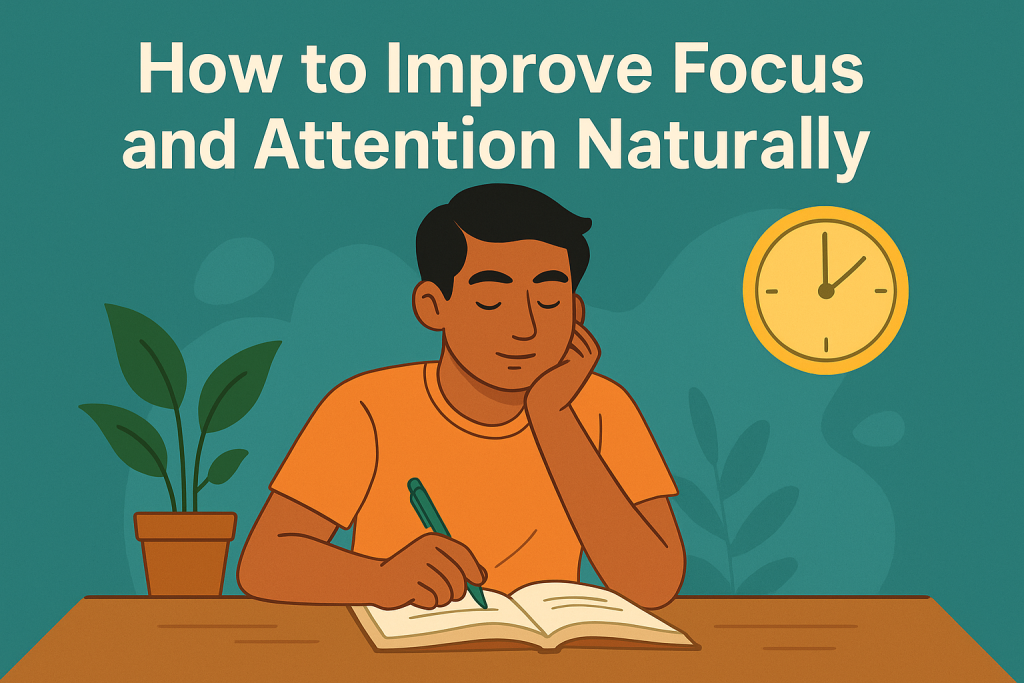
Focus is your brain’s ability to direct mental resources toward a specific task or thought while filtering out distractions. It’s the cognitive skill that allows you to concentrate on what matters most at any given moment.
Strong focus leads to:
- Higher productivity and efficiency
- Better quality work and fewer mistakes
- Improved learning and memory retention
- Reduced stress from task completion
- Greater satisfaction in personal and professional life
The Science Behind Attention Span
Your attention span is controlled by several brain regions, including the prefrontal cortex and the parietal lobe. These areas work together to help you maintain concentration and switch between tasks when necessary.
Attention operates on three levels:
- Sustained attention: Maintaining focus over extended periods
- Selective attention: Filtering relevant information from distractions
- Divided attention: Managing multiple tasks simultaneously
Understanding these different types helps you identify which areas need improvement and apply the right strategies.
Common Factors That Reduce Focus
Before diving into solutions, it’s important to recognize what’s sabotaging your concentration:
- Digital distractions and constant notifications
- Poor sleep quality or insufficient rest
- Nutritional deficiencies and blood sugar fluctuations
- Chronic stress and mental overload
- Sedentary lifestyle and lack of physical activity
- Multitasking and context switching
- Environmental factors like noise and clutter
15 Natural Ways to Improve Focus and Attention
1. Practice Mindfulness Meditation Daily
Mindfulness meditation is one of the most powerful tools for improving focus naturally. This ancient practice trains your brain to stay present and resist distractions.
How it works: Regular meditation strengthens the prefrontal cortex and improves neural connections related to attention control. Even short daily sessions can create noticeable improvements.
How to get started:
- Begin with just 5 minutes each morning
- Focus on your breath or use guided meditation apps
- When your mind wanders, gently return attention to your breath
- Gradually increase session length as you build consistency
Expected results: Most people notice improved concentration within 2-3 weeks of daily practice.
2. Optimize Your Sleep Schedule
Quality sleep is non-negotiable for sharp focus. During sleep, your brain consolidates memories, removes toxins, and prepares for optimal cognitive function the next day.
Sleep optimization strategies:
- Maintain consistent sleep and wake times, even on weekends
- Aim for 7-9 hours of quality sleep per night
- Create a cool, dark sleeping environment
- Avoid screens 1-2 hours before bedtime
- Limit caffeine intake after 2 PM
The connection: Poor sleep directly impairs the prefrontal cortex, making it nearly impossible to maintain sustained attention.
3. Use the Pomodoro Technique for Structured Focus
The Pomodoro Technique leverages your brain’s natural attention rhythms by breaking work into focused intervals with regular breaks.
Basic Pomodoro structure:
| Interval | Duration | Activity |
|---|---|---|
| Work block | 25 minutes | Complete focused work |
| Short break | 5 minutes | Rest and recharge |
| Repeat | 3-4 times | Continue the cycle |
| Long break | 15-30 minutes | Take an extended rest |
Why it works: This technique prevents mental fatigue while maintaining high concentration during work periods. The time pressure creates healthy urgency without overwhelming stress.
Pro tip: Adjust intervals based on your natural focus capacity. Some people thrive with 50-minute work blocks and 10-minute breaks.
4. Fuel Your Brain With the Right Nutrition
What you eat directly impacts your cognitive performance and ability to concentrate. Your brain consumes about 20% of your body’s energy, making proper nutrition essential.
Focus-boosting foods:
- Omega-3 fatty acids: Found in fatty fish, walnuts, and flaxseeds—essential for brain cell structure
- Blueberries: Rich in antioxidants that support memory and focus
- Dark leafy greens: Packed with vitamins that protect cognitive function
- Eggs: Contain choline, which supports neurotransmitter production
- Dark chocolate: Moderate amounts improve blood flow to the brain
- Green tea: Provides L-theanine and moderate caffeine for calm alertness
Foods to limit:
- Refined sugars that cause energy crashes
- Processed foods with artificial additives
- Excessive alcohol that impairs cognitive function
Hydration matters: Even mild dehydration can significantly reduce focus and mental clarity. Aim for 8-10 glasses of water daily.
5. Exercise Regularly to Boost Brain Power
Physical exercise is perhaps the most underrated focus enhancer available. Movement increases blood flow to the brain, promotes neuroplasticity, and releases neurotransmitters that improve attention.
Best exercises for focus:
- Aerobic exercise: Running, cycling, or swimming for 30 minutes
- Yoga: Combines physical movement with mindfulness
- Strength training: Builds discipline and body awareness
- Walking in nature: Reduces mental fatigue and restores attention
Timing recommendations: Morning exercise can set a positive tone for the entire day, while afternoon sessions can combat the post-lunch energy dip.
Consistency over intensity: Regular moderate exercise beats occasional intense workouts for long-term cognitive benefits.
6. Eliminate Digital Distractions Strategically
Digital devices are the greatest threat to modern focus. The average person checks their phone over 50 times daily, fragmenting attention and reducing productivity.
Digital minimalism strategies:
- Turn off all non-essential notifications
- Use website blockers during focus sessions
- Keep your phone in another room while working
- Implement “no phone” zones in your home
- Schedule specific times for checking email and messages
- Use grayscale mode to reduce phone appeal
The two-minute rule: If you feel the urge to check your device, wait two minutes. Often, the impulse will pass.
7. Create an Optimal Work Environment
Your physical environment significantly impacts your ability to concentrate. Small adjustments can create dramatic improvements in focus capacity.
Environmental optimization checklist:
- Lighting: Natural light is best; otherwise, use bright, cool-toned lighting
- Temperature: Keep your workspace slightly cool (around 70°F/21°C)
- Noise: Use white noise, nature sounds, or silence based on preference
- Organization: Declutter your workspace to reduce visual distractions
- Ergonomics: Ensure comfortable seating and proper screen height
- Plants: Add greenery to improve air quality and mental well-being
Color psychology: Blue tones promote calm focus, while green reduces eye strain. Avoid excessive red, which can increase stress.
8. Practice Single-Tasking Instead of Multitasking
Contrary to popular belief, multitasking is a myth. What we call multitasking is actually rapid task-switching, which reduces efficiency and increases errors.
Why single-tasking works:
When you focus on one task at a time, you:
- Complete work faster with higher quality
- Experience less mental fatigue
- Make fewer mistakes
- Feel more satisfied with your accomplishments
- Reduce stress and overwhelm
Implementation strategy:
- Choose your most important task
- Remove all other distractions
- Work on that task exclusively for a set period
- Take a break before moving to the next task
- Repeat the process
The switching cost: Every time you switch tasks, your brain needs time to refocus, wasting an average of 23 minutes per interruption.
9. Take Strategic Breaks to Maintain Mental Energy
Continuous work without breaks leads to diminishing returns. Strategic breaks restore mental energy and actually improve overall productivity.
Effective break strategies:
- Micro-breaks: 30-second pauses every 10 minutes to reset
- Movement breaks: Stand, stretch, or walk every hour
- Nature breaks: Step outside for fresh air and natural light
- Social breaks: Brief conversations with colleagues or friends
- Creative breaks: Switch to a completely different type of activity
What to avoid during breaks: Don’t scroll social media or check work emails—these don’t provide true mental rest.
10. Train Your Focus With Brain Games and Exercises
Just like physical muscles, your attention can be strengthened through targeted exercises. Regular cognitive training builds mental stamina.
Focus-building activities:
- Reading without distractions: Start with 20-minute sessions and gradually increase
- Puzzles and chess: Challenge your strategic thinking
- Memory games: Strengthen working memory capacity
- Learning new skills: Languages, instruments, or crafts
- Concentration exercises: Focus on a single object for increasing durations
Progressive overload principle: Gradually increase difficulty to continue building focus capacity.
11. Manage Stress Through Natural Techniques
Chronic stress is one of the biggest focus killers. When stressed, your body produces cortisol, which impairs the prefrontal cortex and reduces attention capacity.
Natural stress management methods:
- Deep breathing exercises: 4-7-8 technique or box breathing
- Progressive muscle relaxation: Systematically tense and release muscle groups
- Journaling: Write down worries to clear mental space
- Time in nature: Reduces cortisol and restores mental clarity
- Social connection: Quality time with supportive people
- Creative expression: Art, music, or other creative outlets
The stress-focus cycle: Managing stress improves focus, and improved focus reduces stress—creating a positive feedback loop.
12. Use Natural Supplements Wisely
While not a replacement for lifestyle changes, certain natural supplements may support cognitive function and focus when used appropriately.
Evidence-based options:
- Omega-3 fatty acids: Support brain health and neurotransmitter function
- Ginkgo biloba: May improve blood flow to the brain
- L-theanine: Promotes calm alertness when combined with caffeine
- Rhodiola rosea: Adaptogen that may reduce mental fatigue
- Bacopa monnieri: Traditional herb studied for memory support
Important considerations: Always consult with a healthcare provider before starting supplements, especially if you have existing health conditions or take medications.
13. Establish Morning and Evening Routines
Consistent routines reduce decision fatigue and create automatic pathways for optimal focus throughout the day.
Powerful morning routine elements:
- Wake at the same time daily
- Hydrate immediately upon waking
- Practice 10 minutes of meditation or stretching
- Eat a nutritious breakfast with protein
- Review your top priorities for the day
- Avoid checking email or social media immediately
Evening wind-down routine:
- Stop screen time 1-2 hours before bed
- Reflect on daily accomplishments
- Prepare tomorrow’s priorities
- Practice gratitude journaling
- Create a calm environment for sleep
The compound effect: Small daily routines create exponential improvements over time.
14. Set Clear Goals and Prioritize Tasks
Focus becomes much easier when you know exactly what deserves your attention. Clear goals provide direction and motivation.
Goal-setting framework:
- Define your outcome: What specifically do you want to achieve?
- Break it down: Divide large goals into smaller, manageable tasks
- Prioritize ruthlessly: Use the 80/20 rule—focus on the 20% of tasks that create 80% of results
- Time-block priority tasks: Schedule your most important work during peak focus hours
- Review and adjust: Weekly review to stay aligned with goals
The clarity advantage: When you’re crystal clear on your priorities, distractions lose their power.
15. Practice Gratitude and Positive Thinking
Your mental state directly affects your ability to focus. Negative thinking patterns create mental clutter that fragments attention.
Gratitude practice benefits:
- Shifts focus from problems to possibilities
- Reduces rumination and worry
- Improves overall mental well-being
- Enhances motivation and engagement
- Strengthens resilience against distractions
Simple implementation:
- Write down three things you’re grateful for each morning
- Notice and appreciate small positive moments throughout the day
- Express gratitude to others regularly
- Reframe challenges as opportunities for growth
Creating Your Personal Focus Improvement Plan
Now that you understand the strategies, it’s time to create your personalized action plan. Trying to implement all 15 strategies at once will likely overwhelm you—start small and build momentum.
Your 30-day focus transformation:
Week 1: Foundation
- Fix your sleep schedule
- Start with 5 minutes of daily meditation
- Eliminate the biggest digital distraction
Week 2: Environment and Nutrition
- Optimize your workspace
- Add focus-boosting foods to your diet
- Begin taking strategic breaks
Week 3: Structure and Habits
- Implement the Pomodoro Technique
- Establish morning and evening routines
- Practice single-tasking
Week 4: Advanced Techniques
- Add regular exercise
- Try brain training activities
- Incorporate stress management practices
Progress tracking: Keep a simple journal noting your focus quality each day on a scale of 1-10. This helps identify which strategies work best for you.
Measuring Your Progress and Staying Consistent
Improvement requires consistent effort and honest self-assessment. Here’s how to track your focus enhancement journey effectively.
Key metrics to monitor:
- Time to complete specific tasks
- Number of distractions during focus sessions
- Quality of work output
- Energy levels throughout the day
- Subjective focus rating (1-10 scale)
- Sleep quality and duration
Accountability strategies:
- Share your goals with a friend or colleague
- Join online communities focused on productivity
- Use habit-tracking apps for consistency
- Schedule weekly self-review sessions
- Celebrate small wins along the way
The long game: Focus improvement is a marathon, not a sprint. Some changes feel immediate, while others take weeks to manifest. Stay patient and trust the process.
Some of Trending Sleep Gadgets
Purisaki Berberine Patches Review
Sondur Travel Cushion Review
Vanish DrySerum Review
Hears Earplugs Review
Serenesitz Orthopedic Seat Cushion Review
Common Mistakes to Avoid When Improving Focus
As you implement these strategies, watch out for these common pitfalls that can derail your progress:
Trying too much too soon: Start with 2-3 strategies and master them before adding more. Building sustainable habits beats temporary enthusiasm.
Expecting instant results: Some techniques work quickly, but lasting change requires consistent practice over weeks or months.
Ignoring your unique needs: Everyone’s brain works differently. Experiment to find what works best for your specific situation.
Perfectionism: Don’t beat yourself up over occasional lapses. Progress isn’t linear—focus on the overall trend, not daily fluctuations.
Neglecting the basics: No technique can compensate for chronic sleep deprivation, poor nutrition, or excessive stress. Address fundamentals first.
Conclusion: Your Journey to Better Focus Starts Today
Improving your focus and attention naturally isn’t about finding one magic solution—it’s about building a comprehensive system of habits and practices that support optimal cognitive function. The 15 strategies outlined in this guide provide a proven framework for enhancing your concentration, boosting productivity, and achieving your goals more effectively.
Remember these key takeaways:
Focus is a skill you can develop through consistent practice. Start with the fundamentals like quality sleep, proper nutrition, and regular exercise. Build from there by implementing structured techniques like the Pomodoro method and mindfulness meditation. Create an environment that supports concentration and eliminate unnecessary distractions. Most importantly, be patient with yourself—lasting change takes time.
The modern world will continue throwing distractions your way, but with these natural strategies in your toolkit, you’ll be equipped to maintain focus on what truly matters. Choose one or two techniques from this guide and commit to practicing them consistently for the next 30 days. Track your progress, celebrate improvements, and gradually incorporate additional strategies as you build momentum.
Your ability to focus is one of your most valuable assets in today’s information-saturated world. By investing in your attention, you’re investing in your success, well-being, and quality of life.
Ready to transform your focus? Start today with just one small change. Your future self will thank you for the commitment you make right now.
FAQs to Help Readers Quickly
How long does it take to see improvement in focus and concentration?
The timeline varies depending on which strategies you implement and your current baseline. Some techniques like eliminating digital distractions or using the Pomodoro method can show immediate results within days. However, deeper changes like those from meditation, exercise routines, or nutritional improvements typically become noticeable within 2-4 weeks of consistent practice. For lasting transformation in your attention capacity, expect to invest 2-3 months of dedicated effort. The key is consistency—daily small actions compound into significant improvements over time.
Can I improve my focus if I have a naturally short attention span?
Absolutely. While some people may have genetic predispositions that affect baseline attention capacity, focus is largely a trainable skill. Think of it like physical fitness—some people may start with natural advantages, but everyone can improve through consistent practice. Research shows that targeted interventions like meditation, cognitive training, and lifestyle optimization can significantly enhance attention span regardless of your starting point. The strategies in this article are designed to work with your brain’s natural capabilities and gradually expand them through practice.
What are the best foods to eat for better concentration throughout the day?
For sustained focus, prioritize foods that provide steady energy and essential brain nutrients. Start your day with a breakfast containing protein and healthy fats like eggs with avocado or Greek yogurt with nuts and berries. For lunch and dinner, include fatty fish rich in omega-3s, dark leafy greens, and whole grains that prevent blood sugar crashes. Snack on blueberries, dark chocolate, or walnuts between meals. Avoid refined sugars and heavy carbohydrates that cause energy spikes and crashes. Most importantly, stay consistently hydrated—even mild dehydration significantly impairs cognitive function and focus.
Is it better to work in complete silence or with background noise for focus?
This depends entirely on your personal preferences and the type of work you’re doing. Some people concentrate best in complete silence, while others perform better with ambient sound. Research suggests that moderate background noise around 70 decibels—like café chatter or white noise—can actually enhance creativity for some tasks. For analytical work requiring deep concentration, most people benefit from quieter environments. Experiment with different soundscapes including silence, white noise, nature sounds, or instrumental music to discover what helps you focus best. The key is finding what minimizes distractions for your specific brain.
Can too much focus or concentration actually be harmful?
Yes, excessive focus without proper breaks can lead to mental fatigue, burnout, and decreased productivity over time. Your brain needs regular recovery periods to consolidate information, restore mental energy, and maintain optimal function. This is why techniques like the Pomodoro method incorporate mandatory breaks—they’re not optional rest periods but essential components of sustainable high performance. Signs you’re over-focusing include headaches, eye strain, irritability, reduced creativity, and declining work quality. Balance intense focus sessions with adequate rest, physical movement, social interaction, and relaxation to maintain long-term cognitive health and productivity.